Slop Gigantism

Wednesday, November 18th, 2026
Bill Bonner, from Ardmore, Ireland
“If one body in a society can create money at little or no cost to itself, while the rest must expend energy, that body will inevitably grow disproportionately large.”
Last Friday, our email communications were breaking down.
On Saturday, the FAA’s “ground stop” left the airplanes empty and the airports full.
On Monday...ABC7 LA:
A technical issue at JPMorgan Chase triggers online banking delays
Customers reported difficulty accessing their online accounts at some of the nation’s largest banks on Monday.
And on Tuesday came this from Reuters:
The highly classified network that the US National Security Agency uses for its internal communications is down, CNN reported on Tuesday, citing five people familiar with the matter. The agency was working to understand the scope of the problem, but there was no immediate evidence of a cyberattack, CNN reported.
‘Talk about asymmetric warfare,’ commented a friend, ‘if some group really wanted to bring the US to a halt, you’d think it would be fairly easy. A glitch here. An ‘accident’ there. A line cut. A code scrambled. A bridge blown up. A communications tower knocked down. Staged pileups on the interstates.
‘Who knows what kind of chaos and mass hysteria a determined enemy might create.’
The ‘security’ implications are there for all to see. But somehow a complete breakdown has been avoided — either because the systems are sturdier than they appear...or because no one has ever given them a proper kick.
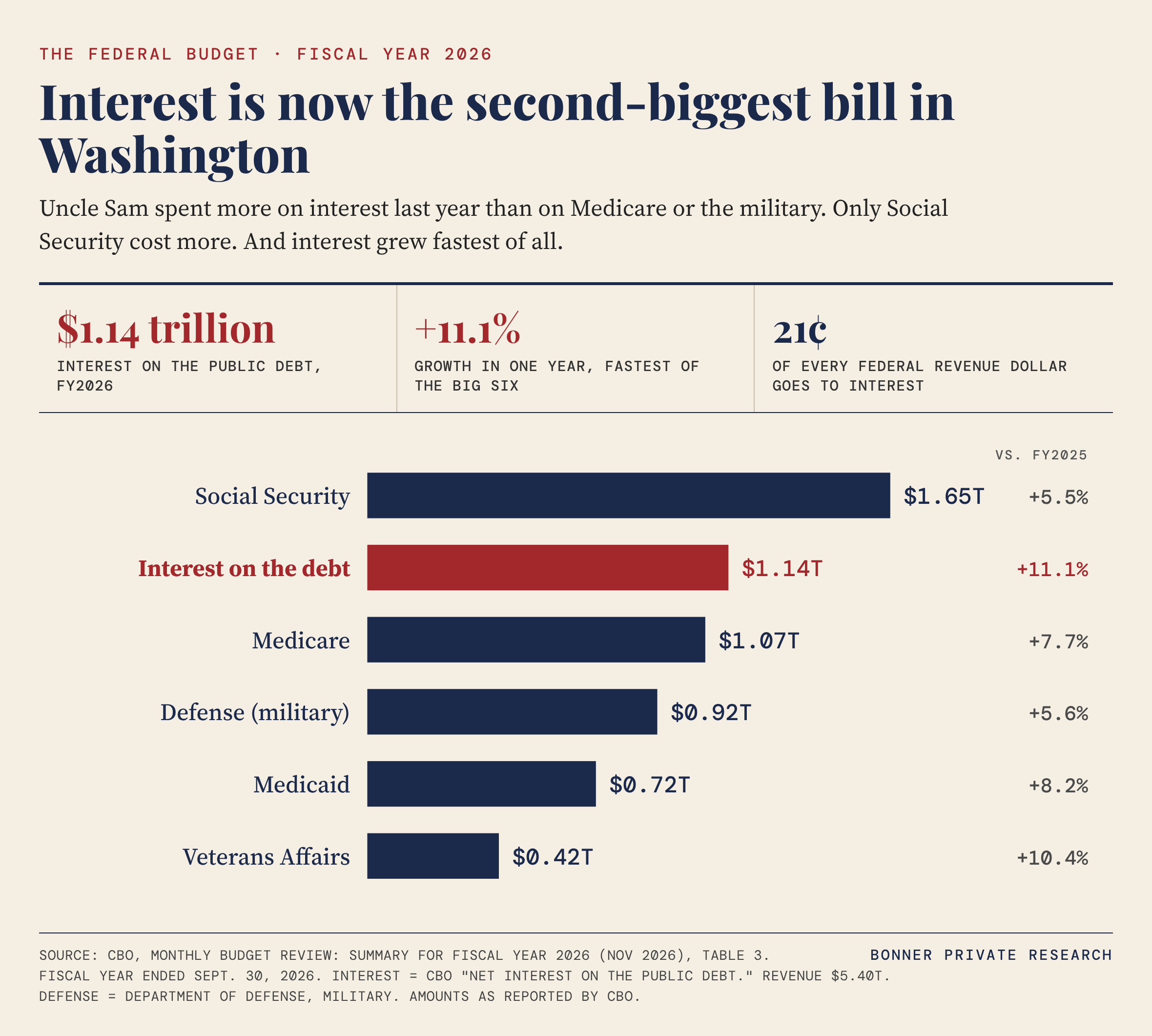
But what we are hinting at today is something larger. To what extent has our out-of-control debt caused similar dysfunctional gigantism throughout our modern economy?
Between our little airport at Cork, Ireland, and the sprawling Charles de Gaulle airport that serves Paris, is a world of difference. In Cork, we are able to get to the airport, check in and board the airplane in just a few minutes. At CDG, we will spend hours standing in lines, on rolling sidewalks, and in traffic going into the city.
It’s a problem of scale. And the money that enables it. A man of modest means might construct a house of reasonable charm and dimensions. Give him more money and he is likely to build a monstrosity.
Some things work fairly well on a small scale. Like democracy, for instance. A small group — even a small country — can get along tolerably well, almost indefinitely, solving challenges by consensus and the ballot box. A small government may enjoy relative peace and prosperity for generations. Switzerland, for example, with its smallish, self-governing cantons, has not been in a serious war for generations. Its last military conflict — the Sonderbund War of 1847 — was so marginal we had never heard of it.
A small airport, too, can function decently well. It may allow you to park directly in front of the terminal. From there, you go to the ticket counter...get your boarding pass...then are able to walk a few steps through polite ‘security,’ and then get on the plane.
A large airport, au contraire, forces you on a long hike to a line where you can get through ‘passport check’ — complete with attack dogs and pat-downs. As far as we know there is no record of any 70-something Episcopalian posing a threat to civil aviation. No matter, we got such an intimate pat-down at CDG airport we felt we should leave a tip. But you can’t be too safe!
Then you get in another line to retrieve your luggage...and yet another forced march to a taxi line, followed by a slow, traffic-clogged crawl into town. It’s an ordeal! The faithful, journeying to Mecca for the Hajj, may suffer less.
The two experiences, large and small, are worlds apart — in terms of convenience, efficiency, and charm.
Likewise, a customer’s experience at a local, neighborhood bank, before the great digitalization, was very different from today’s big bank slog.
Back in the long-gone ’60s and ’70s, you went into your local bank. The teller greeted you warmly. You asked for your money. He gave it to you. You thanked him, with a smile.
Now, you go on your computer. If the connection is working, you get a menu. But if what you want is not on the menu, you will speak to someone in Karachi...or to an AI make-believe person.
When we were just starting out in business, we’d rush to the bank on Friday afternoon, with the week’s receipts — in cash and checks. The teller — who later came to work for us — would count it out carefully and give us a receipt. No muss. No fuss.
If there were a problem, we discussed it with the manager.
But just as the government itself has been enlarged and distorted by fake money, so have many key industries -- medical care, banking, and travel, for example. Like adding federal debt...the changes and ‘upgrades’ were meant to make things better. This was ‘progress,’ we were told. New protocols, new technology and more borrowed money enabled them to provide greater service, at larger scale and at less cost. Or, so they said.
But what kind of progress is it? Like the progress in Rome after the ‘barbarians’ took over? Like the progress in the US stock market after Irving Fisher proclaimed that it had reached a ‘permanently high plateau’ of prices? Or is it the kind of progress Europe enjoyed when the first plague cases were reported on Genoese ships?
More to come...
Regards,
Bill Bonner
Exactly why I live in the smallest town I could find.
Not sure size is the culprit.
I remember the days of "personalized human service".
Computers wiped that out...
I remember when I could read every sign on the street.
Now much of it is in Spanish.
I remember when I could keep my car running while I ran into the store for coffee.
I remember when the store clerk spoke English.
Not so sure largess is the problem...