Sunday, July 26th, 2026
Laramie, Wyoming
By Dan Denning
You want to know something that didn’t make the news last week? The heads of Private Credit at BlackRock and Blackstone both resigned. For separate and personal reasons, of course. And it may not mean anything. But those are a couple of interesting ‘dots’ that may be connected. Why?
Cast your mind back to the to the long hot summer of 2007. The Bear Stearns High-Grade Structured Credit Strategies fund was in trouble. The fund was packed with mortgage backed securities and collateralized debt obligations—heaps and heaps of housing-based debt. Only problem? The fund, Bear Stearns said, had almost no remaining value left.
Then, a few weeks later, another Bear Stearns fund—the High-Grade Structured Credit Strategies Enhanced Leverage Fund also effectively went to zero. Two funds. Chock full of debt, one full of leverage. Early warning signs.
Twelve months later, the S&P 5000 was down 18.7% and the Dow Jones Industrial Index was down 18.1%. Twenty four months later, the S&P 500 was down 39.3% and the Dow 37.4%. The Big Loss had arrived.
This is not to say that Private Credit is the new subprime. But it was a little concerning last week when several investment banks floated the idea of ‘wrapping’ private credit on their books into securities that could be sold to investors as if they were investment-grade bonds. Because that worked so well for retail investors last time around.
For our paying subscribers, we’ve recently incorporated credit spreads as one of five Pre Crash Indicators to follow. These are market-based signals that may trigger a mean-reverting correction in stocks (all of the valuation metrics we follow are in the 97th percentile or greater based on historical data…meaning US stocks have never been so over-valued).
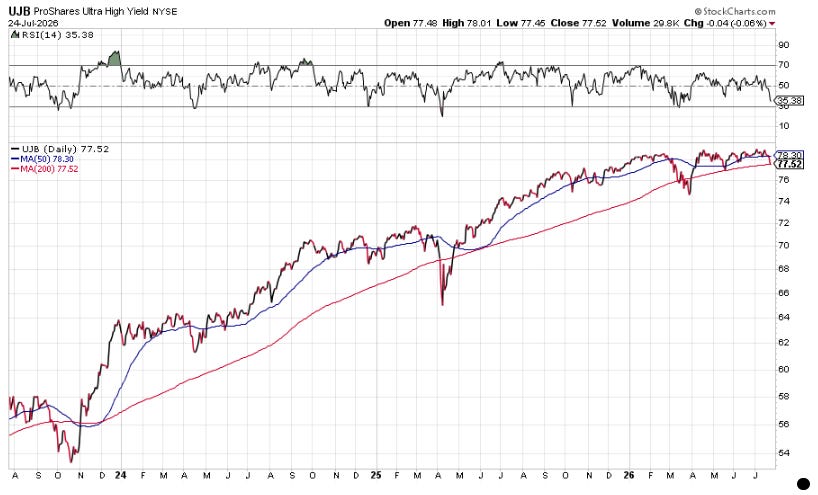
I ran the chart above this morning just for fun. It’s an exchanged traded fund with a twist. It tracks the Markitt iBoxx Liquid High Yield Index (basically high yield corporate bonds). But the ETF is 2x, meaning it aims to double the performance of the underlying index (in either direction). It does so using exotic financial instruments and derivatives.
It’s not a widely traded or terribly liquid ETF. But I wanted to go past the usual suspects (HYG, JNK) to see if there are any earlier outlier signs that also suggest all may not be well in the world of private credit and leverage. UJB has been bobbing along at the top of a channel and recently traded down to its 200-day moving average.
Geopolitical events get all the airtime. For example, the Strategic Petroleum Reserve (SPR) is down to around 311 million barrels. News reports this weekend are that Iran rejected several cease fire offers from the Trump administration. No deal.
The reports speculated that the Mullahs want to see what happens when the SPR hits or exceeds its ‘operational’ threshold of 300 million barrels (about two or three weeks of drawdowns, at this pace). The Mullahs think they’ll get a better deal if oil is at $120/barrel, the Strait of Hormuz is still closed, no traffic is moving through Bab al-Mandeb on the Red Sea, and the SPR is at its lowest level since 1983.
Bab al-Mandeb apparently means ‘Gate of Tears’ in Arabic. Like in the summer of 2007, we may have passed through that gate this week in the credit markets. And when the credit market weeps, the stock market follows. Does the Fed know all this?
We’ll find out later this week when it meets. In the meantime, enjoy all our best research published this week at BPR.
Until tomorrow,
Dan
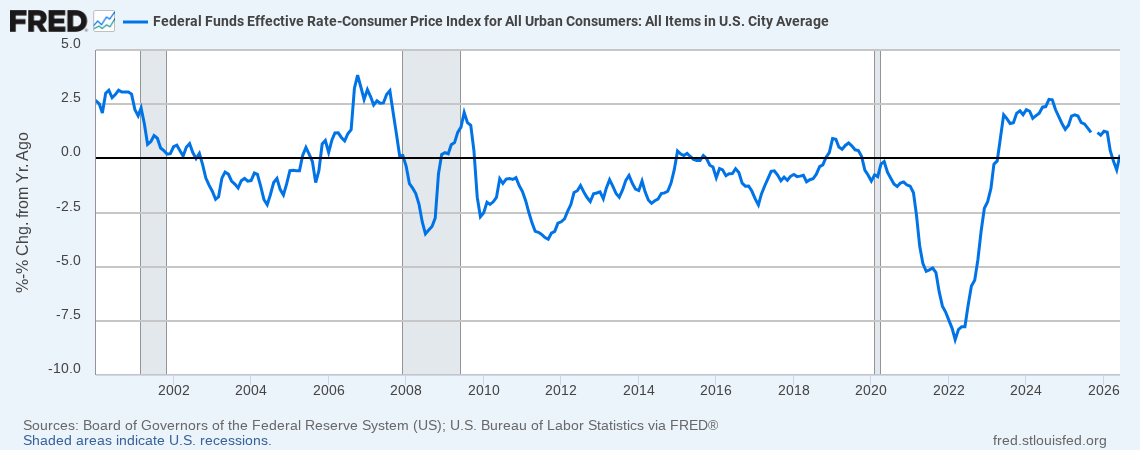
P.S. ‘Real’ interest rates are barely positive, meaning monetary policy is not currently ‘hawkish’. You get the ‘real’ rate of inflation by substacting the year-over-year rate of change in CPI from the Fed Funds target rate.
As Investment Director Tom Dyson pointed out earlier in the week, war is inflationary. It’s hard to imagine that with oil at $90/barrel the Fed would raise interest rates this week, though. Why?
That would raise ‘real’ interest rates and put a shock through capital markets already twitchy about private credit and valuations. The Fed never makes mistakes, of course.