

Monday, July 20th, 2026
Bill Bonner, writing from Normandy, France
On Thursday of last week, POTUS had an important message for us. He rambled even more than usual, but suggested that the election process could be compromised. NPR:
In a 25-minute primetime address from the White House’s East Room that included many baseless claims, Trump said he was declassifying Intelligence documents that he said reveal “shocking vulnerabilities in our election infrastructure.” Those include allegations of Chinese efforts to influence American elections, concerns over voting machine security, and that noncitizens are found on certain states’ voter rolls.
Those who studied the documents say they do not support the president’s arguments. But the real purpose of the address was probably just to see how people would react. What would they do if he really did use ‘emergency measures’ to protect the integrity of US elections...and/or to get the results he wants?
Here’s the situation. POTUS seems to be losing popular support. CNN:
While the latest Quinnipiac University poll showed 27% strongly approved of Trump (in that case, of registered voters), other polls have pegged that number significantly lower. In those other polls, it’s been at 21% (NPR-PBS-Marist), 20% (Fox News), 19% (AP-NORC), 16% (Marquette Law School), 15% (Post-Ipsos) and 14% (Reuters-Ipsos).
In most of the recent high-quality polls, the percentage of Americans who strongly approve of Trump is between 1 in 7 and 1 in 5.
Very few Americans see what Trump is doing and strongly support it.
Is he losing his grip...on his party...or his own frayed rigging? Is it permanent? Or temporary? A real peace with Iran might turn things around. So might a gush of easy money.
The gist of today’s message: Trump may or may not tamper with election outcomes. He will have less reluctance to meddle with the economy. Meddling with the votes is regarded as treachery. Meddling with the money brings applause.
While Donald Trump is still front page, headline news, the markets have their own ancient journals. They have their highs and lows...their bubble peaks and dark bottoms.
As we mentioned last week, trying for a base hit...a nickel here, a dime there...will probably not make an investor rich. He’ll strike out from time to time too. What he needs is a home run, something he can get into fairly early, nod off, and wake up years later much wealthier. He needs a Primary Trend.
That is what he got from the flower of American industrial capitalism — from the moment Paul Volcker put inflation to flight in 1980...to the moment yields finally found their bottom in July 2020. That trend would have multiplied your wealth — either in stocks or bonds — for four decades. All you had to do was to sit tight.
What are the odds of a repeat performance?
They are probably very low. It is mathematically and physically impossible for asset values to become too far removed from the underlying economy for too long. Instead, they cycle up and down, anchored to the real economy by a long, bungee-like cord. So, if you’re aiming for a long cycle of rising prices, your best bet is to grab ahold of the cord when it is stretched about as far as it can go to the downside, after a long cycle of falling prices.
The Dow was under 1,000 in 1980. But today, it’s over 50,000...higher than ever before. The most likely thing — though hardly guaranteed — is that stock prices will snap back down from here, in real terms, if not in nominal ones...and for a very long time.
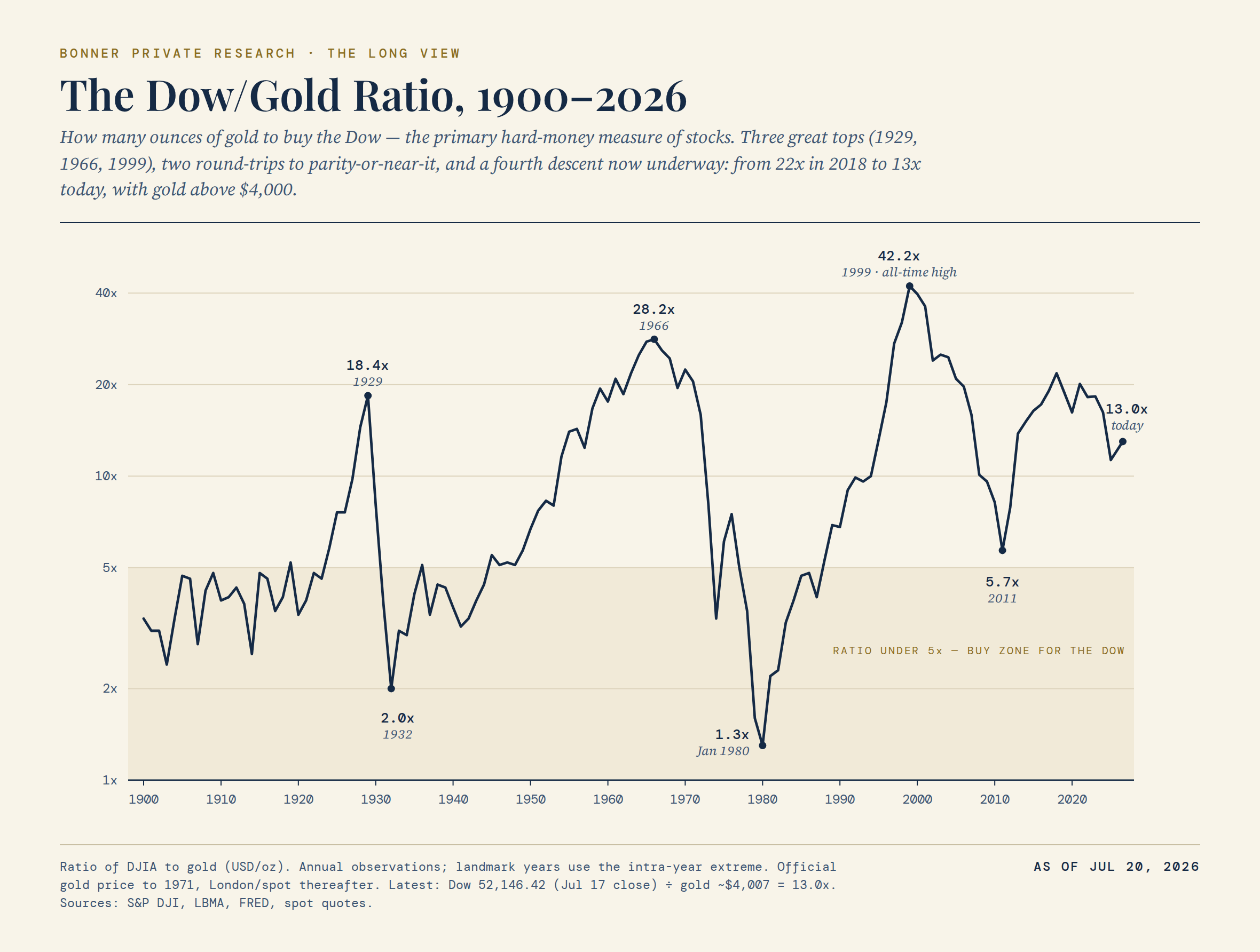
Our favorite measuring stick is the Dow/Gold ratio. It measures the Dow stocks in terms of gold. We expect Dow highs worth over 15 ounces of gold...and lows below 5. Now around 13...and still holding gold...we look for more stretch to the downside before we close our eyes and make the big trade — out of gold and into stocks. That could happen either by gold going to $10,000...or the Dow stocks falling below 25,000. Most likely, they’ll shake hands somewhere in the middle.
Just where they meet, though, depends to some extent on POTUS and the Fed. Trying to overthrow the election results might outrage the vox populi. But while most people might disapprove of efforts to manage or deny election results, they would cheer to the rafters any temporary measures that offered them lower mortgage payments.
Most people, endowed by Nature with the earnest faith of a friendly dog, believe an economy is adjustable...manageable...and improvable by Ph.D.-bearing technicians in expensive suits. That touching naïveté is what dug our present hole. Few protested in 1971 when Richard Nixon declared a series of new measures — including wage price controls and taking the US off the gold standard. They thought the economic bigheads knew what they were doing. And the New York Times — then as now, cheerleader for the feds — said the moves would only be necessary “until exchange rates realign.”
They’ve been realigning ever since — almost all countries have raced to devalue their currencies to keep up with the US. If a nation allowed its currency to go up against the dollar, it would make its own goods and services more expensive to foreign buyers and find its high-priced goods shunned on the shelves.
But inflation (the loss of purchasing power) encouraged bad habits — spending money we didn’t have. It was also the real cause of the huge bull markets in stocks, bonds, and gold — 1980-2020. And now the bottom of the yield cycle has been passed and interest rates are going up. And debt has reached such levels — over $300 trillion worldwide — that even a modest twist on the interest rate screw sends the public howling for relief.
The authorities are cornered. Either they throttle back their spending. Or they ‘print’ faster and let the whole system go up in a blaze of glorious inflation later on.
It is either ‘inflate...or die.’ Either allow more credit at lower rates to help cover the interest bill...or the bubble economy shrivels.
Most likely, as bubble death draws near, the feds will inflate...and inflate some more. And they will be heroes...for a while.
Regards,
Bill Bonner
I think it depends on how we define inflation. According to the mainstream definition, the last 40 years were characterised by declining CPI inflation (disinflation). But under the Austrian definition—where inflation is the expansion of the money supply—we experienced persistent inflation throughout the entire period.
Broad money supply grew at roughly 6.2% per year, while CPI increased by only about 3.2% annually. In my view, we were fortunate that consumer prices rose only about half as fast as the money supply.
Part of this gap may reflect changes in the way CPI is calculated, which some critics argue have understated inflation. However, I think other factors were at play: rapid technological progress, the collapse of the Soviet Union, the integration of Eastern Europe into the global economy, China's accession to the WTO, and the expansion of global supply chains. These developments dramatically increased productive capacity and exerted persistent downward pressure on goods prices.
In addition, the velocity of money declined significantly, particularly after the 2008 financial crisis, which further limited the impact of money creation on consumer prices.
As a result, much of the monetary expansion was reflected not in CPI, but in asset prices—stocks, bonds, and real estate. In that sense, Bonner's conclusion may actually reinforce the Austrian view: the inflation was there all along, but it manifested primarily in financial assets rather than in the consumer price index.
As Dolly Parton Sang: "Here we go again!" Thanks again for another wasted read. Wake up, eat some cheese and have a glass of wine, then tell us something new. In the real world, somethings become irrelevant over time.