


Friday, October 9th, 2026
Bill Bonner, from Ardmore, Ireland
Expecting voters to exonerate the party in power through a considered examination of the origins of the credit cycle is an overly optimistic view of human nature.
—Daniel Oliver
Last night, after supper, we saw a dim glow against the garden wall, about as bright as a dozen fireflies.
We went out to investigate. And as we approached, we gradually made out a human-like shape...but of the science fiction genre. This was ‘The Thing from Another World;’ we recalled it from one of our first and most horrifying trip to the movies, in the 1950s. The being was tall, with bulky arms and legs, making him look a bit ungainly, like he had been outsized by a bicycle pump. But the most remarkable thing was the head. It was about three times the size of a normal human head. And rounder, with a flatter face.
Surely the aliens had finally arrived. But why were they sneaking around in our garden, at night, in an obscure part of Ireland? And did they mean to harm us?
While the questions swirled, we edged toward the figure, still indistinct in the dark.
‘We mean you no harm...’ we called out, thinking the creature might be put at ease by a friendly human voice.
‘Well, I’m glad to hear that,’ came the answer from a voice with a proper English accent.
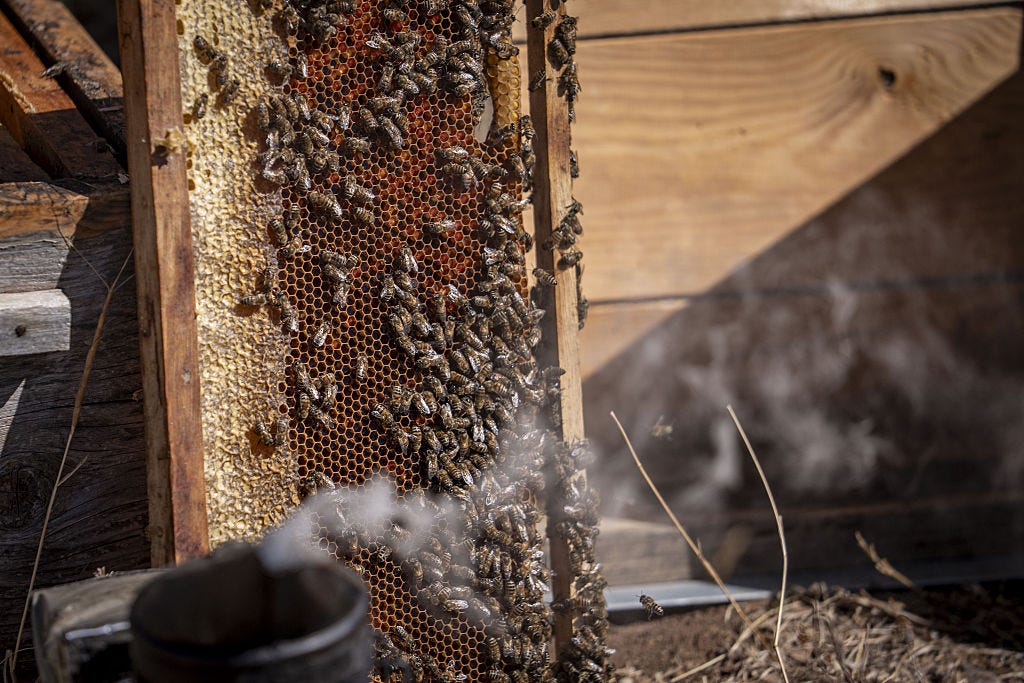
It was the voice of the local beekeeper, Robert, in his protective gear.
‘I won’t be more than five minutes. Hope I didn’t scare you. There is a nest of bees in the wall. I’ve waited until they were asleep to make my move. It’s dangerous to let them stay there.’
Robert has placed his hives in several places on the farm. We are happy to have them, and the honey he gives us. As long as they stay in the hives, they pose no problem. But sometimes, like AI, they go rogue.
‘A fellow in Clonmel was stung by bees. He was driving a tractor. The bees must have been in the ground. Well, they went after him. And he went into shock. His heart stopped. The family got him to the hospital. And he’s still alive. But he suffered irreparable brain damage. You’ve got to be careful with bees.’
Reassured...it was a comfort to know we’d be more likely to die from earth-bound bees than from extra-terrestrials...we returned to our work.
Here’s the latest, from MarketWatch:
French bonds are suffering through their worst decade since 1803 — and investors are bracing for more pain
French bond turmoil is the worst since the 10-year period that included the Reign of Terror
Parlez-vous crise du credit?
Meanwhile, back in the USA, the S&P has hit a new record. But it is a funny kind of new high...driven, we believe, by a funny kind of money chasing a funny kind of stocks. Fewer than half the stocks in the S&P 500 are actually above their 200-day moving averages. That leaves the aforementioned ‘funny’ stocks — those growing from capital investment rather than real earnings — doing most of the heavy lifting.
Also, a little ‘funny’ is the fact that while the US and France suffer from very similar self-inflicted macro wounds, their stock markets are going in opposite directions. The Wall Street Journal found the ‘funny’ business worth exploring:
America has had to endure financial crises, stock-market crashes and military setbacks, just like any other country. But the regularity with which the U.S. recovers is remarkable. For many Americans it’s an article of faith that the stock market eventually rises over time, that Uncle Sam’s liabilities are risk-free and that America’s armed forces will never lose a fight for lack of money.
But the closer you look, the ‘funnier’ the situation appears. The US started a war which has greatly weakened perceptions of US power. America is untrustworthy, say the diplomats. And it is increasingly ineffective, say military analysts. WSJ:
Now, federal borrowing is starting to feel unsustainable, U.S. stocks fetch twice the valuation of other developed markets and the Navy is struggling to protect vital sea lanes from a third-rate adversary.
The French stock market is down 10.5% in the last six months. But the US stock market is up 15%.
And you can’t explain it by differences in exchange rates or other big picture curiosities. In terms of cyclically adjusted p/e ratios, US big-cap stocks are twice as pricey as those in France.
Why?
The Journal leans on the ‘exorbitant privilege’ insight first popularized by France’s Valery Giscard d’Estaing. The nation that has the world’s reserve currency, he noticed, can ‘print’ more currency, which is taken into foreign vaults as though it were gold. Other nations can’t do that. WSJ:
Unlike France, the U.S. has its own printing press and can’t default if borrowing costs spiral.
You’d think this advantage would show up in different costs for borrowing, too. The two countries face roughly the same fiscal problem. Each has to borrow money to keep up with current spending. By this measure the US is slightly worse than France, with a deficit equal to 5.7% of GDP. France’s deficit ratio is just 5%.
As Donald Trump maintains, if the US really has the strongest economy in the world, it ought to have the lower interest rates. Apparently, not. France, as widely reported, may be on the brink of a default. But the US pays more to borrow. The yield on France’s 10-year notes is now 4.9%. America’s 10-year yield is 5.3%. Both countries are broke. And as interest rates rise, the broker they get.
As for the ‘exorbitant privilege,’ at some point every ‘privilege’ sends its bill.
Robert Triffin outlined the paradox back in the 1960s. The US ‘prints’ money. Foreign nations sell products and services to the issuer to get it. This results in a trade deficit for the reserve currency nation, the US (with the accompanying ‘hollowing out’ of its own industries).
A country that produces more (fake) money than stuff soon suffers price increases. At first, the US exports its inflation to the rest of the world. Eventually though, the foreigners question its solvency and wonder about its IOUs. They sell their US bonds...and look for alternatives.
The WSJ adds context...along with a dose of dread.
U.S. bonds aren’t really risk-free when the president is openly talking about the benefit of “very rapidly” eroding their real value through inflation. The usual pattern of foreign money flooding into the Treasury market in a crisis isn’t some law of nature. Imagine the sort of rush for the exits France is experiencing instead.
‘Inflating our way out’ of the US debt problem is another ‘red dye’ solution. It promises to fix a problem America ought not to have with a solution that won’t work.
More to come...
Regards,
Bill Bonner
The Debt Crisis is now Beginning

Please note, we’re aware some Gmail users are not receiving the weekly market and research notes from Tom Dyson and Dan Denning. Substack is aware of the issue and working with Google to resolve it. It in the meantime, we’ll also send the weekly updates to our back-up email list to ensure you receive them. As always, all BPR communications are available at the website at www.bonnerprivateresearch.com
Nice start Bill. I raised bee's more than 10 years and if you treat them with "respect" they are easy to work with and the honey is a great reward. Respect is the key word. There are rules of engagement that you should not break.
For the "fake" currency issue, I'll stick with gold forever (until I die) and spend my pile of "fiat" paper for normal expenses. T-Bills arn't don't gain much but they arn't a total loss .
It would be nice to see a correction so we can get on with some cheaper stocks that have a history of paying good dividends.. Enjoy your weekend.
P.S. Did the bee keeper get the bee's out of the wall?
Jim Marshall
I don't know about France, but the American debt is especially destructive because its
debt on depreciating assets and consumption. If the government would have spent on
infrastructure such as roads, bridges, airports, sea ports, electrical grid, water projects, etc.
It wouldn't be nearly so bad. Instead, the government has pissed away trillions of dollars on wars, ineffective military "defense" spending. welfare, subsidies, regulations, bureaucratic institutions and innumerable interventions. A sure way to insolvency.