Fun House of Cards

Friday, November 13th, 2026
Bill Bonner, from Paris, France
How much of the US economy is like a meme stock? Empty? Worthless? Fake? Motley Fool:
Nvidia stock has wiped out $1.7 trillion in value since October…
Nvidia’s business hasn’t changed. Same chips. Same customers. Same profits. How could it be worth $1.7 trillion less? And could it shed another $1.7 trillion?
Without the hype...and the frenzy...how much is Nvidia really worth? And how much is it just pumped up...inflated by the AI capex boom and phony credit money?
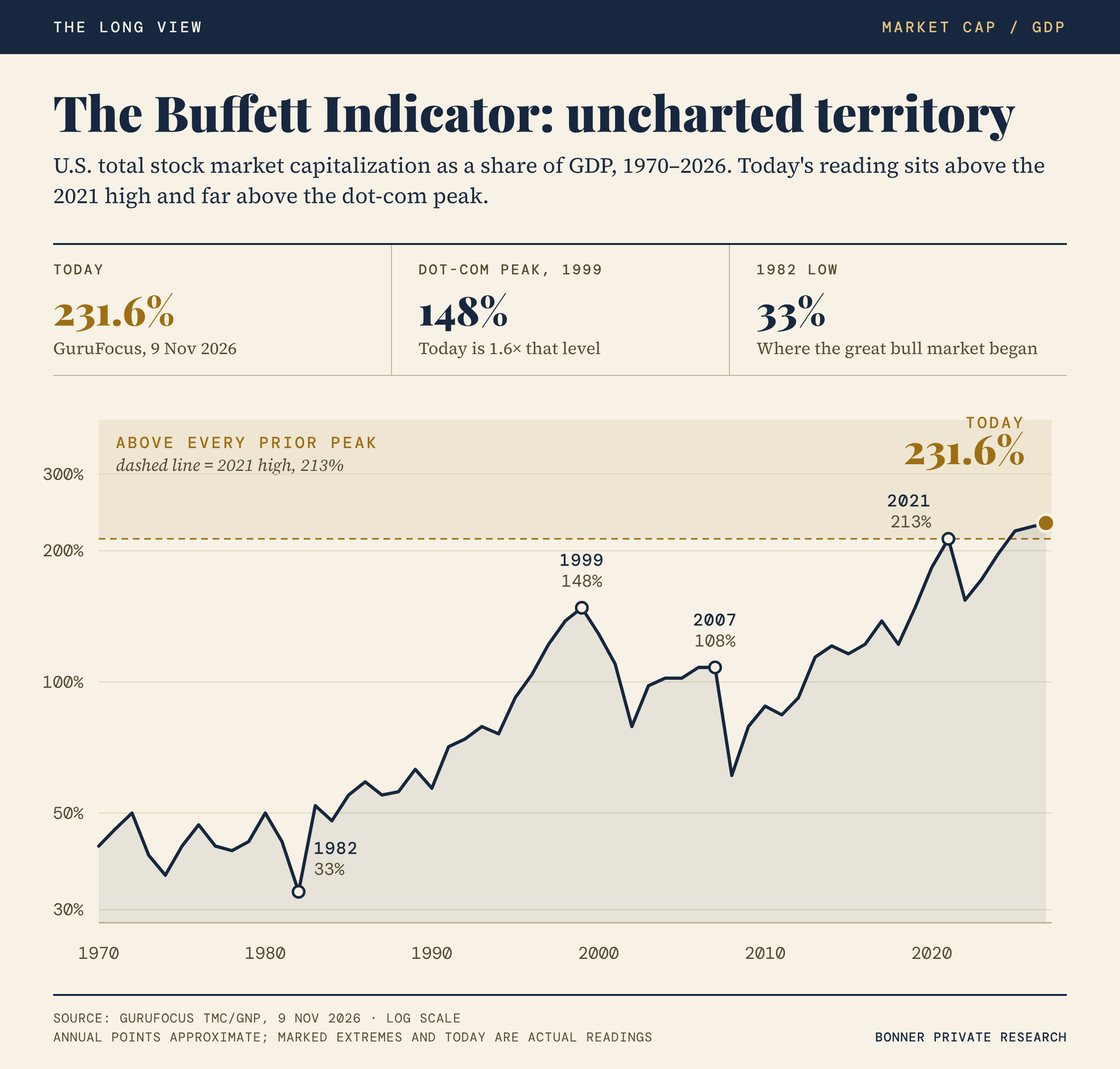
We’ve pointed out before that, according to the famous Buffett metric, comparing stock prices to GDP output, there’s about $40 trillion in US listed stocks that never dirties its hand. It toils not. Neither does it spin. Like memes, these stocks can be traded for goods and services. But like memes, their values can also wilt like a lily at a dead man’s wake.
The math is simple enough. Up until around 2013 there was almost always at least $1 of output behind each $1 of stock value. Not until mid-ways through the Obama years did stock values go decisively and permanently above 100% of GDP. And now they’re about 231% of GDP. Which is to say, stock prices now float high above their real worth. About $40 trillion above, by our back-of-the-envelope calculation.
Let’s begin by reminding ourselves that stocks are evidence of ownership in what are supposed to be profit-making companies. Those profits are the difference between the value of goods and services produced and the cost of producing them.
If the costs are greater than the value of the output, the company is losing money...destroying wealth. Logically, the shareholders should participate in the losses as well as the gains. Sometimes they do.
So, here we have Opendoor Technologies. It is the brainchild of some fellows who thought they could make the housing market more fluid by putting it online. They buy houses online...send out crews to fix them up...and then resell them. In 2021, for example, they bought 37,000 houses. A year later, they sold 7,500 of them at an average loss of $28,000 on each one.
We’ve fixed up a number of houses. If someone had asked us about the Opendoor business plan, we would have said that it would never work. You can buy a house carefully, fix it up frugally, and sell it sensibly. And maybe you’ll make money. But you can’t do it at scale. Because the good deals go to the local guys, who know their trade, have the local knowledge, and often do much of the work themselves. And those guys, who are successful locally, will scale up as much as they can.
“Opendoor will lose money,” we would have predicted. But we never would have guessed that it would lose so much. It lost $339 million in 2019, $253 million in 2020, $662 million in 2021...and on and on, year after year, up to a loss of $1.3 billion last year.
Total losses tot up to $5.1 billion.
How much is a company like that really worth? Back in 2021, it was valued at $18 billion, $28 a share. But in terms of what it was really worth — a serial wealth-destroyer on a grand scale — its value was always negative. And now the share price has dropped down to near $1; more than $17 billion of fake value has been wiped out. Wall Street Psychology:
The irony of flipping houses in a 7% mortgage environment while claiming to be an AI company shouldn’t be lost on anyone.
Opendoor is a gaudy example. But how much of Nvidia is unsupported by real output? Apple? Microsoft? These are real companies with sales and profits. But all through the economy, sales and profits — and losses — have been flattered by inputs of ‘money’ that isn’t real money.
As Tom has explained, it is actually debt. Debt is not the same as money. You can pile up all the money you want. You can even lend it out and receive interest on it. But pile up debt and you’ll be the one paying interest. Then, more debt is needed just to pay the interest on the old debt. And whee! You are on your way to hyperinflation.
Individual companies or memes can boom and bust...creating false value and then destroying it...all good fun. But when an entire economy does it, the fun stops. People believe they have real wealth. They expect to live on it...to retire on it...to use it to pay mortgages and tuition...and to fund the feds’ retirement and medical programs.
A few years ago, the feds inflated the economy for pleasure — it gave them a boost, like a glass of wine before dinner. Now, they inflate it to avoid the pain of a correction hangover.
Time to close the door.
Regards,
Bill Bonner
Nope, if anything the Fed's meddling will get worse as socialist programs increase giving money away to those who can't afford to even begin to pay their debt back. More of the same scheniganins on steroids.
Bill, The wave of incoming Democrats are likely not going to reduce Federal spending.
More likely, they'll shuffle the deck chairs by taking from Defense to give to social programs.
What will it take to ensure all our elected Federal officials are aware the Ship of State is precariously ever closer to the Wiemar Shoals