


Sunday, March 1st, 2026
Scottsdale, Arizona
By Dan Denning
The oil price quadrupled during the Yom Kippur war and the OPEC oil embargo in 1973-1974. Gold more than doubled in the same time. It got a ‘safe haven’ bid AND an inflation bid during the same time frame (from $64/oz in early 1973 to $195/oz by the end of 1974).
In the second oil crisis of the 1970s, during the Iranian revolution, oil prices doubled again. Gold was already in the end stages of a multi-year bull market. But the last stage was spectacular. It started 1979 at around $216/oz. It finished the year at $512/oz. And then it peaked at $850/oz in January of 1980.
Bad times and good times.
We’ll know later today whether the financial markets think 2026 is more like 1973 or more like 1979. It may be like neither. If the Iranian regime is replaced by something more Persian and less Islamic/theocratic, the oil price could end the year much lower.
And gold? We’ll be watching it all this week, monitoring the situation. Paid subscribers can look for the March Monthly Strategy Report on Wednesday. Until tomorrow!
Dan
P.S. Here’s an interesting question: Are potential IPOs from Anthropic and OpenAI more or less valuable now that the US government seems to have deemed AI ‘critical’ to national security and the war effort? If AI models are now part of America’s ‘Arsenal of Democracy,’ the commercial upside of the technology (whatever it ends up being) may be limited.
Bull market peaks are often accompanied by highly anticipated IPOs. I thought that might be the case with OpenAI and Anthropic both rushing toward public listings this year. But if the US government restricts the development and proliferation of AI models based on national security concerns, the value (and size) of future AI cash flows from these companies is suddenly up in the air.
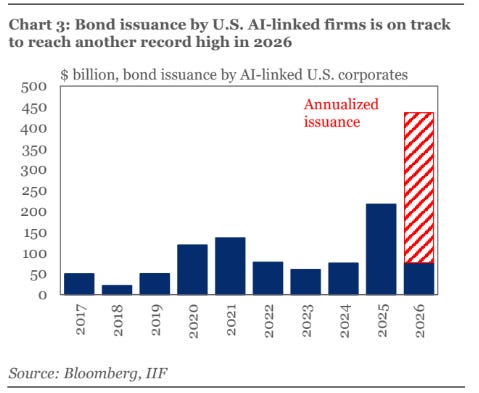
That’s not good for a stock market that’s been riding the wave of AI hype for four years. And with bond issuance from AI firms on track to hit another record high in 2026, you have all the classic signs of an investment bubble with billions in mis-allocated capital.


Nothing is changin' in Iran except maybe a more hardliner is going to be the replacement. This regime change Bullsh!t is just that - BS. Geez.....It is going to get ugly as the U.S./Israel run out of interceptor missiles. Then Trump will threaten with nuclear weapons....going to get uglier and uglier. Do you think China, Russian, and maybe even Pakistan is going to allow Trump or Israel to nuke Iran without retaliation?
Now where did I put that crystal ball, dammit!