

Tuesday, February 24th, 2026
Bill Bonner, from Paris, France

Paris 2026 is not the same city we first knew in 1969. We wrote about it for next month’s issue of our magazine, International Living. Here we share some of it with you.
But first, a financial update. It looks more and more as though the Golden Age is an imposter. A fraud. The four wheels of it — inflation, growth, deficits, and employment — seem to be stuck into the mud. To make a Golden Age work...
Inflation had to go down; instead it is holding steady near 3% with much larger increases for essentials such as energy and food…
Growth had to go up; it did not. The last quarter was disappointing with only 1.4% GDP increase. Overall, there is no sign of an upward trend…
Deficits were supposed to go down, too, thanks to the tariff revenue. For a few months, it seemed like it might be happening; but the long-term trend, towards a growing Everest of debt, never changed. And now that the Supreme Court has struck down the president’s improvised tariffs, there may be no tariff revenue at all.
(This looks like the worst possible outcome; all downside; tariffs alienated friendly nations...and the US could end up with no manufacturing boost and no tariff revenue.)
So, what about jobs? Washington Monthly reports:
Almost all of the jobs created in January were in just two sectors, healthcare (82,000 jobs) and social assistance, e.g., therapists, counselors, and social workers (42,000 jobs created).
Those jobs are not exactly the kind that will power a dynamic economy. They are ways to spend money, not make it. But back to WM for the rest of the story:
Now the bad news for Trump’s base:
Manufacturing jobs aren’t growing
Coal mining jobs aren’t growing either
Fewer white men are working
No Golden Age in the USA, not anytime soon. But how about here in Paris? ‘Non plus!’
What does the over-70 American see when comes to Paris? A gray city? Old? Tired? Or is he looking at his own reflection?
We checked the faces when we got off the train at the Gare Montparnasse. Gloomy...as gray as the roofs and the sky. Downcast. Only one lady smiled as she swept up her grandchild who had come to visit.
“Paris is a disaster,” says a Parisian colleague. “It hasn’t stopped raining for two weeks. Or maybe two months. There are no jobs. Everything is frightfully expensive. I don’t know how anyone can afford to live in central Paris...except maybe rich foreigners.
“And it’s going to get a lot worse. The elections are coming and we’ll have a chance to vote for evil right wingers or stupid left wingers. The responsible middle seems to have disappeared.”
Paris had its Golden Age too; probably in the 1960s, when we first visited. French movies were exotic and fascinating. Who can forget the theme song from ‘A Man and a Woman?’ Or Brigitte Bardot in ‘And God Created Woman?’ They were catnip for hip, young people. And French cars — notably the Citroen DS — were the wonders of the automotive world...with front wheel drive, radial tires and pneumatic suspension (you turned the key and the car rose up).
The city was also cheap back then. If you had dollars, you could rent a ‘chambre de bonne’ (a maid’s room) for only $50 a month. A hearty glass of red wine cost only about a dollar. But it was easy to get confused about the prices. Inflation in France had run up to over 18% in 1958, prompting a devaluation. The French franc was devalued — 100 to 1 — in 1960 and again, though less dramatically, in 1969. Merchants often quoted their prices in ‘old’ francs. So, you would have a glass of wine and the waiter would ask for cent francs (100 francs). You’d have a moment of panic and then realize that one new franc would do the job.
But even with inflation and devaluations...and the end of the empire at Dien Bien Phu and Algiers...the French economy boomed. It wasn’t until the election of Francois Mitterand in 1981 that the French feds were able to stop it. Today, the French government spends 57% of GDP, compared to 40% in the US. The difference is largely a feature of education and medical spending, which are controlled by the government in France and considered mostly private in the US.
For a further comparison, America’s big devaluation began in 1971...and is on-going. In gold terms, the dollar has lost 99.2% of its value. And it is being devalued — though not officially — everyday.
We recalled these things as we walked the streets of Paris once again, fifty-seven years later. The difference is night and day...and a lot of crepuscule, between being a poor student in 1969 and a (relatively) rich American visitor in 2026.
We went to the Louvre on Saturday. It was cold and rainy. Still, a long line waited to get in. Not wishing to wait, we paid for a guided tour and entered smoothly.
The tour guide was Italian. Earnest, knowledgeable...and friendly, he gave the tour in English. A pair of women from Northern Ireland joined us, as well as an extended family from somewhere in the Near East. There was also an Italian couple who always seemed to lag behind and get lost.
Tourism has been an important industry in Paris since the days of the Grand Tour in the 18th and 19th centuries. It was a different kind of tourism then. You needed letters of introduction to get you into the best salons. Here in Paris, you might have run into Ben Franklin...a much-appreciated dinner guest. Or, maybe you would have met a Russian count fleeing the Tsar...or a down-on-his-luck aristocrat from a kingdom you’d never heard of.
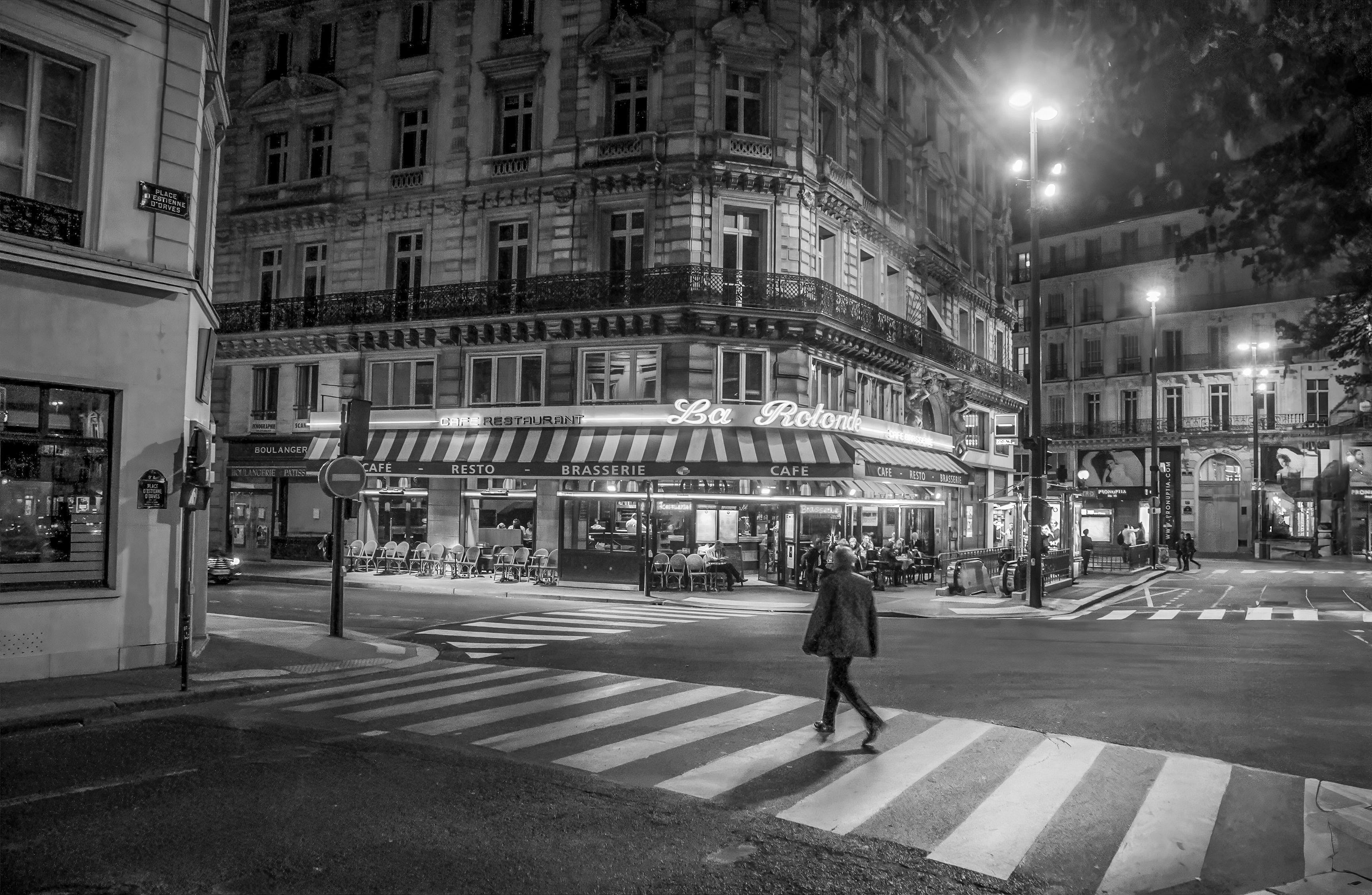
Paris always seemed to collect outcasts...and talent. Writers...artists...architects...composers. Even as late as 1969, it was as if Hemingway’s half-smoked cigars still smoldered in the ‘cendriers’ (ashtrays) of the Ritz bar...and Picasso’s scribbles still littered the floor at the Rotonde.
Our first stay in Paris was like being on a bridge between the old and the new. We had a friend who had been in Paris in the ‘50s and who had acted as a translator for the ‘Beat Poets’ — particularly Allen Ginsburg and the novelist William S. Burroughs.
They came because it was cheap...and arty. And they could get away with almost anything. This group must have taken its cue from Oscar Wilde. The disgraced homosexual was run out of Victorian England and took refuge on the rue de Seine in Paris.
But it is not the same water flowing under the Pont Neuf today as it was in 1969. The city is no longer cheap. There is air-conditioning (la clime) in many hotels. Fancy (expensive) shops line the Rue Jacob. And the people who come to visit are not necessarily like Franklin or Wilde.
When we recently searched for an apartment for friends, we scarcely found anything for less than $1 million. They settled on something for $2 million.
“I’m probably paying a foreigner’s price,” says our friend. “But I’m only going to live in Paris once in my life. I want to be at the center of things...where I will get the whole experience.”
Paris is chic. While there are many chic neighborhoods, our friend judged the 6th arrondissement, where we had hung out as a student more than half a century before, between the river and the Boulevard St. Germain, as the chic-est.
It certainly wasn’t very chic when we lived there. It was a student hangout. It was where you could go to a student cafeteria and get a decent meal for 35 cents. It was where, in 1968, students had pried up the paving stones to barricade the streets. And it was where you could sit at a sidewalk café, drink wine, smoke Gauloise cigarettes (with their very strong and unique odor), and BS each other about Nietzsche until the wee hours.
Now, the waiters close up early — they only work 35 hours per week, by government decree. And the sidewalk space is much too valuable for vagabond students; better to sell old antiques...or new handbags. Paris, back in the ‘60s, was a hotbed of art and insurrection. Now, it is calm, like a museum…or a morgue. Often, we thought we smelled lilies.
The city is still beautiful, however. Physically, it is much the same as it was in 1969 — and about the same size. And it still attracts people from all over the world. But now, there are more people in the world. And more of them want to come to Paris. As many as half the people waiting at the Louvre were Indians, Chinese and Russians. There would have been none of them a half century ago.
Neither Soviet citizens nor Chinese peasants were allowed to travel. And Indians couldn’t afford to do so. But now, they come to take in the sights. To shop. To strike Notre Dame and the Louvre from their ‘bucket’ lists. They fill the cute little hotels of the rue Jacob...spill into the many cafes near St. Germain des Pres...and discover that many of the most authentic Parisian dives still don’t have air-conditioning.
“This is where Jean-Paul Sartre worked,” proudly announce the waiters on the second floor of the Café de Flore.
“Who?” ask the tourists.
Regards,
Bill Bonner
Bill, a correction. The court did not strike down tariff's. It only said that IFFPA could not be used to justify the tariff's. As I am sure you know, there are other laws passed long ago to support going after tariff's.
I am sure everyone knows there will never be any refunds to those who have already paid tariff's.
These games will continue.
Jim Marshall
Feb 24, 2026 the official U.S. inflation rate is 2.4%... not 3%
The gov't shut down in 2025 is said to have lowered the GDP by around 1%
-
France is comparable to California in population and GDP.
And the fact both suck at the moment...