


Tuesday, August 11th, 2026
Bill Bonner, from Poitou, France
‘They don’t take eyeballs at the bank. Those who value stocks by eyeballs should go be ophthalmologists, not stock analysts. There is no cyberworld where reach trumps profits.’
—Jim Cramer
When money is too cheap...people tend to treat it like a stolen car. The next thing you know, it is upside down, a blackened shell.
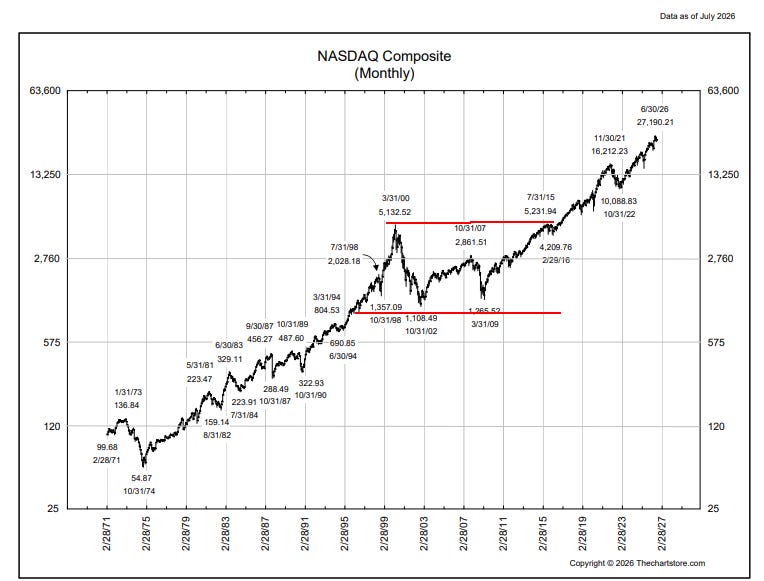
That is what happened in the dot com bubble of 1999-2000. And it is what is happening again now. Capital investment gushes in as if from a ruptured pressure tank. This capex supports revenues and profits. Then, near the end, capital investment slackens. And when investors take a good look at the earnings, they realize that there is nothing beneath them.
Back in the 90s, it was the wonders of the internet that set investors’ hearts racing...followed by hands reaching into pockets. People thought vaguely that electronic communications could make such a big difference in our lives, you could not ‘over-invest.’ The idea was to get as many ‘eyeballs’ as you could; you could figure out how to make a profit on them later.
After all, you could order almost anything ‘on line.’ You could work ‘on line.’ You could get your entertainment — and even conduct your love affair — ‘on line.’ Doing things ‘on line’ was vastly cheaper than getting in your car and driving to the mall. So, the ‘on line’ trade was widely viewed as the place to make money.
And they were right...up to a point. The internet revolution made a lot of expensive infrastructure redundant or unnecessary. Walk down any street in any major city and you will see the results for yourself. NPR:
Empty office buildings litter US cities.
Malls, too, once the crown of consumer creation have fallen into desuetude. Smithsonian Magazine:
Hundreds of malls, meanwhile, have closed and been demolished or converted, overtaken by a renewed emphasis on walkable neighborhoods and challenged by that overwhelming force of 21st-century living: online shopping.
The internet was a great success. Still, the industry went through the same boom-bust fever to which all are subject. AI merely follows the script. Already the story is fairly advanced. Turn the page; perhaps beginning is the ‘bust’ chapter.
Here’s how it works. The initial excitement brings investment cash into the leading companies. Those companies, like the ‘49ers’ attracted to California’s gold rush, use the money to buy the picks and shovels they need to exploit the discovery. This capex spending swells sales and income...and proves to investors that the original thesis was correct. In the early days of the Gold Rush, Samuel Brannan – who sold supplies to the miners – became the richest man in the state.
As enthusiasm builds in the goldfields, the pick and shovel makers become richer more reckless. Today, they buy customers’ stocks and offer vendor financing for their purchases. This adds even more proof that the AI boom is real.
But it is capital, not sales revenue, that is funding it. Real wealth is being consumed, not created. Salaries, rent, data storage, chips...these outlays must be depreciated...recognized as ‘expenses.’ These are then matched up against actual income. And uh oh...when the peak of the mania comes, so much money has been invested, it is almost impossible for sales and earnings to measure up.
That is what happened after 2000. Some ‘dot com’ businesses were great successes. Most were not. And the weight of the losers hit the Nasdaq like a barge running into a Baltimore bridge. Investors had to wait fourteen years to recover. Superficially. Actual recovery took much longer, because inflation had gnawed down the value of the original investment...and the capital had lain dead for fourteen years when it might have been earning an average of about 5% interest in safe US Treasuries.
That is why we spend so much effort trying to avoid the Big Loss. They’re always bigger than you think. You have $1 million in your account. The market goes down and you lose money. You think you’ll get it back when the market recovers. But it doesn’t work like that.
You wait fourteen years until your stocks get back to $1 million. But by then, the cost of an average house has gone up 50%. You are now fourteen years older and you missed $560,000 in Treasury interest. So, instead of being made whole in 2014, you end up with only about half of what you should have had.
And now, the ‘hyperscalers’ – Apple, Alphabet, Meta, Microsoft and Oracle -- are said to be putting $1 trillion more capital into AI. The chipmakers are worth $11 trillion. And the three leading AI ‘labs’ are worth another $2 trillion, despite never having earned a dime, net.
That is $14 trillion right there – nearly half of US GDP. It is only a matter of time before the arithmetic becomes overwhelming. With so much money pouring in, the trickle of profits coming out is bound to be disappointing.
Stay tuned...
Regards,
Bill Bonner
Research Note, by Dan Denning
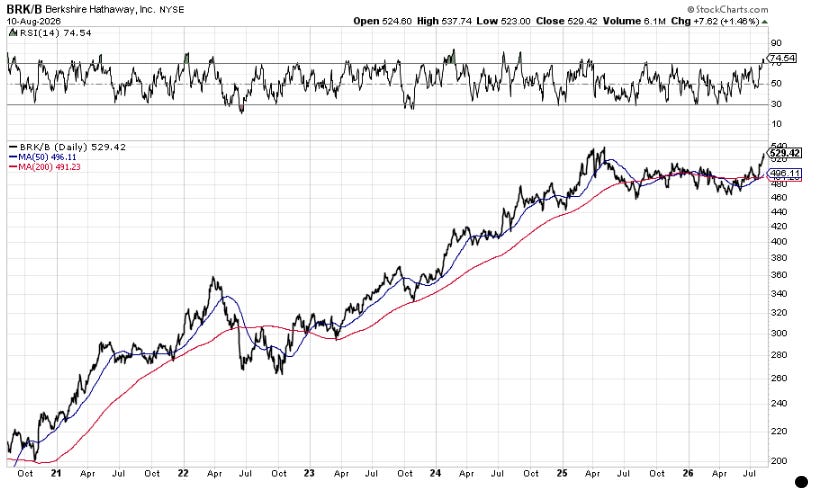
Lo and behold! Berkshire Hathaway’s new CEO Greg Abel began tentatively deploying some of the company’s $400 billion cash war chest in the second quarter. SEC filings show that the company spent $4.5 billion in buybacks of its own shares (most of it the Class B shares). It also spent nearly $20 billion buying stock in other companies (including Google parent Alphabet), as well as $6.8 billion closing out the acquisition of Sun Belt home-builder Taylor Morrison. The average price paid for the Class B shares over the course of the quarter was $486/share. The shares closed yesterday at $529.42, just below the all-time closing high of $537.74 set in May of last year. With a market capitalization of $1.13 trillion, Berkshire is the tenth largest US company by market cap and the largest non-tech company.
“October: This is one of the peculiarly dangerous months to speculate in stocks.
The others are July, January, September, April, November, May, March, June, December, August, and February.”
Mark Twain.
I think your letter today points to the fact that our best "potential" protection for our money is to be invested in commodities that everyone needs to live. Things that are inverse to the USD. I've been reading Stansberry Research since 2008 (Porter Stansberry, Doc Effrig, Dan Ferris and others) and their analysis of solid long term investments has been good. Rich people over the years own the basics, gold, energy, timber, farmland plus others. NO I WON'T GET RICH FAST, but as the USD goes down, these basic commodities will always be valuable.
Jim Marshall