


Thursday, April 30th, 2026
Bill Bonner, from Tola, Nicaragua
It was only a few years ago that speculators were keen to buy NFTs.
The frenzy reached the point where things that were worth, essentially, nothing, came to be valued for millions of dollars.
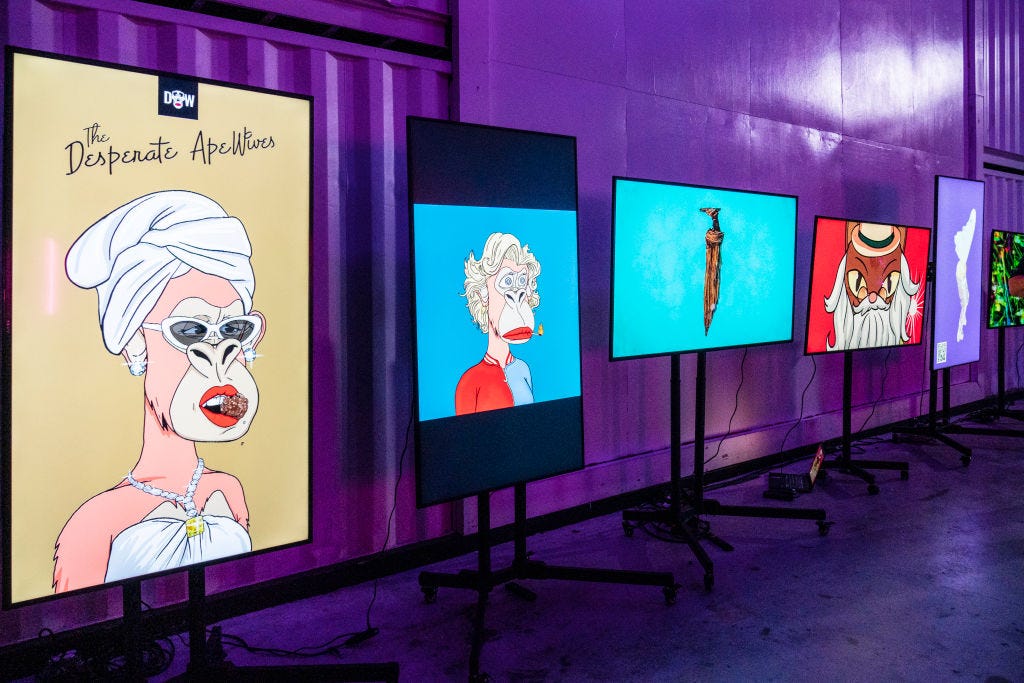
Beeple’s digital artwork, for example, sold for as much as $69 million. And in 2021, the NFT market traded over $2.8 billion monthly. Beeple’s work is at least ‘artistic.’ The Bored Ape Yacht Club also became super chic while the fad raged. Celebrities — such as Justin Bieber — paid millions for these cartoons. Their value now? Futurism in 2023:
It Was All a Dream
Remember Bored Apes? They’re Almost Worthless Now
They probably have some residual value as curiosities. But it’s the speculators who are bored now. Analysts say prices have declined 95%. But most NFTs are probably worth nothing.
What happened to the ‘value’ that was supposedly locked up in this marvelous frou-frou? Now you see it; now you don’t. It got deflated away...squeezed out of the market like the remnants of an old tube of toothpaste.
Today, there is about $27 trillion of nothingness built into the stock market. That is simply a rough guess about how much wealth will disappear in the next major correction. As Paul Tudor Jones explained, the stock market’s periodic corrections take prices down about 30%...and since the stock market is now valued at 250% of GDP....a 30% pruning would reduce wealth by about $27 trillion.
That’s deflation. ‘Wealth,’ thought to be safely locked up in the stock market, is suddenly taken out into the prison yard and gunned down.
All major innovations begin by destroying wealth. New tech — from internal combustion engines to dot-coms to AI — offers to cut costs for both consumers and producers. People take up the new products because they save time and money. Prices go down.
Later in the cycle, new industries are created. Automobiles, for example, led to an explosion not just of cost cutting...but spending and new wealth. Highways, suburbs, Detroit, shopping malls, oil companies, and junk yards — all grew quickly with the new machines.
AI is likely be much more deflationary than either the dot-com or the internal combustion engine. The latter put the muleteers out of business, but it almost immediately required many thousands of new machinists, rubber tire manufacturers, battery makers, parking lot attendants, and ambulance-chasing lawyers.
AI may be exceptionally deflationary. It has the potential to eliminate thousands of jobs...and not replace them. At least, not quickly.
There are more than three million truck drivers, for example. Self-driving software will eliminate their jobs. Will they take their places on robot assembly lines…or will the robots have those jobs too?
In time, of course, the free-ish market will find gainful employment for them all. But in the short-run, the effect will be to eliminate millions of money-earning workers from the market.
In his Tesla factory, Elon Musk famously replaced some of the robots with humans. He was under pressure to deliver cars and he found the machines were too slow. But that was already 10 years ago. Now, the machines are back – faster, smarter than ever. ProgrammerHelper, Jan. 2026:
Tesla’s Optimus Gen 3 Goes Into Production: Over 1,000 Humanoid Robots Now Working in Tesla Factories as Manufacturing Enters the Humanoid Era
So, what’s coming?
In view of the exceptionally overvalued stock market…and the exceptionally deflationary nature of AI…the coming stock market correction could be exceptionally depressing.
Regards,
Bill Bonner
P.S. Tom published his latest monthly report on what to do. If you’re a subscriber, yo u can read it by clicking on the link below.

There remains much hype in the commercial potential of AI IMO. Keep in mind that we are talking about something that cannot comprehend, cannot discern and cannot think. What it can do may be impressive, but the lack of the aforementioned skills represents more than a glass ceiling. More like a brick wall. Even driverless semis are going to be limited to controlled logistical loops in good weather zones(mainly the southwest) for some time, according to ChatGPT. And with so many career truckers ageing out(retiring) with no human replacement pipeline, AI may be more of a backstop to the transportation industry than a job loss engine. Everyone knows that dealing with software versus a real human being can be exasperating. At some point this is going to become both a customer satisfaction/economic issue as well as a political issue, I believe. I just used the federal government’s new AI software to renew my passport online. The AI photo analyzer kept rejecting my uploaded passport photo, telling me to remove my glasses and retake/upload a new photo. I wasn’t wearing any glasses. Inexplicably, I had the patience to retake and upload 8 photos. The last one, the one accepted, was so bad I was convinced it would be rejected for any number of reasons. I was ready to capitulate and then, voila, my photo was accepted. Welcome to our future in an AI driven world.
That's a good one today and history backs you up. It reminds me of a great quote from Charlie Morris by way of Dan Denning. "Gold is a zero coupon perpetual bond with no credit risk, and no counterparty risk, issued by God." 5000 years of history shows us it has stood the test of time.
I don't expect AI to change the story for gold.
Jim Marshall