


Wednesday, July 1st, 2026
Bill Bonner, from Youghal, Ireland

Subscribe to Bonner Private Research before July 4th to lock in the best price we offer
We have grandchildren visiting us here in Ireland. So, we’re going to do even less thinking than we do normally. For the next two weeks, we’ll try to keep up with the news...but the dots will have to connect themselves.
No president has done as much as Donald Trump to leave his footprints in the sands of time. While still in the private sector, he embossed his family name on every enterprise he attempted — Trump University, Trump Shuttle, Trump Vodka, Trump Taj Mahal, etc. In the White House, the pattern continues — The Trump-Kennedy Center, Trump accounts, the Trump Ballroom...the Trump Arch of Triumph...the Trump $250 bill.
The $250 bill was in the news this week. The internet came to life when it was reported that ‘250’ has a special meaning in Chinese. Copilot on the story:
In Mandarin Chinese, “250” is written as 二百五 and pronounced èrbǎiwǔ, used as a slang term for an idiot or foolish person.
It is customary to put pictures of dead presidents on US currency. Putting a live president is, well, unpresidented. And maybe bad juju. Most of the Trump-named businesses failed. The public projects are shaky too.
But who knows; Mr. Trump is much different from other POTI who came before him. But like them, he will soon cross the bourn from which no traveler returns. Then, his photo on the currency will not seem so vain. And a few years from now, you may be happy to have a Trump $250 bill...maybe you will use it to buy a cup of coffee.
Meanwhile, the farmers are getting more $250s. The Wall Street Journal reports:
The Agriculture Department earlier this year estimated that direct payments to farmers would hit $44 billion in 2026. That meant government payments could account for more than a quarter of projected net farm income, a broad measure of farmers’ profits.
That was before President Trump on Wednesday asked Congress to approve $11 billion in funding, largely to help farmers deal with effects from the war with Iran. If approved, government payments to farmers this year could hit a record high.
These measures bring US farmers into an expanding group of federal dependents — along with geriatrics, employees, half-wits, cripples, contractors, consultants, grifters and chislers — and brings them more into line with Europe’s farmers. The farmers we know in France tell us that their subsidies are approximately equal to net farm revenue. Without the payments, many would be out of business.
In the past, the US spent much of its national surplus on its military; Europe spent on social welfare programs. But now, with rising Social Security, Medicaid, and farmer subsidies — along with a $1.5 trillion Pentagon budget — America will dissipate its fortune on both...guns and butter.
Over on Wall Street things have been mostly quiet. The Nasdaq is said to be rotating out of the very expensive AI stocks...and into more reasonably-priced equities. There’s an old Wall Street saying: ‘They’re shooting the generals.’ In this case, the generals are the Mag 7 stocks that led the market for the last few years. But those stocks — Nvidia, Apple, Alphabet, Meta, Microsoft, Amazon and Tesla — are down 3% this year.
The generalissimo supremo, however, is SpaceX, a company that investors believe is really set to go ‘to the moon.’ They may want to consider what happens to these go-go companies after they IPO. Charlie Bilello:
Every major IPO in the last 15 years traded below its first day close at some point in its first year.
Didi Global lost 90% of its value. Robinhood and Rivian each lost 80%...and so on. And now Space X, like Alibaba before it, is down 35%. And the insiders haven’t even begun to sell. Companies like SpaceX give out enormous quantities of stock to attract and reward early employees, lenders and investors. Typically, these shares are ‘locked up’ to reduce the ‘float’ — the number of shares actually trading — and support the price.
In the case of SpaceX only about 5% of the shares have been made available so far. Later, the locks come off, so that after 180 days nearly 60% of them will be floated. These shares are not in the hands of long-term investors. They are owned by employees. And venture capital funders. And speculators. All of them must be thinking the same thing we are...
Better to sell; take the jackpot gains off the table before they disappear.
Regards,
Bill Bonner
Research Note, by Dan Denning
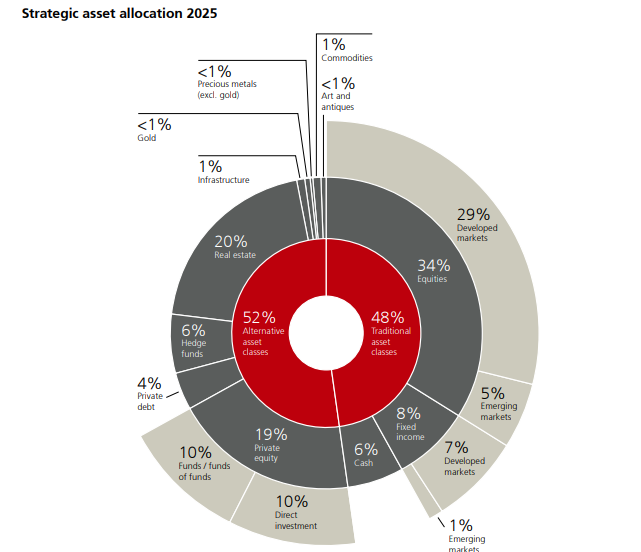
US Family Offices have less than one per cent of their portfolios invested in gold, according to 2026 UBS Family Office Report. The chart above tells the story. While Family Offices allocate 52% of their resources to ‘alternative assets,’ Real Estate and Private Equity are far more popular than Precious Metals. But is now the time to add more metal?
Gold just had its worst quarterly performance in thirteen years. It was down 13% in the second quarter. The last time it fell that much was during the ‘Taper Tantrum’ in 2013 when it fell 23%. Traders and investors have ‘priced in’ a more hawkish Federal Reserve and higher interest rates under new Chairman Kevin Warsh.
If you believe interest rates are the main driver of the gold price, higher rates are generally bearish. But keep in mind central banks are still net buyers of gold (officially and unofficially). The famous ‘death cross’ pattern has formed on a five-year chart, as I mentioned last week. Paying subscribers should look for Investment Director Tom Dyson’s research note later today for more analysis.
Many are considering a reduction in exposure to the US dollar or are planning to diversify regionally, but North American assets clearly continue to represent the greatest share of allocations. And, while some family offices are leaning more into emerging market equities and selected alternatives such as infrastructure and gold, developed markets firmly remain the backbone of portfolios