

Friday, June 12th, 2026
Bill Bonner, from Youghal, Ireland
“I love it. The numbers were great. You know what I really love? I love the inflation.”
--Donald Trump
MSN reports:
US oil reserves sink to 22-year low as Hormuz crisis deepens
Crude oil inventories in the United States decreased by 8.0 million barrels during the week ending May 29, according to new data from the U.S. Energy Information Administration (EIA) released on Wednesday. The decrease brings commercial stockpiles to 433.7 million barrels, according to government data, which is now 3% below the five-year average for this time of year.
The EIA’s data release follows API’s figures that were released a day earlier, which reported that crude oil inventories saw a draw of 6.75 million barrels in the period.
Mr. Trump does not commute to work in a pick-up. Were he a normal working stiff, with an honest income, inflation might not be so agreeable. Nexstar:
Americans are paying, on average, 27 cents more for a gallon of gas since Sunday, data from AAA shows. That increase was partially fueled by a 10-cent jump that happened overnight Monday into Tuesday, the largest single-day rise since Russia invaded Ukraine in 2022.
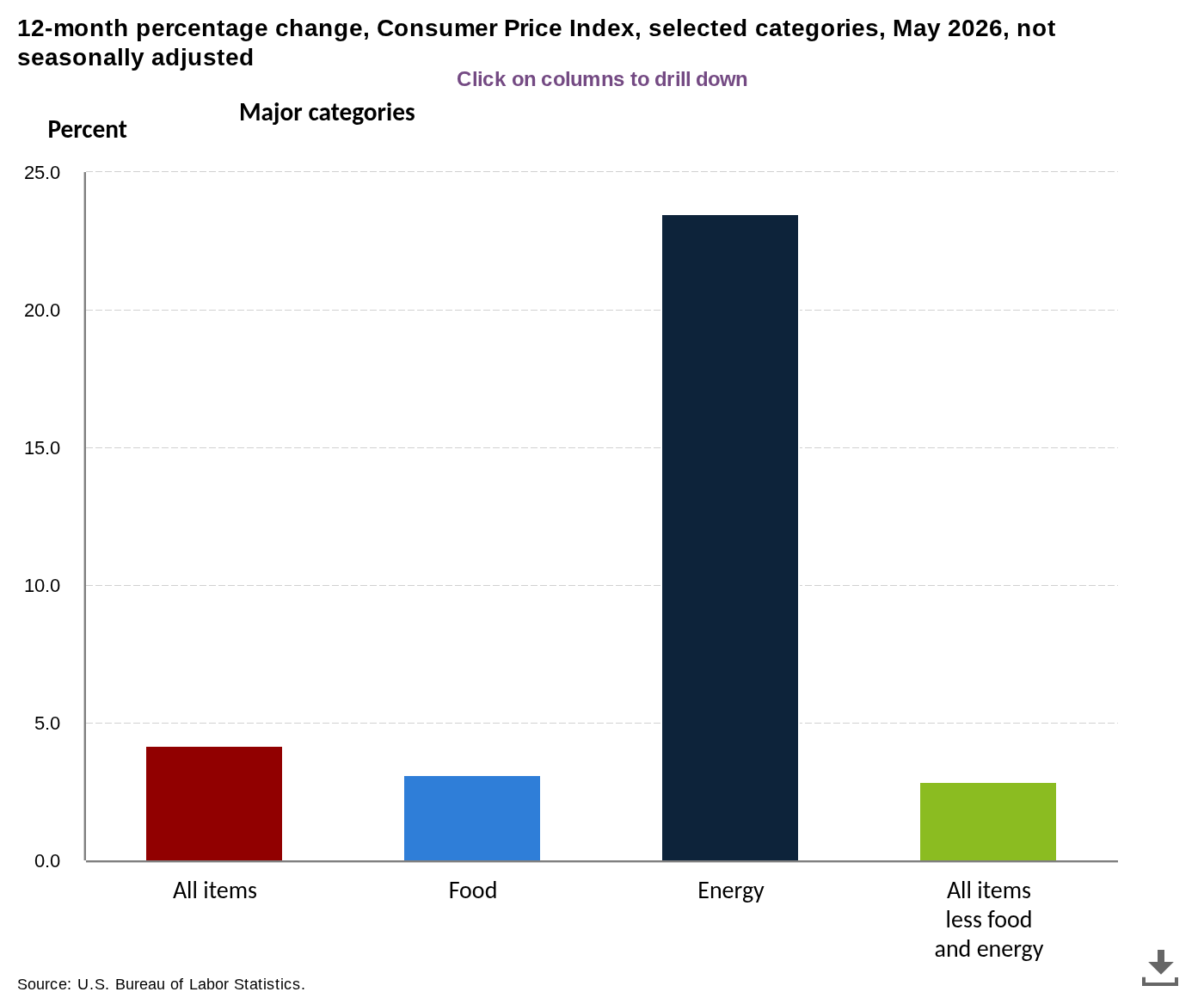
Taking a longer view, in January of this year, a gallon of gas cost about $2.60. Today, it’s $4.30. That’s $1.70 more.
The average commuter logs 37 miles per day, 13,500 per year. At an average of 25 miles per gallon, this means he is paying almost $1,000 more per year. Not a big number, if you’re a Trump. But if you’re an average worker, you earn about $50,000 and, after taxes and health insurance, take home about $40,000.
At $4.30 a gallon, your driving costs you $2,300....not to mention the costs of the vehicle itself. And if you stop for a coffee and a donut, it will be another $1,700 or so, per year...leaving you with only $36,000 to live on.
But Mr. Trump assures us that the war will be over soon. And then gas prices will drop ‘like a rock.’ CBS:
“And now we’re in the final throes of what will be a very very good deal that will not allow any way shape or form nuclear weapons,” Mr. Trump told reporters after attending the third game of the NBA Finals at New York’s Madison Square Garden. “And the strait will open up right away. It will open up immediately upon signing, which could be in two or three days.”
By our count, since March 1st, that was the 23rd time he has said the war would soon be over.
We have our doubts. The International Energy Agency:
With Hormuz tanker traffic still restricted, cumulative supply losses from Gulf producers already exceed 1 billion barrels with more than 14 mb/d of oil now shut in, an unprecedented supply shock.
Semafor:
The US oil industry has dwindling options to offset losses from the shuttered Strait of Hormuz. …Since the Iran war began, US oil exports have reached a record high and have helped stave off extreme global price spikes. But the precipitous drawdown since March essentially erases the stockpile built up since the 2010s shale boom.
Higher prices, such as they are, cause ‘demand destruction,’ where people simply decide to drive less. That helps to hold down prices too. Informed Comment:
The IEA says that in Q2, ending June 30, world demand for petroleum will be down by 2.45 million barrels a day....People are just using less petroleum because it is more expensive than it was before the US and Israel attacked Iran on February 28. In the US, gasoline is up by 35% to 50%. In Europe, diesel, which runs trucks, was the equivalent of $6.78 a gallon in February, and is now $8.02 per gallon (€1.82 per liter). If you are running a fleet of trucks over thousands of miles, that is a huge loss, and you might consolidate and cut out less remunerative routes.
You can cut the fat, but pretty soon you reach the muscle. Informed Comment describes what happens next:
Airlines have cancelled tens of thousands of flights and ticket prices have risen, so some passengers are cancelling or postponing trips. Trucks deliver goods to retail stores, so prices of commodities have gone up, and some customers have put off buying things they don’t desperately need right now. If the retailer doesn’t sell a product, it doesn’t order more, so the trucks don’t roll as often. And if the goods aren’t selling, the factories scale back production, so they use less petroleum, too.
We don’t want to start a panic, but there’s bound to be some kind of hazard on the road ahead. And this could be it: an oil slick. Even if the Strait of Hormuz were opened tomorrow, it would still take months for oil inventories to recover. The US economy depends on cheap gas…and cheap credit. Both could become much more costly.
Stay tuned...
Regards,
Bill Bonner
Need to stop "searching" for ways to make data fit your point. I agree oil supply is down and so are inventories. But showing a headline that says "US oil reserves sink to a 22-year low as Hormuz crisis deepens" and then later stating "crude oil inventories in the USA decreased by 8 million barrels with commercial stockpiles now 3% below the five-year average for this time of year" kind of sinks your headline! Stockpiles 3% below the five-year average for this time of year does not sound like a crisis to me. Most of the change in USA commercial stockpiles over the past 22 years relates to a "just-in-time" refinery supply chain structure in 2000 to 2008 then the Shale surge of 2009 to 2014 which unleashed massive amounts of domestic oil that outpaced pipeline infrastructure and so this oil was stored heavily in commercial storage hubs raising inventories well above 350 million barrels followed by global oversupply of oil from 2015 to 2021 which pushed commercial storage to its limit and went to a historic high of 540 million barrels when Covid hit in 2000 and oil demand collapsed. Followed by 2022 to 2026 where post pandemic export demand and domestic refinery runs pulled commercial storage back down to historical norms. So a 22-year low of US commercial oil reserves has nothing to do with the Strait of Hormuz. The Strait of Hormuz issue has hurt other countries, but it has not done much to US commercial oil reserves (the USA produces lots of oil - more than we need), so I would focus more on on the fact that USA commercial reserves are 3% below the five-year average and to that I say "should I worry about a 3% decline off a five-year average when we produce more oil than we consume?"
Wonder why the comment of An Ol' LSO is hidden? Is it because he mentioned the destruction of Israel? Our great leader frequently mentions that he will wipe Iran off the map. Didn't Voltaire say something like - Show me who you can't criticize and I'll show you who runs the country.