

Sunday, June 07th, 2026
Laramie, Wyoming
By Dan Denning
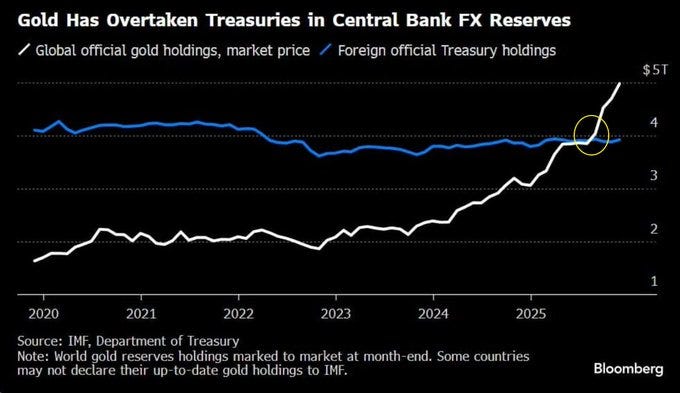
Maybe you’ve seen the chart above. It shows that crossover point last year where central bank gold holdings became more valuable than official holdings of US Treasury bonds and bills and notes. Makes sense. Why?
Central banks have been net buyers of gold since 2018. The gold price is up roughly 240% in that time. Russia invaded Ukraine in February of 2022 and was quickly kicked out of SWIFT, the global payments system run/enforced by the US.
This ‘weaponization’ of the dollar alerted investors to the fact that US government bonds are not ‘risk free’. They may be a reserve asset on the balance sheet. But with high inflation, political dysfunction, and the willingness to use the dollar as a foreign policy cudgel, US bonds come with strings attached.
Gold does not. Its market value can fall too. So the chart above could reverse on a big dollar rally…or big gold fall. Or—more likely in my view—the current trend, the Primary Trend, may continue. As my old friend Charlie Morris once famously quipped, ‘Gold is a zero-coupon bond with no counter-party risk, inflation-linked, and issued by God.’
Couldn’t have said it better myself. And while I’m thinking about old friends in London, Dominic Frisby writes that he has a new book about gold. He actually mentioned it a few weeks ago and I forgot to tell you. So I’m telling you now. Dominic’s told me that he’s been told it’s the best book ever about gold, which is saying something.
It’s called The Secret History of Gold: Myth, Money, Politics, and Power.
I asked Dominic if he’d give me a short summary before I got stuck in this weekend. Here’s what he wrote back:
The book is a narrative history of gold as money, power and myth, tracing its role from the formation of the solar system to the modern financial system. It argues that gold’s unique physical properties – permanence, scarcity and incorruptibility – made it the natural foundation of monetary systems for thousands of years, and explains why its abandonment in the twentieth century enabled the expansion of state power and the erosion of currency stability. It also examines gold’s future role in a shifting global order, including the likelihood that China’s true gold reserves are far larger than officially reported – potentially by an order of magnitude – with significant implications for the next monetary regime.
He’s got a point. Quite a few of them, in fact. It also made me wonder…if all those oil exporting countries in the Persian Gulf are selling gold to make up for lost energy sales…who’s buying the gold?
And where would that show up in the official data…and when will it show up in the gold price?
More on that later this week at BPR. In the meantime, please check out Dominic’s book here. And enjoy the summary below of all the best research we published this week.
Dan


Good question; The chinese stopped buying oil a while back, maybe they've been buying gold instead
According to the Bible, the ancient Israelites put much trust in gold… but it didn’t save them from the Assyrians or the Babylonians. There is a limit to what even sound money can do for you.