

Monday, May 18th, 2026
Bill Bonner, from Asuncion, Paraguay
What lured us to Paraguay? Is it not a backwater? A disreputable refuge for war criminals and disgraced smugglers? A sweltering tropical island without a beach?
Not anymore. It is still hot — in the summer months. It is still landlocked, snuggled in between Brazil, Uruguay, Argentina, and Bolivia. But the old Nazis, if there ever were any, have died...and Paraguay has come alive.
A proximate purpose of our trip was revealed in the headline of the La Nacion (Paraguay) on Friday:
Shipments of beef to Europe will begin in June
Then, in Saturday’s paper came more motivation in the UltimaHora:
The Fall of the Dollar Means Recalculating Investments
It is always a mistake to base investments on macro guesses. Even if you’re right about the trends, they often don’t have the results you expect.
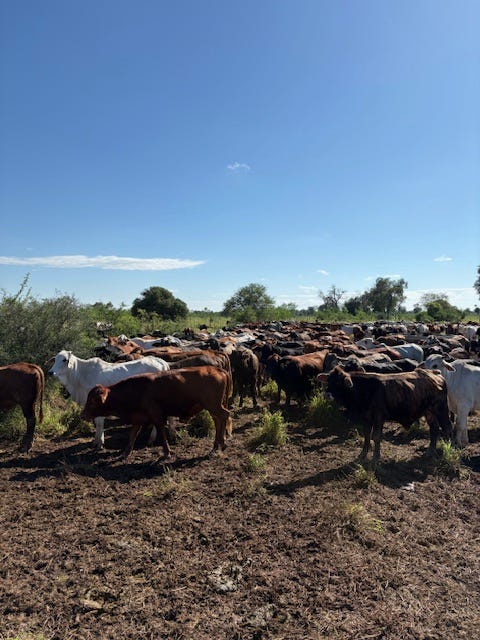
But we don’t expect people to stop eating beef. And if we can produce the meat efficiently, we might be able to eek out a modest living. No outsize profits. No serious capital gains. Just a decent business with decent returns. So, we’re teaming up with an Argentine family to raise cattle in Paraguay.
Why Paraguay? Because it has lush, low-cost pastures...low taxes...and low labor costs. And a cattle investment in Paraguay is about as far from Wall Street as possible. More important, our partners know what they are doing. They’ve been raising cattle in Argentina and Bolivia for many years. Now, they want to do it in the Chaco of Paraguay.
The logic of our business is simple. We buy the weaned calves at about 200 kilos. We let them eat grass, give them vaccines, watch over them...and then hope to sell them at 400 kilos. Generally, the young animals gain about a pound per day.
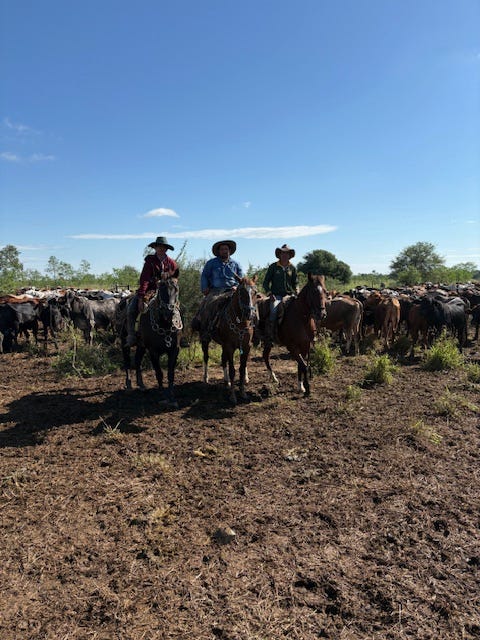
You just have to make sure they’re taken care of properly.
Here are the gauchos who do it:
The trip from Buenos Aires to Asuncion was uneventful. From the airport, we drove directly out to the project. It’s in the Chaco, a vast region to the west of the capital city, with few people, little infrastructure, and a rough past.
Along the way were the typical signs of Latin American poverty — trash next to the road, and smoke rising from where people were burning it...ramshackle houses of tin, plastic and rude lumber.....big gas stations...and dangerous potholes. It was not rare to see entire families on motorbikes. We watched nervously as a 7-year-old sat in front and steered, while his mother looked at her phone and his sister held onto her waist.
After we left the sprawl of Asuncion, however, we were on a new highway where the ubiquitous Toyota trucks flew by at 100 mph. On both sides of the road, for four hours, stretched vast fields of swampy wilderness.
Then, as we finally approached Filadelfia, in the Chaco, things changed. Houses were respectable. Tractors were in the fields. And our hotel, was unexpectedly nice. So far from civilization, in such a dusty little burg, we anticipated a very basic place to stay. But the hotel in Filadelfia was surprisingly large and well-run. Not at all fancy in its design or furnishings, it nevertheless had a very attentive and professional staff, full restaurant with a wide-ranging menu...and a bar with plenty of selections.
“The Mennonites developed this area,” explained our partner. “They came here because there was nothing here. Land was very cheap. Nobody wanted to come way out here.”
After the five-hour drive to ‘way out here’ we wondered if — even today — anyone wanted to come. But there we were. And around us was evidence of a boom. There were many shiny new tractors and harvesters on display. Huge trucks pulled huge trailers — laden either with animal feed or the animals themselves. And around us were big, blond people speaking Spanish...or German.
There were no suspenders, long dresses or white caps. But these people were definitely not like the mestizos of most of Paraguay.
“First, they cleared the thick trees and bushes away and raised a few cattle.” Our partner continued. “They imported the Zebu and Nelore breeds from India and mixed them with the local cows. They’re more ‘rustic’ animals. They don’t seem to mind the heat or the bugs.
“They only started raising crops a few years ago. But now that they’re producing corn, wheat, soybeans and other field crops, they have something to feed the calves; they can keep them longer and can fatten them up. And now they’re exporting them all over the world.
“They are also very well organized and capitalized. They set up a cooperative years ago. It’s very important down here. The Mennonite cooperative partners with banks, insurance companies, developers and farm suppliers. Even this hotel is a joint venture with the Mennonite cooperative. Really, it was the Mennonites who made this area what it is.”
After a hearty breakfast, we drove out to see our cattle. It had rained during the night. The moisture left a slick layer of mud on the unpaved farm lanes; even with four-wheel-drive, we almost slipped off the road several times.

When we finally got to the fields, we were greeted by the gauchos above and the veterinarian:
“They’re good animals. A mixture of Zebu, Brahmin, Nelore and Brangus. The whole business depends on putting on weight. So, we weigh them every couple of months. Then, we sell those that don’t gain weight...and those that gain it fastest. Together, they give us an average price per animal and it leaves us with a herd that is more or less what we want — animals that steadily gain weight at a predictable rate.”
One of the drawbacks of this operation is that it is a long way from anywhere. It is a long way from Asuncion. It is even farther for our partners — two young men from a large farming family. They are based in Argentina, a 10-hour drive away. They come up once a month to check on it. After a cup of coffee and a brief discussion of how it is going, they got back in their truck for the long drive home.
The Chaco area is flat. It is hot. It is not a place we’d like to live. But it may be a good place to raise cattle.
We’ll find out.
Regards,
Bill Bonner
It’s beautiful how every rich Paraguayan investor describes exploitation it like they’re narrating a children’s nature documentary.
“We found lush, low-cost pasture…”
Yeah, funny how “low-cost pasture” always means somebody else is living in a corrugated soup can twenty feet away burning garbage beside a highway pothole large enough to swallow a baptist choir.
The whole thing reads like a Hallmark card written by a hedge fund vampire.
Ah yes, the Country of Paraguay. Former refuge of fugitives and meat smugglers. But now? The Nazis are dead! Time to buy cattle!
That’s civilization, folks. That’s the arc of human progress. We waited for the war criminals to die so we could monetize the grass, and send in the undercover FBI folks.
Beautiful, and I love how Paraguayans describe poverty like tourists visiting a zoo. “Entire families on motorbikes…”
No kidding. Because when you’ve got three dollars and a dream, the motorcycle becomes a minivan, a school bus, and a hearse all at once., Then suddenly they reach Filadelfia, the magical Mennonite Totonian Disneyland. Respectable houses, nice tractors, organized blond people speaking German. OH GOOD, the white people arrived. Civilization detected.
The hotel had a bar with selections. Humanity saved itself. You know what really kills me? The moral simplicity of cattle investing. “Buy calves at 200 kilos…feed them…vaccinate them…”
Right. That’s capitalism at its purest:
Turn grass into beef and suffering into quarterly returns.
And these guys always say the same thing: “We’re not looking for huge profits.” That’s because rich people discovered if you whisper greed softly enough it sounds like wisdom. “We just want modest returns…” Yeah. And dictators just want orderly elections.
The Country of Paraguay sounds like the kind of place where every business deal begins with: “So…how enforceable are the laws here, theoretically?” You got these investors acting like rugged pioneers because they drove through mud once.
Buddy, you stayed in the nicest hotel within 500 miles and drank imported whiskey while discussing calf-weight ratios like Bond villains at a livestock TED Talk. Meanwhile the gauchos are out there wrestling mutant mosquito-cows bred from Zebu, Brahmin, Nelore, Brangus, and apparently leftover Jurassic Park DNA. The cattle sound like they escaped from a military experiment.
“These animals are more rustic.”
Rustic? That’s how Airbnb describes a cabin without plumbing. Those cows sound bulletproof.
And can we talk about the economic thesis here?
“The dollar may fall. Europeans still eat beef.”
That’s the strategy?
That’s not macroeconomics. That’s a drunk uncle at a casino buffet. Europeans also drink wine and invade countries every few centuries. Are we buying tanks next? And the Mennonite cooperative? Fantastic. Terrifyingly efficient religious agricultural syndicates always calm me down.
“They own the banks, insurance companies, hotels…”
Oh good. So the entire economy is run by a blond hive mind speaking German in the middle of the Paraguay dust bowl. Historically that’s never made anybody nervous. The whole vibe of this place is: “Welcome to paradise. Please ignore the malaria and the morally ambiguous logistics network.”
And I love the optimism.
“It’s hot. Flat. Isolated. We’d never live here ourselves… but maybe the cattle will enjoy it.”
That’s every investment pitch in human history. “Would you want to be trapped here? No? Excellent. Tremendous upside.
All in all, the Country of Paraguay sounds nice. Any country where a seven-year-old drives the family motorcycle while the mother checks her phone… that’s freedom. That kid’s already more qualified than most Paraguayan senators.
And I like the cattle business. Seems honest.
You buy a cow.
You feed the cow.
The cow gains weight.
Then eventually somebody eats the cow.
Simple. Unlike crypto.
You ever notice cows never try to explain blockchain to you?
A cow just stands there.
Judging you quietly.
I respect that. And these investors keep saying: “We just want predictable weight gain.” That’s also what happens to tourists at the hotel buffet. They’re basically fattening themselves alongside the livestock.
Here’s the funniest part?
The investors say:
“The old war criminals, if there ever were any, have died.” That’s such a careful sentence.
“If there ever were any…” That’s how you describe ghosts in a haunted motel. Some say Room 12 contains the spirit of Klaus von Schnitzel. Hard to say. And then they meet the veterinarian like it’s the climax of an adventure movie. This here is Raul. He vaccinates cows.
Incredible.
Ten-hour drive through mud to meet Cow Doctor Indiana Jones.
Honestly, I hope the cattle succeed.
Not because of the profits.
I just think somewhere out there there’s a calf named Señor Beefington trying to make something of himself. And I admire that.
"we might be able to eek out a modest living" The Great White Father is at it again. Best always. PM