

Wednesday, May 13th, 2026
Bill Bonner, from Buenos Aires, Argentina
“MAKE IRAN GREAT AGAIN (MIGA!)”
Thank you for your attention to this matter!
—President DONALD J. TRUMP
Anything can happen. But it looks like the War against Iran is ending as it began — badly. Jeffrey Sachs and Sybil Fares:
The war against Iran that the United States and Israel launched on 28 February 2026, will likely end in an American retreat. The United States cannot continue the war without producing disastrous consequences. A renewed escalation would likely lead to the destruction of the region’s oil, gas, and desalination infrastructure, causing a prolonged global catastrophe. Iran can credibly impose costs that the United States cannot bear and that the world should not suffer.
Sachs and Fares are ‘peaceniks.’ But the war-nik, Robert Kagan, agrees. “If this isn’t checkmate,” he writes in The Atlantic, “it’s close.”
Kagan is married to Victoria Nuland, who provoked the ‘Maidan revolution’ in the Ukraine in 2014. The Eastern Provinces of the Ukraine were closer to Russia — linguistically and culturally — than to the Ukraine. They voted overwhelmingly to join the Russian Federation. Nuland’s anti-Russian government in Kiev set in motion the events that led to the Russian invasion.
Some families are musical. Some are religious. The Kagan family is a bunch of war mongers. Kagan’s brother, Frederick, was also instrumental in pushing the US to war with Iraq.
But what’s this? The war monger now sees what mongering wars has wrought. The US is trapped. Kagan, echoing Sachs and Fares...or vice versa, in The Atlantic:
‘Unless the US is prepared to accept the devastating long-term damage to the regions’ productive capacity that is likely to result from an Iranian retaliation — walking away now would seem to be the best option.’
The trap is this: the US cannot force Iran to do anything without risking a major retaliation. That could mean much higher oil prices...for a long time. Trump started the war. But he doesn’t want to end it in a way that would also end his political career.
According to Global Geopolitics, Trump asked his intelligence agencies for an assessment. Apparently, they let him know he was a cornered rat:
‘The intelligence community assessments leaked to the Washington Post confirm Kagan’s worst fears. Iran retains approximately seventy-five percent of its prewar missile launchers and inventory, despite weeks of intense American and Israeli bombardment. The Iranian regime has recovered and reopened almost all of its underground storage facilities. It can survive the American naval blockade for at least three to four months before facing more severe economic hardship, a timeline that far exceeds the political patience of any American administration.’
Kagan says this has to be regarded as another defeat for America. More than that, it is a milestone — perhaps the most important one — on the road to substantially less power and influence for the US empire. The outcome, so far:
‘It has increased Russia’s income (selling oil at a higher price). It turned Iran into a Superpower, now in control of the most important waterway in the world. It increased the importance of the Chinese yuan and of China’s influence on world affairs. It left Iran with its enriched uranium, and more incentive than ever to make a nuclear bomb. It did not change the Iranian regime. And it separated the US from its NATO allies.’
Out on the blue water, the US Navy was supposed to open the critical strait. But, according to Global Geopolitics, the US defeat was humiliating:
The indisputable conclusion, as one analyst put it, is that the United States Navy cannot escort even a seagull, let alone oil tankers, across the Strait of Hormuz. That will remain the case from now on.
Robert Kagan tells us what happens next:
Here is what defeat looks like.
Iran remains in control of the Strait of Hormuz...Iran has no interest in returning to the status quo ante...
The power to close or control the flow of ships through the strait is greater and more immediate than the theoretical power of Iran’s nuclear program. This leverage will allow the leaders in Tehran to force nations to lift sanctions and normalize relations or face penalties. Israel will find itself more isolated than ever, as Iran grows richer, rearms, and preserves its options to go nuclear in the future. It may even find itself unable to go after Iran’s proxies: In a world where Iran wields influence over the energy supply of so many nations, Israel could face enormous international pressure not to provoke Tehran in Lebanon, Gaza, or anywhere else.
Once again, Mr. Trump has proven to be the man for the job...the job of dismantling US power. He has done what others said couldn’t be done. He has helped the Iranians reclaim the glory of Cyrus, Xerxes, and Darius. He has made the Persians great again.
Regards,
Bill Bonner
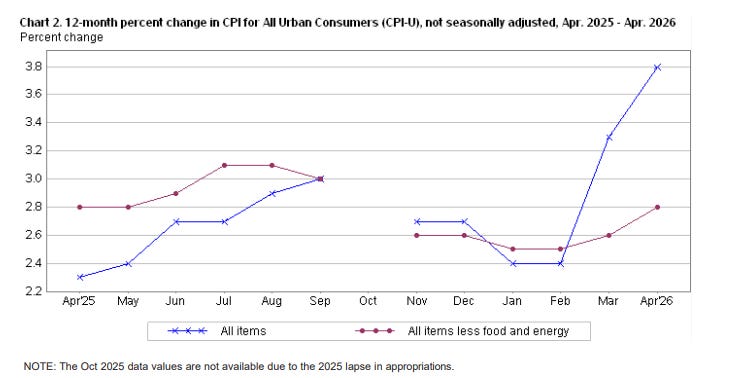
The energy sub-index of the consumer price inflation index rose 3.8% in April. That accounted for 40% of the total rise in CPI for the month (also 3.8%). In the last twelve months, the energy index is up 17.92%. The gasoline sub-index is up 28.4% in the last twelve months. With two weeks before US ‘driving season’ kicks off with Memorial Day, it now looks like the next move by the Federal Reserve could be a rate hike to contain US inflation.
Of course, this outcome assumes that no land invasion occurs. That Irans neighbors will just lick their wounds and put up with Iran being granted regional sovereignty. That Trump, as a man of his word, refrains from launching his own ground invasion. Frankly, it assumes that Trump will simply accept responsibility for a defeat. I have to say Bill, I think that assumes too much. We’ll see…
Sorry Bill, but reporting the truth about the Iran war is now illegal. Please report to your nearest police station.