


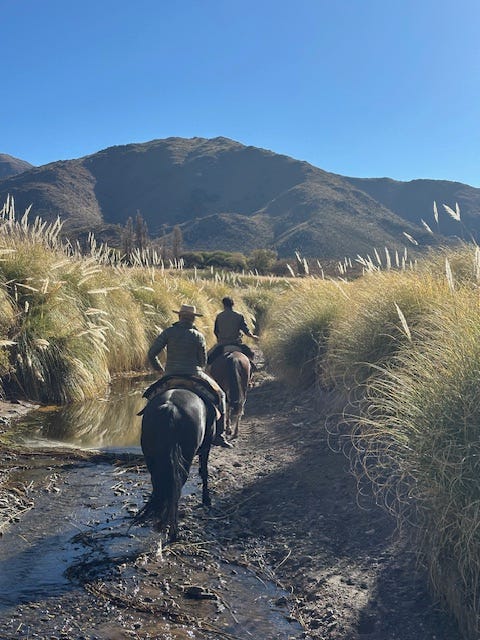
Thursday, May 28th, 2026
Bill Bonner, from Gualfin, Argentina
“How could we only get three calves from 30 cows” was the lead question.
“Who stole our calves” was the follow-up.
We left the relative calm and comfort of our house in San Martin, along the river, to visit the ranch up in the mountains. The two properties are contiguous, but it takes an hour and a half on a windy dirt road to get from one to another.
While the ranch is the more majestic and perhaps more romantic place, suitable for a Zane Grey western, we spend little time there. Over the twenty years since we bought the place, much has changed — including us. The ranch house is at 9,000 feet elevation with spectacular views out across the Gualfin Valley. This was no problem when we were in our 50s...and even in our 60s...but in our 70s, we no longer take oxygen for granted. During the day, we breathe hard and get along. But at night, without an oxygen tank, we gasp and stay awake.
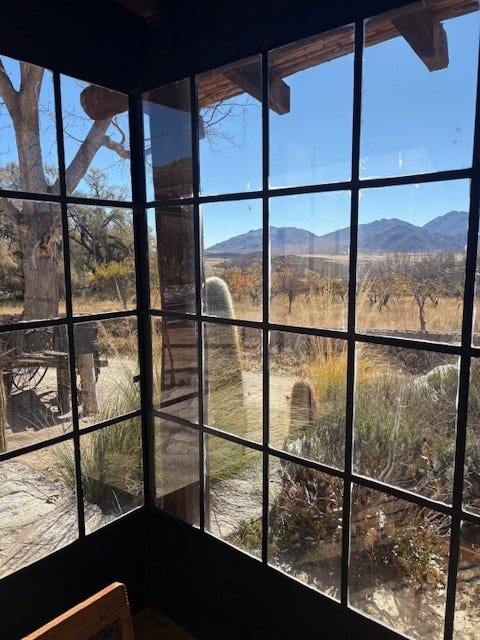
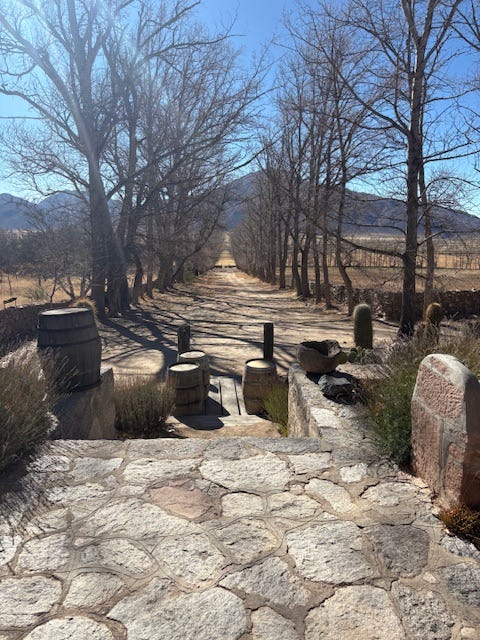
It is late autumn at the ranch. The nights are clear and cold. Days are warm and sunlit. The alamos (cottonwood) trees have already lost their leaves, making the views even more starkly impressive.
Yesterday, we saddled up and rode over to meet the new school headmaster. It is a public school set up on the ranch, bare, charmless and unheated. Many of the students live so far up in the mountains that they have to stay all week in the school and go home on weekends. The teachers live in the school too and usually only last a year or two before they go mad from the solitude and frustration. It is not an easy place to teach. The new headmaster, a handsome man in his 40s, gave us the low-down.
“I never imagined it would be so hard. The children come from such rough backgrounds; they are just not accustomed to sit still. They have TV at home now...but no books. And the Spanish they speak is barely recognizable.
“They tell me what is going on at home...which is often shocking.
“You may know this already but there is a kind of range war going on. Three families have accused each other of rustling cattle. One man [we recognized the name as one of the ‘Originario’ trouble makers] punched a young man from another branch of the same family...and threatened to kill him. And then Ivan was accused of threatening to kill someone in a different family. [Ivan is the man who was arrested after his infant son was found dead outside his house; giving him the benefit of the doubt, our lawyer helped get him released for lack of evidence.]
“It was all a terrible mess. The police came up, but couldn’t do anything. And the children stopped coming to school, because the families were at war with each other.
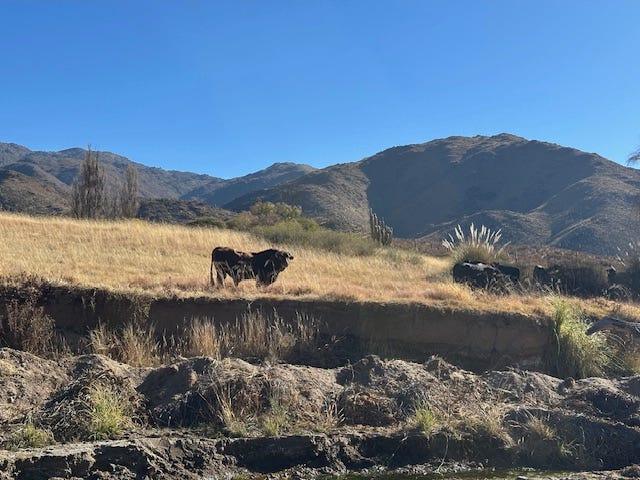
“The latest thing is that several people accused Ivan of mutilating their horses...cutting their mouths so they couldn’t take a bit. They said he mutilated one of your bulls, too. They say, too, that he was the one who tore up your water pipes and burned down your cabins. But, again, there is no way to prove anything. And since the families are at war, you don’t know what to believe.
“I just feel sorry for the children.”
In the dusty courtyard, two children sat idly. While most of the them had gone home, these two remained. It turned out that they were Ivan’s children.
“Hello,” we went over and greeted them. The little boy’s face was blank. But the little girl scowled.
“She’s probably been taught that she shouldn’t be nice to white people...and certainly not to the ranch owners,” the teacher explained.
Leaving him with assurances that in the fight against ignorance and barbarism we stood shoulder to shoulder with the church, the state, the police, the other landowners and God Himself, we took our leave and headed up the river.
This time of year, there is still a little trickle in the ‘rio’ but most of the water has been shunted into one of our irrigation canals to water the remaining hay. It won’t be long before that water too shrinks to a drip. Then, the cows will eat what grass is left.
“How long do you think that will last,” we asked the foreman...a strong, middle-aged man who speaks in the local idiom, almost unintelligible to outsiders.
“Until about August,” we made out. “Then, we’ll bring the round bales up from the valley to keep the cows alive until the rains come in November or December.”
One year, we recalled, the rains didn’t come. The situation grew desperate. We had to drive the cattle over a mountain on a rugged trail to another property. Several, weak from hunger, died along the way.
We followed the river bed on horseback, enjoying the views and the leisurely pace. We were mounted on Bayo, a horse that has grown old along with us in the 20 years we’ve been coming here.
We give him a happy pat when we see him.
“Hi there, ol’ pard,” we say, quoting something we imagine is in Zane Grey’s novels...and summoning a spirit of complicity, if not solidarity, between man and beast.
But we know what Bayo must be thinking:
“If we’re such ‘pards,’ how come you’re always on top?”
Bayo knows us well; we know him. We have a tacit deal. Neither rider nor horse pushes too hard. Bayo plods along, reliably and steadily; we don’t complain.
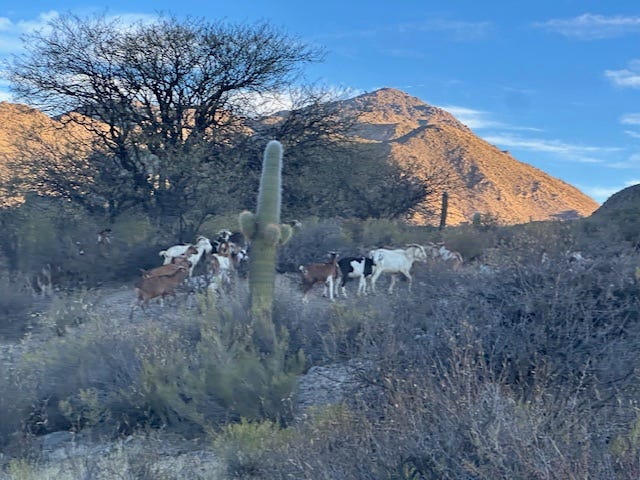
We had been headed upriver for about an hour when we spotted a herd of goats. Frequent, but not acceptable. The riverbed grass is reserved for the cows. These goats were trespassing.
The goatherd appeared a few minutes later. He is the brother of the woman we were going to see. Marchela lives in an adobe shack on a promontory overlooking the river. She takes care of her mother, said to be over 100 years old. The brother was just visiting.
We explained that the goats were meant to stay on the high ground.
“But your fence has fallen down,” he protested.
We didn’t doubt it. Instead, we were surprised that there was a fence. This was mostly open range. The fences — stone and/or wire — were relics of an earlier era, long before we came. That any were still standing was almost miraculous. And today, the rule — as we understand it — is that the goatherd is supposed to keep his goats out of the riverbed.
The custom is to punish the goatherd for trespassing by taking one of his kid goats for a stew. Since the family has far more goats than they need, or probably want, this is not much of a penalty. But it is usually not imposed anyway.
After straightening out the goatherd we proceeded to the goats’ owner — the aforementioned Marchela. We rode along the river bank and then up a narrow trail to a collection of adobe shacks with plastic covering their roofs. Out of a doorway, with an old door of cactus wood, held together by cowhide strips, came a rather non-descript woman in the middle of her life. Plump, but not fat. Swarthy, not black. Friendly, but not really warm, she greeted us with a wary smile. We made introductions (though we had met years ago) and chatted awhile. Then, we got down to business. She sells goat cheese and her own bread. We paid her 14,000 pesos — about $10 — for two sacks, one of cheese, the other of bread.
“Prices have gone up,” said our son-in-law, a regular customer.
We took a different trail on the way back. It led along the main irrigation ditch. Lombardy poplars had been planted by the ditch, again, long before we arrived. In other parts of the farm — notably where we have vineyards — we now use plastic pipes to deliver water. The irrigation ditches have been left to dry out, with the unfortunate consequence that the trees that once drew life-giving water from them are now dying.
“One of the things that bothered me about this place when we first got here,” Elizabeth remarked, “was that the landscape was always changing. Rocks fall off the mountainsides. After ever major rain, sand and dirt gets wash down these rivers. In the summer it’s green and almost lush. But in winter it’s bone dry, withered up, and looks like it couldn’t support a single plant, let alone human life.”
But the lombardy poplars, molles, arkas, and algorrobas here were healthy. The ‘acequia’ (the irrigation ditch) was still in use.
As we were riding along, a quail darted across the path. Ramona, a small terrier that had been in the saddle with our daughter, suddenly jumped down and gave chase.
She ran under the sagebrush...jumped the gullies...and switched back on the switch backs until she was out of breath. But the quail got away.
Ramona scampered back to our daughter’s horse...whimpering, until she was picked up again.
Regards,
Bill Bonner

Bill, I've been reading your work for over 25 years, way back to the paper mail letters. Baltimore, France, Ireland, the resort you and Doug Casey built in S. America and of course the ranch...I think I listed them all. We are the same age I think, 79, and you have weathered the storm well. Not bad for an old bird! As David said below, this is a nice break from crazy world we live in.
Jim Marshall
I love the day in the life post. It reminds me of your posts 25 years ago when you would write about your adventures in the French countryside with your school-aged children, your wife, your mom and your gardener.