



Thursday, May 7th, 2026
Bill Bonner, from Youghal, Ireland
‘Nobody’s ever seen anything like it.’
--Donald J. Trump
Want more evidence of a bubble in the stock market?
We didn’t think so. But we’ll give it to you anyway. CBS News:
GameStop offers to buy eBay for $55.5 billion, threatens hostile bid
The Wall Street Journal, which first reported GameStop’s offer for eBay, said Ryan Cohen is prepared to launch a hostile bid if eBay rejects the deal. EBay could be a “legit competitor to Amazon,” Cohen said in his comments to the Journal.
“EBay should be worth — and will be worth — a lot more money,” he told the paper. “I’m thinking about turning eBay into something worth hundreds of billions of dollars.”
Think big!
“I’m thinking about...” conjures up someone thinking, you know, casually...about creating ‘hundreds of billions’ worth of value. How do you do something like that? A real business worth hundreds of billion would have to be making billions in profits. At least double-digit billions.
But this is not about making real money…or adding real value. This is the foam on an estimated $45 trillion worth of fake beer on Wall Street.
In 2021, the chain of video game stores faced bankruptcy. The company had been middling profitable up until 2018. Then it went into a slump, losing money for the next seven years. Customers could download games online. They didn’t need brick and mortar stores.
The stock traded in 2020 at about $2.50 — while the company lost $368 million. More than 400 stores were closed. And it looked like GameStop was not long for the world of publicly traded enterprises.
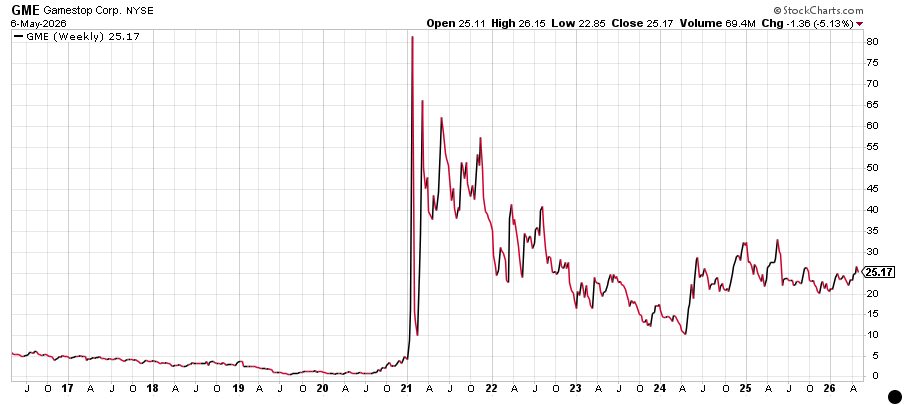
But then, some magic happened. GameStop became a ‘meme stock.’ Buyers bought it to gamble...betting that they could drive the price high enough to punish the short-sellers, forcing them to buy too, to cover their positions. And they did.
Among the basement-dwelling traders are plenty of dreamers, schemers, and young people who would like to poke Wall Street in the eye. They bought the stock. It went up. They thought they were geniuses…at least until the stock went down again.
In January, 2021, they ran the price of the shares up to $81...giving the company a fantastic P/E ratio over 700. Warren Buffett describes the stock market as a ‘voting machine’ in the short run…but a ‘weighing machine’ in the long run. Low-information voters were electing a dumbhead.
It was then that a lightbulb must have lit up at a board meeting. The managers realized that they could make a lot of money from the dumbheads – but not by selling them video games. They had a marginal product, but they had a stock for which there was reckless demand.
We turn to our trusty sidekick, Claude, for what happened next:
GameStop’s huge cash pile mostly came from a single, well-timed move during the 2021 meme stock saga.
When Reddit’s r/WallStreetBets traders triggered a massive short squeeze in January 2021, GameStop’s stock price exploded from around $4 (split-adjusted) to over $80 in a matter of weeks. The company’s leadership — soon to be reshaped around activist investor Ryan Cohen — seized the moment by selling new shares directly into that frenzy. They did two big at-the-market equity offerings in 2021, raising roughly $1.7 billion combined, which wiped out their debt and left them with a serious cash cushion.
Then in 2024, with another meme-driven rally fueled partly by the return of “Roaring Kitty” (Keith Gill), GameStop ran the same playbook again. They issued tens of millions of new shares into the rally and pulled in another roughly $3 billion in cash.
So by 2024–2025, GameStop was sitting on something like $4.6 billion in cash and equivalents — far more than the actual retail business generates. Most of that money came from selling stock to enthusiastic retail buyers during the meme rallies, not from selling video games. More recently, the company has started deploying some of that cash into things like Bitcoin and Treasury bills, essentially operating partly as an investment vehicle on top of its shrinking brick-and-mortar business.
The CEO is ‘thinking about’ adding hundreds of billions to the company’s value.
Are you feeling lucky?
Regards,
Bill Bonner

Well Bill and Tom, I for one do not feel lucky! Yes AU & AG have been good over the past 1.5 years but this too can change. XOP & XOM are nice big players to ride the oil and gas movements plus CASH and T-Bills round out the core mental health mindset for me. I WILL NOT repeat the mistakes I made in Q3, 2008. I sleep well at night.
Jim Marshall
Bill, really, really insightful missive, I mean stating the obvious without the benefit of the legacy media! The only thing missing is why Trump allow the foam to form?