

Wednesday, March 25th, 2026
Bill Bonner, from Youghal, Ireland
Today, we add to that famous reflection of yesteryear: Where are all the customers’ yachts?
In brief, the yachts belong to Wall Street. Ordinary investors get plastic dinghies. People do not normally get rich by buying investments; they get rich selling them.
We saw last week that gold’s relationship to houses and pick-up trucks has gone a little bazooey. Ideally, gold — a real economy thing — stays more or less even with other real economy things. As the real economy produces more real stuff, so does the gold mining industry. That’s why prices — in gold or gold-backed currencies — tend to remain stable.
But today, you get a lot more for your gold than you used to. For the same amount of gold that would have bought one house or one F-150 in 1999, today, you can get ten of them.
Speculators have pushed up the price of gold. Occasionally, the gamblers get carried away.
But wait. There’s more to this story. Much more.
Why bother with gold at all?
If the real money is made in stocks, as we believe it is, why not just hold them all the time? Many people believe you can’t do better than to get ‘into the market’ and stay in. It’s a refrain you hear from Wall Street. It makes ordinary people think they too can be capitalists and benefit from the fabulous wealth-creating power of America’s publicly traded industries.
But there’s one little detail that is often left out: if you invest ‘in the market’ you will most likely lose money, not make it. That is not just our own cynical instinct...it’s the finding of researchers who looked at what really happened in the stock market over the last 100 years. One Hundred Years in the US stock Market by Hendrik Bessembinder:
This study summarizes investment outcomes for 29,754 common stocks listed in the public U.S. stock markets over the 100-year period from 1926 to 2025, reporting on both compound (buy-and-hold) percentage returns and shareholder wealth enhancement measured in dollars. While the cross-stock mean buy-and-hold return is over 30,000%, the median is -6.9%. Shareholders’ wealth was enhanced by $91 trillion over the century, but long-term investors in nearly 60% of stocks incurred wealth reductions. The degree to which wealth creation is concentrated in a few firms has increased sharply in recent years. Over the 1926 to 2016 period studied in Bessembinder (2018), 89 firms accounted for half of the $43 trillion in net wealth creation. After including outcomes for the most recent nine years, just 46 firms account for half of the $91 trillion in net wealth creation over the full century.
The Dow was created at the end of the 19th century. By 1900, it was trading around 70. If you’d put in $1,000 then, and didn’t pay taxes on your gains, today, in theory, you’d have $657,000, not counting dividends.
Pretty good.
Gold didn’t do as well. From $20 an ounce to $5,000 an ounce is a jump of only 250 times, so you’d only have $250,000 if you left your money in gold.
There’s a time for everything. And the time to get into stocks is when prices are low, not when they are high. This is not exactly advanced geophysics, but when they are at epic lows there is more upside than when they are at epic highs.
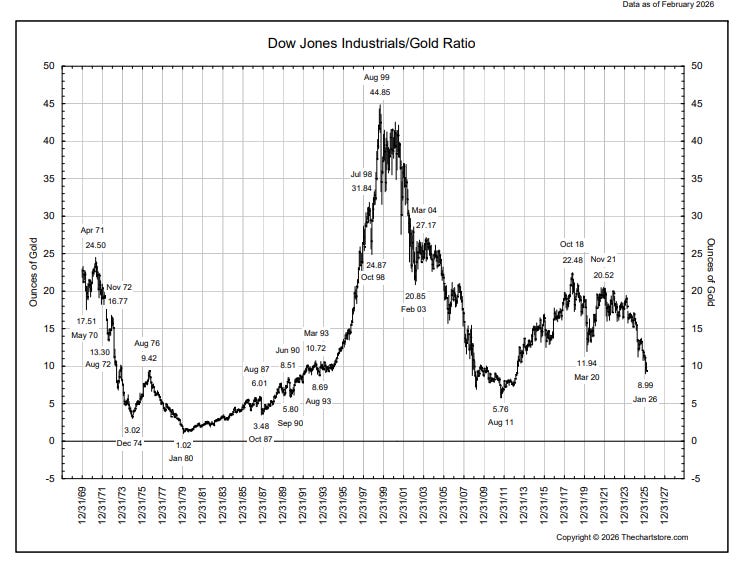
And included in the long upward march of stock prices are decades when stock prices go down. Or nowhere. Adjusted for inflation, stock prices went down for the entire decade of the ‘70s. And adjusted to gold, they’ve been going down for the last 26 years.
How you do in ‘the stock market’ depends on where you start and where you stop. Looking back from 1982, it looked like stocks ‘always go down.’ Looking back from today, with prices near all-time highs, it looks as though they were always going up. Sometimes prices go up. Sometimes they go down. Mostly, they go nowhere. The Dow, today, is worth roughly as much — in gold — as it was 100 years ago. Over an entire century, Dow holders made no real capital gains (leaving out reinvested dividends).
But it gets worse.
There are a lot more stocks on offer than those in the Dow. The index merely includes the best of them. You don’t know which will be best...until their prices rise to confirm it.
Starting out...you take a ‘random’ sample. In the auto business, for example, there were hundreds of start-ups. But only a handful of them succeeded...and eventually were included in the Dow. Most failed and were forgotten. As a retail investor, the odds are against you; you’re not likely to find one of the very few real moneymakers.
So how did the typical investor actually do? Paul McCaffrey:
‘I think it’s safe to say that the median investor who randomly picked a few stocks and held them likely lost money over the last 100 years.’
You might be thinking...‘well, I’ll just avoid the ‘random’ stock selections. I’ll just stick with the best of them, in a Dow ETF.’ But as soon as the ETF showed out-performance, other investors would buy it too. And then, it would soon be over-priced and unable to make future gains.
And now, let’s recall what we were thinking when we began this reflection.
First, as we’ve seen, you can’t expect to make money simply by being ‘in the market’ even for long periods of time.
Second, most stocks don’t make you money. According to the research above the majority of shares are losers. And just 46 firms accounted for half of the stock market’s entire gain.
Third, since the odds that you’ll stumble onto the super-performers are low, you have to hope ‘the market’ as a whole rises...so your stocks will rise with it.
Fourth, individual stocks do what they do. But the ‘stock market’ tends to go up and down in long sweeps, from very cheap to very expensive, and back again.
The function of gold is not to make you money, but simply to hold your place relative to other goods and services until such time as stocks are cheap and likely to rise.
The theory seems solid. Back-testing seems to confirm it. And we’ve been following it in real time for the last thirty years....with favorable results so far.
Will it work in the future?
That’s what we’re going to find out.
Regards,
Bill Bonner
Time marches on and nearly every things change. It has always been that way. In physics there is a term entropy " It represents the natural tendency of systems to move from ordered to disordered states" and the term, a case could be made applies to the stock markets. John Prine had a lyric that could apply to markets as well - "Did you every notice when your feeling really good, there is always a pigeon who will shit on your hood.
In my case when I got started in investing was when IRA's had just come out. It seemed it was going to be easy you find someone who tells you they know what they are doing, and since you don't you buy the Kool-Aid. It took me 3 years to find out paying 8.5% to IDS as a management commission to consistently lose me money. The 4th year I woke up. At my meeting that year I was advised stick in it for the long haul, I replied I was going to do better for sure the next year by myself. The response was how are you going to do that? I stated I simply was going to quit paying someone to lose my money and I would for sure be 8.5% ahead. I was in my 20's then and I am 68 now and along the way age has something to do with wisdom. Never to old to learn something new.
No one will watch your money like you will. The fix was I needed to get smarter and learned something & I joined AAII the American Association of Individual Investors, I read Peter Lynch the famous fidelity manager, I read John Bogle the head of Vanguard, and by continuing to read and educate my self on what was happening one got a bit of an education. Further down the road I heard about George Soros, Warren Buffet, Ray Dalio, John Templeton, Carl Icahn and eventually this fellow Bill Bonner and his team including Tom Dyson. I like Tom he is bright, interesting, he is straight forward on what he doesn't know and if in a quandary he admits it.
I don't believe there is one simple answer but when you look at what works for others you can start to develop a plan and my thoughts are you will be able to start to filter out the noise. Don't put all of your eggs in a single basket. Just about every bodies theory works sometime and most likely know ones works all of the time.
Lastly my advice to anyone reading is quite simply ask questions and "If your in a room and your the brightest one in the room you need to realize that your in the wrong room."
I have worked for myself most of my life in industry in a finishing plant that does metal plating. There is no school or university you can go to to learn the trade therefore 80% + of most facilities are family run. What I have learned over all of the years is don't be afraid to try something new and also never waste a mistake. Mistakes educate you & point out what doesn't work and guide you to try something else that perhaps will!
I will make a case for many here by reading the American Association of individual investors it is a great place to meet like minded folks who are all trying to put together what we are trying to do here. You can run ideas by one another and often learn something in the process. They may challenge your thoughts and you may come away a bit smarter and or avoid making a mistake someone already has. Looking at other perspectives has should help you understand yours better and may even change your mind!
Hmmm.......does it always go on as it was before? At one point America was the engine for the World. It isn't any more. But, then, the U.S. was the safe haven for the World. Stock market, currency, and land were always safe havens even if your stock picks went south. But today, the world it is a-changin' as Bobby Dylan lamented. The U.S. isn't the safe haven and most country are beginning to see that. The Empire is no more and even our neighbors to the north and south are finding the U.S. unfriendly. Where does this lead as the US$ does not have the hegemony anymore? And, our government seems to focus more on international concerns and less on the U.S. economy and jobs here in the U.S. As ol' Bill said - "That’s what we’re going to find out."