Friday, August 7th, 2026
Laramie, Wyoming
By Dan Denning
Here we are, eighty-one years later, sandwiched between the anniversary of the atomic bombs dropped on Hiroshima (August 6th, 1945) and three days later on Nagasaki (August 9th 1945). Japan announced its public surrender six days after the second bomb. The official surrender took place on September 2nd, 1945, on the deck of the USS Missouri, anchored in Tokyo Bay.
What if Japan hadn’t surrendered?
The soonest the US could have dropped a ‘third shot’ on Japan was ten days from August 9th. The ‘demon core’ of the third plutonium implosion bomb was scheduled to be deployed to Tinian Island where the bomb would be assembled. US President Harry Truman halted the deployment (the 1989 Hollywood movie Fat Man and Little Boy features actor John Cusack playing a fictionalized version of Los Alamos scientist Louis Slotin, who was killed by a massive dose of radiation in testing the criticality threshold of ‘the demon core’...this process…which killed another scientist on the project, was called ‘tickling the dragon’s tail.’)
Declassified official records show that the US could have manufactured about three atom bombs a month in 1945. It’s commonly believed that Los Alamos, New Mexico was the only location in the Manhattan Project. It wasn’t. The Met Lab Chicago, headed by Enrico Fermi, crated the world’s first self-sustaining nuclear chain reaction. And the facilities for enriching uranium into fissile material were in Oak Ridge in Tennessee and the Hanford Lab in eastern Washington.
There was a real shortage of both raw ore and enriched uranium that constrained US bomb production. I’m mentioning this in the context of current events in Iran and the US, but also in while keeping in mind our BPR theory of Megapolitics. The evolving theory holds that States who can drive down the cost of violence down fastest and the most (as a function of technology and efficiency) become the most powerful.
But Empire is not so simple these days. The cost of violence (or having a credible threat of overwhelming force) is a function of policy, technology, geology, and geography. The US has great technology. And it currently has a national security/industrial policy designed to accelerate the processing of critical metals and materials crucial to the Warfare State. But that may not be enough in the current circumstances. Why?
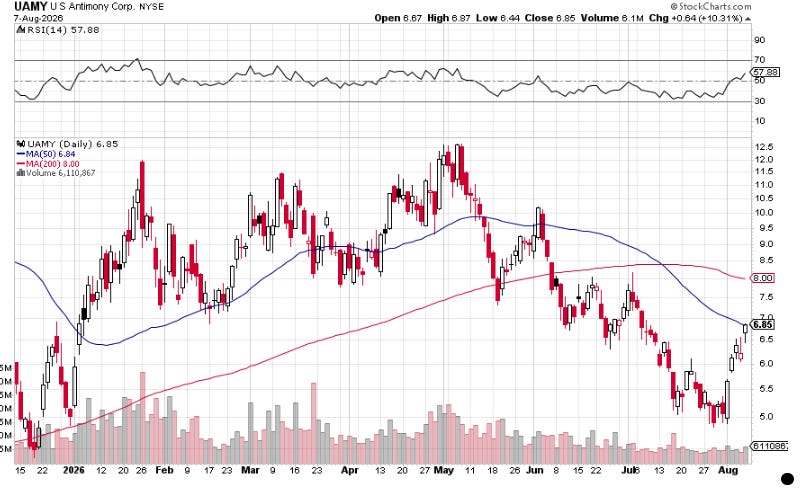
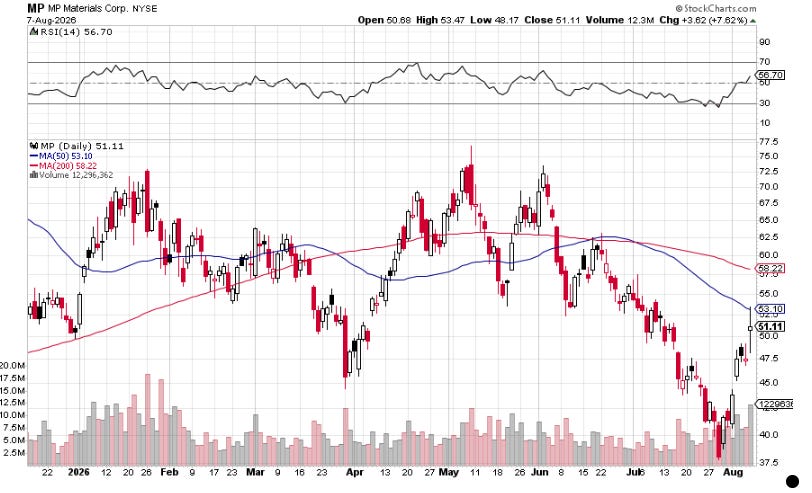
A neodymium-iron-boron magnet is the kind used in fighter jet motors and for guidance systems on missiles. Economy-wide (including the US military) the United States consumes about 48,000 metric tons worth of these type of magnets a year. It produces around 300 tons. The difference has to be made up through imports.
The trouble with rare earths and critical minerals isn’t that they’re rare. It’s that you can’t ramp up the ore processing and refinement overnight to produce ‘just in time’ metal inventories. Even if you have favorable geology and geography, which America does, a real constraint on the cost of violence emerges. If you can’t make and deploy the weapons of war, your ability to wield violence is diminished. Power shifts. You are less powerful and maybe even backed into a corner of your own making. Back to that in a moment. First a quick chart.
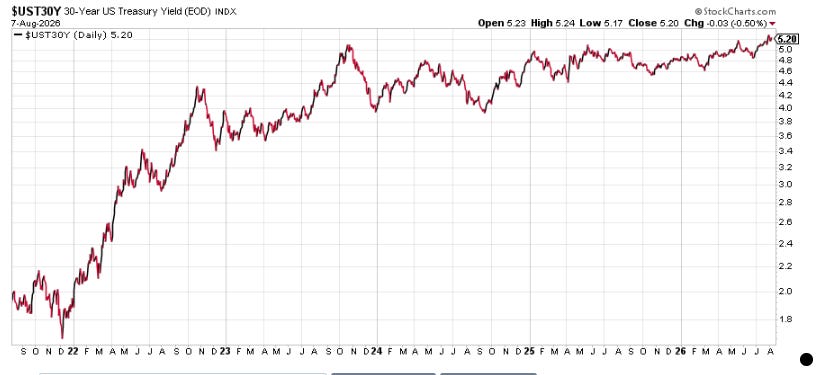
All week, especially after Tom’s note on Wednesday, I’ve been wondering why the US government intervened in the FX market to strengthen the Yen by selling Euros. It was unusual, for one country to so actively try and help another country strengthen a weakening currency.
What risk were US policymakers trying to mitigate: stocks crashing with the un-wind of the Yen-carry trade, or US bond yields rising as the Japanese sell their Treasuries so they can buy dollars with Yen?
Which is it? Or is it both?
Quantifying the risk to a disorderly unwinding of the carry trade is hard. It’s hard to tell how much money has been borrowed in Japan and invested (with leverage) in US stocks. A falling yen forces the rather rapid unwinding of a leveraged position (a stock market crash).
BIS records about official bank borrowing put the low end of the figure at around $260 billion. The high-end, which is really just a guess, includes short positions in the FX market and is closer to $11 trillion. The middle figure, also mostly a guess, is between $700 billion and $1.2 trillion.
It’s a big position. If leveraged, it’s even bigger. But is it enough to take down US stocks? Or is the risk in the bond market? And what IS that risk?
Well, according to the latest TIC data, Japan is the single-largest owner of US Treasuries, with about $1.2 trillion as of May 2026. One way for Japan to ‘defend’ the yen is to sell those US bonds and then turn around and use the dollars from the sale to buy yen. Only that’s not what happened this week.
The US government intervened as described above. And Treasury Secretary Scott Bessent actively urged the Japanese to use a special Fed facility that allows them to use Treasuries for collateral against which they receive dollars (the official name is the Foreign and International Monetary Authorities Repo Facility).
It’s an awful lot of trouble to keep the fiat money shell game going. Japanese selling of US Treasuries would force US interest rates higher. The Fed would have to either ‘monetize’ new debt issued by the Treasury. Or the US government would face much higher interest costs on borrowed money.
In case you haven’t noticed, the US government can’t afford higher interest costs. Uncle Sam spent $857 billion on interest payments in the first nine months of the government’s fiscal year. It’s on pace to be well over a trillion dollars by the time the fiscal year ends in September. Hence the shenanigans we saw in the last ten days to ensure an orderly Treasury market and avoid a crashing stock market.
To return to the original question, which is the bigger risk: a disorderly unwinding of the carry trade resulting in much lower US stock prices…OR…a spike in US bond yields as Japan sells Treasuries, which would also, all things being equal, lead to lower stock prices?
It reminds me of an old Saturday Night Live skit from 1976 featuring Dan Akroyd (husband), Gilda Radner (wife), and Chevy Chase (product spokesman). It was about a household product called ‘New Shimmer.’ The wife says the product is floor wax. The husband says it’s a dessert topping. The spokesman says don’t worry.
It’s both!
The world’s financial markets run on borrowed money on leverage. The yen carry trade is a huge pipeline of credit supporting US asset prices. To prevent a crash in those prices (asset deflation) be prepared for the Fed to try anything. But don’t be complacent about the risks of a sudden re-pricing of stocks and bonds. And for goodness sake, don’t eat the floorwax.