Sunday, August 16th, 2026
Laramie, Wyoming
By Dan Denning
‘No, I didn’t say I would have punched Richard Nixon in the face.’
‘I said if I’d known then what I know now, I might have said something at the time.’
‘Said what, though?’
I’ll come back to this conversation shortly. But it will only make sense to you if you understand what happened 55 years ago this weekend.
Historians call it ‘The Nixon Shock.’ But it was more like the first of three funerals and a death. The worst part is, what began happening to the value of your savings then from the White House…may be happening again.
Are you ready for it?
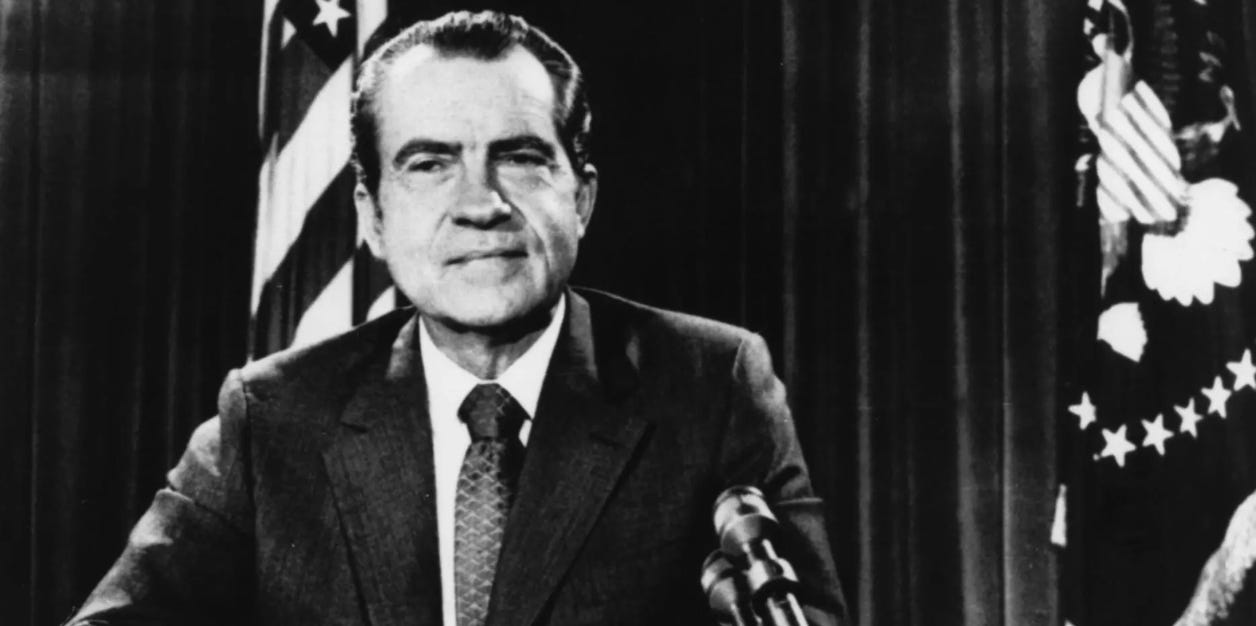
Sunday, August 15th, 1971. It’s 9pm Eastern Standard time. Live from the Oval Office, President Richard Nixon pre-empts NBC’s Bonanza with a televised address to the nation. He announces three measures to take effect immediately.
First, a 10% ‘surcharge’ on imports to the US. There were some exceptions. But the official inflation figure in the US was 5.84% a year (it’s 3.4% today according to the July numbers from the BLS). Second, a 90-day ‘freeze’ on wages and prices. This was a ‘time out’ meant to halt inflation in its tracks.
The ‘shock’ was the third thing. Nixon immediately suspended the convertibility of US dollars into gold. It was targeted toward the British andthe French. Both countries had been redeeming dollars for gold at a faster rate. They’d watched the growth of US debt and deficits from the war in Vietnam and an expanding federal government.
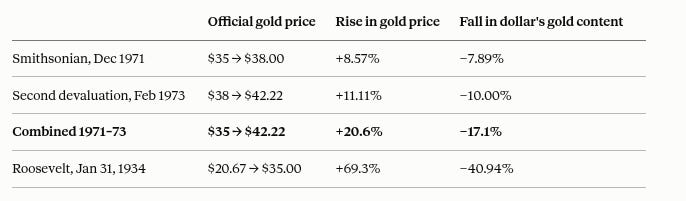
The ‘shock’ was meant to be temporary (a shock that continues is more like an electrocution). But as history sees it now, it was the first of three ‘deaths’ for the US dollar. The second death came with the Smithsonian Agreement in December of the same year. It re-set the statutory price of gold from $35 to $38. It was intended to stabilize the value of the dollar. It lasted fourteen months.
In February 1973 the dollar was devalued again, from $38/oz to $42.22/oz. That’s where it sits today. And if you think it sounds weird the President or the Secretary of the Treasury can arbitrarily ‘set’ the price of an ounce of gold, it IS weird. These days it is largely for accounting purposes, to establish a value for the gold owned by the Treasury and stored (we hope) at places like Fort Knox and West Point.
By 1976, it was official. The US dollar was no longer backed, in any sense, by gold. No one could redeem US paper for real metal. The world had moved beyond the post-World War II Bretton Woods system to a system of free floating exchange rates, where currency values were determined by a combination of interest rates, GDP growth, and government deficits.
Government deficits (and the national debt) are obviously a MUCH bigger problem today (the government debt-to-GDP ratio was 35% at the end of 1971…it’s 125% today). That makes another devaluation more likely. Perhaps soon. Remember, every devaluation of the dollar is a kind of default. It’s a betrayal of the Federal Reserve’s responsibility to keep prices stable. Everyone knows this. But no one says it out loud. What do I mean?
In 2012, Ben Bernanke was Chairman of the Federal Reserve. Without any real authority to do so, he declared the Fed would set a 2% inflation target for the US economy. It was threadbare, but the argument was that the US economy needed about that much growth in the money supply to continue expanding at a stable rate each year.
But when inflation is 2% a year, the value of your dollar halves every 35 years. It’s compound interest in reverse, only you’re losing more value each year. It happens slow enough that most people don’t notice it. But over time, the value of your savings and retirement is eroded. This is by design.
Nixon set all this in motion 55 years ago. But it’s still playing out today. The dollar is no longer linked to gold in any way. Inflation, the policy the Fed itself embraced in 2012, is also a kind of default on the government’s obligation to keep the value of money stable.
It’s little more than organized theft. A wealth transfer from savers to debtors. Did you know the official rate of inflation has been above the Fed’s target for 65 months in a row (going all the way back to 2019). And then there’s this…
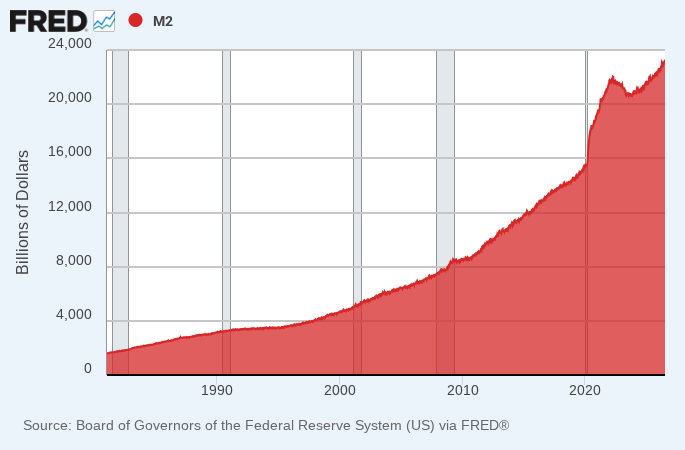
Money supply drives inflation. Between 2019 and 2022, the broadest measure of US money supply expanded by 40%. This was a permanent shift higher in the price level for Americans. Food. Fuel. Houses. Insurance. Drugs. All of it.
The annual rate of change is what the news and economists focus on. That’s bad enough when it’s above 2%. But Americans don’t pay the bills based on ‘rates of change.’ It’s the absolute price level that matters.
This huge shift higher in the money supply in 2020 was a kind of default of the dollar, a permanent reduction in the value of your savings and the purchasing power of your wages. And if we’re right, it’s going to happen again.
People ask me all the time why BPR spills so much ink writing about things that happened over 50 years ago. Aren’t there better things to write about? There’s nothing we can do about it anyway, right? Shouldn’t we be focusing on ways to make money faster than inflation steals it away? AI? Bitcoin? Something else? Anything else?
If you’re new to our story, you may not realize is that the devaluation of the dollar is an ongoing affair. It’s happening everyday, as we speak. For example, last Thursday the US Treasury auctioned off $25 billion worth of 30-year bonds for a yield of 5.21%. That was the highest yield offered on a 30-year since 2001—twenty five years ago.
So what?
Ask yourself: would YOU want to loan the US government money for thirty years right now? In my research note to subscribers on Friday, I showed how each 1% increase in interest rates makes the coming US deficit crisis worse. The government has to pay more to borrow. With $39 trillion in debt to begin with, the ‘day of reckoning’ in which this giant pile of debt triggers another dollar devaluation gets closer.
How and when that happens is beyond the scope of my note today. But what to do about it? We’ve got that covered.
BPR Investment Director Tom Dyson and I write every week to our readers; Tom in his Investment Note to subscribers on Wednesdays and me in my Research Note on Fridays. Our goal is to help you understand it and prepare for it with the right investment decisions.
The research we publish each week to subscribers is an attempt to preserve the value of your savings in what comes ahead…Maximum Safety Mode, we call it, but with a small, targeted allocation to specific types of stocks Tom tracks each week on his Official List of BPR recommendations…there are currently 13 open positions on the Official List…10 of them are in the black with an average gain of 46.96%...and 11 are rated ‘buy’ with one ‘hold’).
If you’re not a paying subscriber to our financial research yet, you can join today and save $100 of the annual price of $395 per year. This offer is good for the next 48 hours only. Why?
Bill, Tom, and I prefer to spend all our time improving the quality of the research we provide to our paying subscribers. A couple of times a year we remind free readers like you that it’s not too late to join up. But how serious you are about your money and your family’s future is entirely up to you.
Of course BPR’s founder, Bill Bonner, has been on this case for decades. Better than anybody, Bill understands that a system in which the debtor controls the value of the money is bound to be inflationary when the debtor is the United States government, the world’s largest. He’ll continue his work every day, at no charge to you no matter what you decide today.
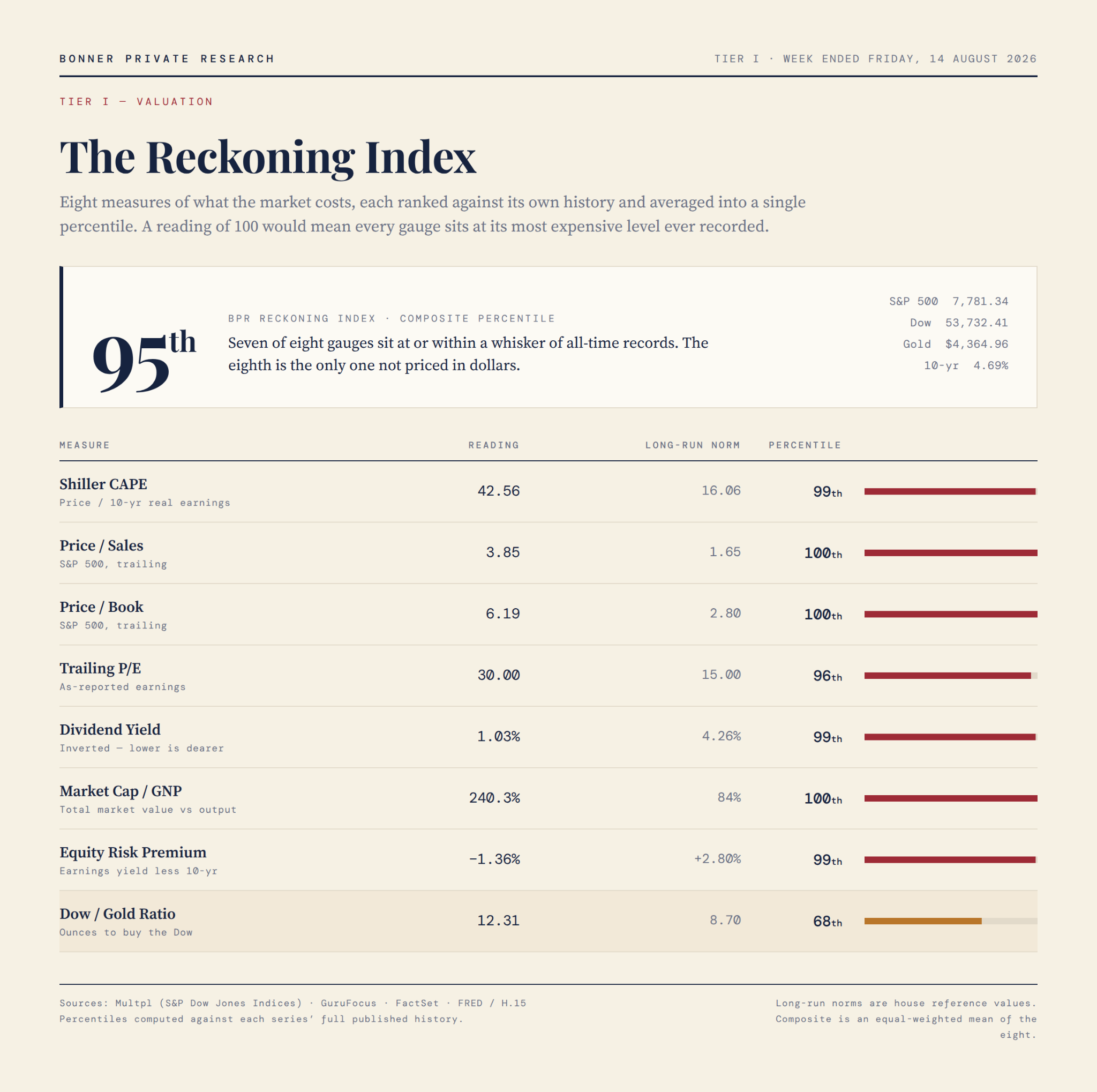
If you’ve thought at all about arming yourself with the best analysis and research you can for the years ahead, now is the time to do something about it. The S&P 500 closed just off its all-time high on Friday. The Dow and the Nasdaq are also near all time highs.
Historic stock market valuations make today’s market look as dangerous as the market in 2000…and even in 1929. To some people, that doesn’t mean anything. The past is the past. But to us, the past is prologue, a kind of preview of what comes next.
A ‘Big Loss’ of 50% to 80% in the stock market is unacceptable. It’s what we’re positioned for right now. And if we’re right about the debt and the Fed and the politicians in Washington, what comes next is yet another betrayal of American savers and voters.
Do something about it while you still can.
Regards,
Dan Denning
Research Director, Bonner Private Research
P.S. ‘You’re making a big mistake. You’re betraying the American people and enabling a massive expansion of the Federal government. History will judge you as a villain.’
That’s what I would have said to Nixon. At least that’s what I told my friend decades later. I’d told him the story of when I met Nixon at the New Jersey Avenue corner of the Cannon House Office Building. I was a 16-year old Congressional Page. Our bosses told us to wait at that spot, without telling us who we were meeting.
We went. About 15 minutes later, with a discrete Secret Service detail, Nixon came in through the brass-framed revolving doors. He was old and stooped by then. But he made his way down the line, shaking each of our hands and smiling.
He told us how he and Jack Kennedy were Freshman members of Congress together in 1947, both recently out of the US Navy. Nixon was in ‘the attic’ on the fifth floor of the Old House Office Building (it wasn’t the Cannon Building then). Kennedy was on the third floor. Both would go on to become President, and famous (or infamous) for different reasons.
P.P.S. About once a month we update the short list of metrics we monitor internally about the valuations in the stock market (we call it The Reckoning Index). This tells us how today’s market compares to previous markets and gives a sense of where we’re at in the cycle.
It doesn’t tell us WHEN a crash might happen. For that we’ve developed another set of ‘pre crash indicators’ based on credit, liquidity, and market breadth. The valuation metrics we usually provide only to paying free readers are below. If you didn’t believe me that it’s like 2000 all over (or 1929), please review it carefully.