

Friday, September 18th, 2026
Laramie, Wyoming
By Dan Denning, Research Director
About seven weeks. That’s when we’ll know who controls the next Congress. And we’ll know if the IRGC has been trying to wait out the Trump Administration, keep the Strait of Hormuz closed, and end the war on favorable terms. Seven weeks.
Markets don’t have to stay idle until then. They won’t. They never do. In fact, today I’m going to look at a convergence of factors that suggest what five year total returns might be from today. But first, it’s worth thinking ahead to what might happen…when things change. Or if they’ll stay more or less the same (in terms of the fiscal trajectory of the US government).
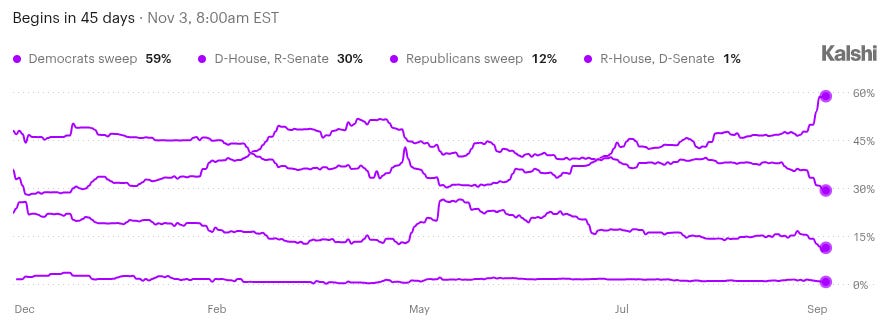
The prediction markets have a 60% chance that the Democrats take back both the House and Senate (see chart above). If so, you’ll get impeachment and hearings galore. But probably no spending cuts. A divided government is more of the same from a budget point of view. And after all, Republicans have had control of Congress and the Presidency for two years and all we have is bigger deficits and a $40 trillion debt. What’s your prediction?
Warren Buffet is stepping down as the Chairman of Berkshire Hathaway [BRKB]. The 96-year old from Omaha has already given up on making the investment decisions for the company. He’ll stay on the Board for now.
The company has about $363 billion in cash on the balance sheet. That’s down from the peak of $397 billion earlier in the year. And remember, only $41 billion of that is actual cash. Around 89%--or about $325 billion–is in T-Bills that generate around $12 billion in interest income for the firm each year.
It’s the same dilemma Investment Director Tom Dyson faces. Cash is an investment position–essentially short stocks. It also gives you ‘optionality.’ You can spend it when you see something you want at a good price. But you have to live with inflation–which is almost certainly higher than official figures suggest.
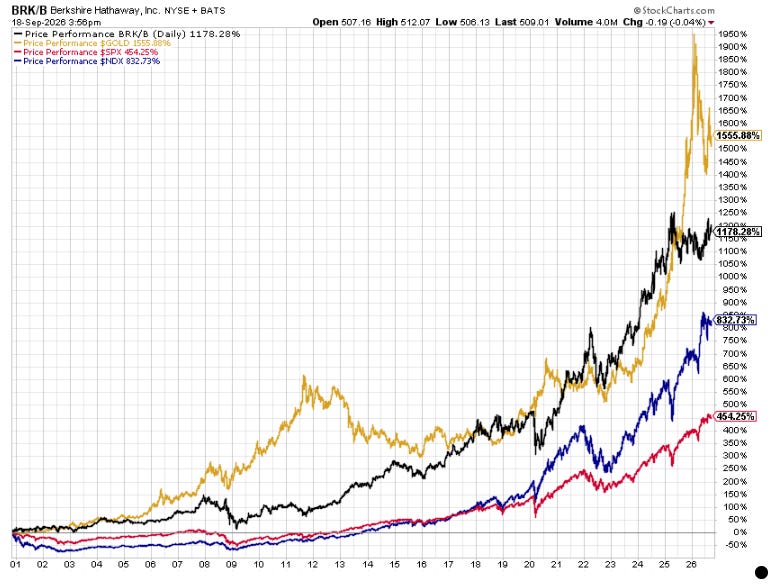
Buffett is probably glad it’s not his problem anymore. Looking back since the turn of the century, Berkshire’s B shares have outperformed the S&P 500 and tech stocks (based on the Nasdaq 100). Even if you use the total return for the S&P 500 (with reinvested dividends over 26 years and not just the price performance), Berkshire still killed the index.
And gold still killed everything. Yet over the long-run, you’d rather own shares in for-profit enterprises that create wealth (the key is being able to buy them at a good price, which you definitely cannot do right now). Gold preserves our purchasing power until we can buy those enterprises at a better price. When will that be? For another perspective,hHave a look at the tables below.
