Wednesday, April 1st, 2026
Laramie, Wyoming
By Dan Denning
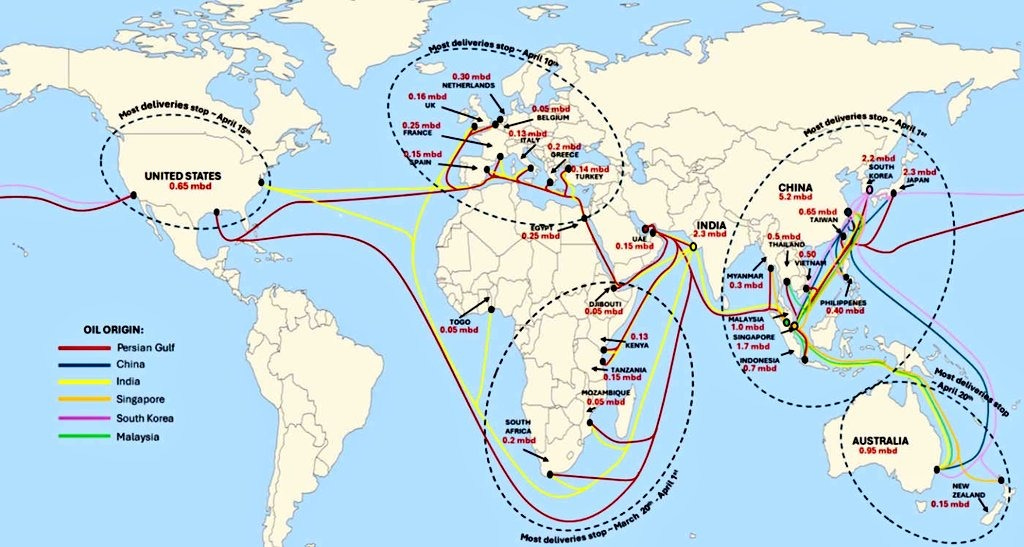
This could be the last ‘normal’ week for awhile. Why? The last ‘pre-crisis’ cargos of oil and refined fuels are arriving in Asia today, April 1st. It’s no joke.
In Europe, it will be in about 10 days, 15 for the US, and 20 for Australia. That’s according to map above from JP Morgan. This oil arrived on ships that were already in transit when hostilities broke out in Iran and the Strait of Hormuz was closed.
But if you’re at the end of the global supply chain for oil and gas, and you don’t have your own domestic refineries or oil and gas production, it’s no joking matter. The last (in distance) shall be first to experience the pain of a global oil supply crunch. That’s exactly what’s happening.
LPG is being rationed and factories are shutting down in India, Pakistan, and Bangladesh. The poorest will be hit hardest, and first.
Flights are cancelled and long lines at gas stations are forming in Laos and Thailand. Higher airfares and food prices (with shortages) are incoming.
Australia’s idiot government is preparing for fuel lockdowns in the coming month months (creepy authoritarian Covid vibes). Another emergency resulting in more laws and restrictions and less freedom.
The situation may dramatically change with President Trump’s speech tonight. Whether it changes for the better or the worse, with higher oil prices or lower prices, remains to be seen. He could announce ‘mission accomplished’ and that the war is over. Or, ‘boots on the ground’ and weeks more of uncertainty for energy markets.
Either way, the clock is ticking (believe it or not, an oil glut is actually possible in the coming months…but we’ll save that for a different research note). But what about the stok market?
CNBC tried to get Warren Buffett to come on air this week and calm investors down. Buffett, whose company Berkshire Hathaway is sitting on over $370 billion in cash, wasn’t having any of it. He’s seen it all and knows better. He’s not buying this market and says the poor first quarter ‘is nothing’ compared to previous stock markets during an energy shock where stocks fell by 50% or more.
How big this energy shock will be,and when the first waves begin to hit American shores? Not just financial markets but ports, trucking, agriculture, and supply chains? We don’t know yet. But we would not suggest waiting around to find out, at least not financially.
Investment Director Tom Dyson published our April Monthly Strategy Report a week ago. In it, he updated our asset allocation model with an important change. He also updated the new energy recommendations on the BPR Official List. Later today, Tom will publish his Weekly Update and answer some of the questions we’ve received from paying subscribers over the last six days (you don’t see this emails in your inbox because we send them only to paying subscribers).
You know what they say about the best time to plant a tree, right? It was twenty years ago. The next best time is today.
The same thing goes if you’re not receiving all our investment research at BPR. The best time to get Tom’s Tanker Trades, oil and gas trades, and our Trade of the Decade was a year ago (four years, in case of the Trade of the Decade, which is a simple oil and gas play). The next best time is today.
You can save over $100 when you subscribe to BPR today for one year. This price automatically renews each year for as long as you choose to remain a subscriber.
We spend 99% of our time at BPR trying to improve the quality of the research we provide to our paying readers. You will not see this offer again. And it will expire automatically on Easter Sunday. Bill will be back with more from Baltimore tomorrow.
Until then,
Dan Denning
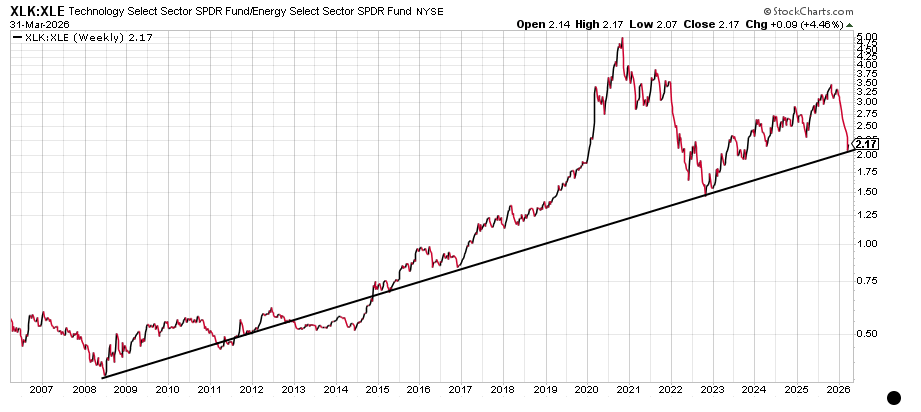
P.S. In my Friday note to paying subscribers I’ll be asking whether control of the Strait of Hormuz is really about whether China or the US will be the first to develop Artificial General Intelligence (AGI). You can’t have data centers and AIs (or AGI) without massive amounts of energy. The chart below tracks the relationship between the tech sector (XLK) and the energy sector (XLE). Stay tuned for more on this means and what to do about it now. To become a subscriber today (and save $100/year) go here.