

Friday, March 27th, 2026
Laramie, Wyoming
By Dan Denning
Let’s return to basic physics to explain why the world–and financial markets–are woefully unprepared for the interruption to global energy flows in the Middle East and the destruction/degradation of oil production and export infrastructure. It’s all physics. But with a weird twist.
Light is an electromagnetic wave that travels at 300 million meters per second. Sound is a mechanical pressure wave. It travels at 340 meters per second. You see a large explosion first (if you’re watching it from a safe distance and not the target of it). Then you hear it, and possibly feel it (the pressure wave). Here’s an example, based on the demolition of the second stage of a C-4 Trident rocket motor.
We see things happening on the TV over in Iran, Qatar, Baltic oil terminals that ship Russian oil, and Saudi Arabia. But their economic effects don’t travel with equal speed to all parts of the world. We should pay attention to these effects. They may be headed your way soon.
Australia, which has only two working oil refineries and imports most of its transportation and aviation fuel, has a new national dashboard showing which gas stations are running out of diesel and other fuels.
South Korea announced a five-day vehicle rotation system for public sector vehicles that determines who can drive each day.
The Philippines has declared a national fuel emergency, in which the government can control who gets fuel and when, as well as price controls (to prevent hoarding by consumers and price gouging by producers, they say).
In supply chain terms, the further you are away from your refined fuels, the more likely you are to feel the effects of the closure of the Stait of Hormuz first. It’s not happening yet in the United States or Europe. But even if shipping of crude oil and other products through the Strait of Hormuz were to resume today, there is a lag or delay in oil at sea that is going to show up in the real economy even as the oil itself does not show up for days, weeks, or months (depending on how long this goes on).
It’s not quite Mad Max. Not yet. But a bit later, I’ll show you what the global elites think we should all do to prepare. It’s all sounding very much like the early stages of the pandemic, when it was just ‘two weeks to stop the spread’ and we were ‘all in it together’ (we weren’t). The energy lockdowns are coming. But first, what about US financial markets? Take a look at the chart below.
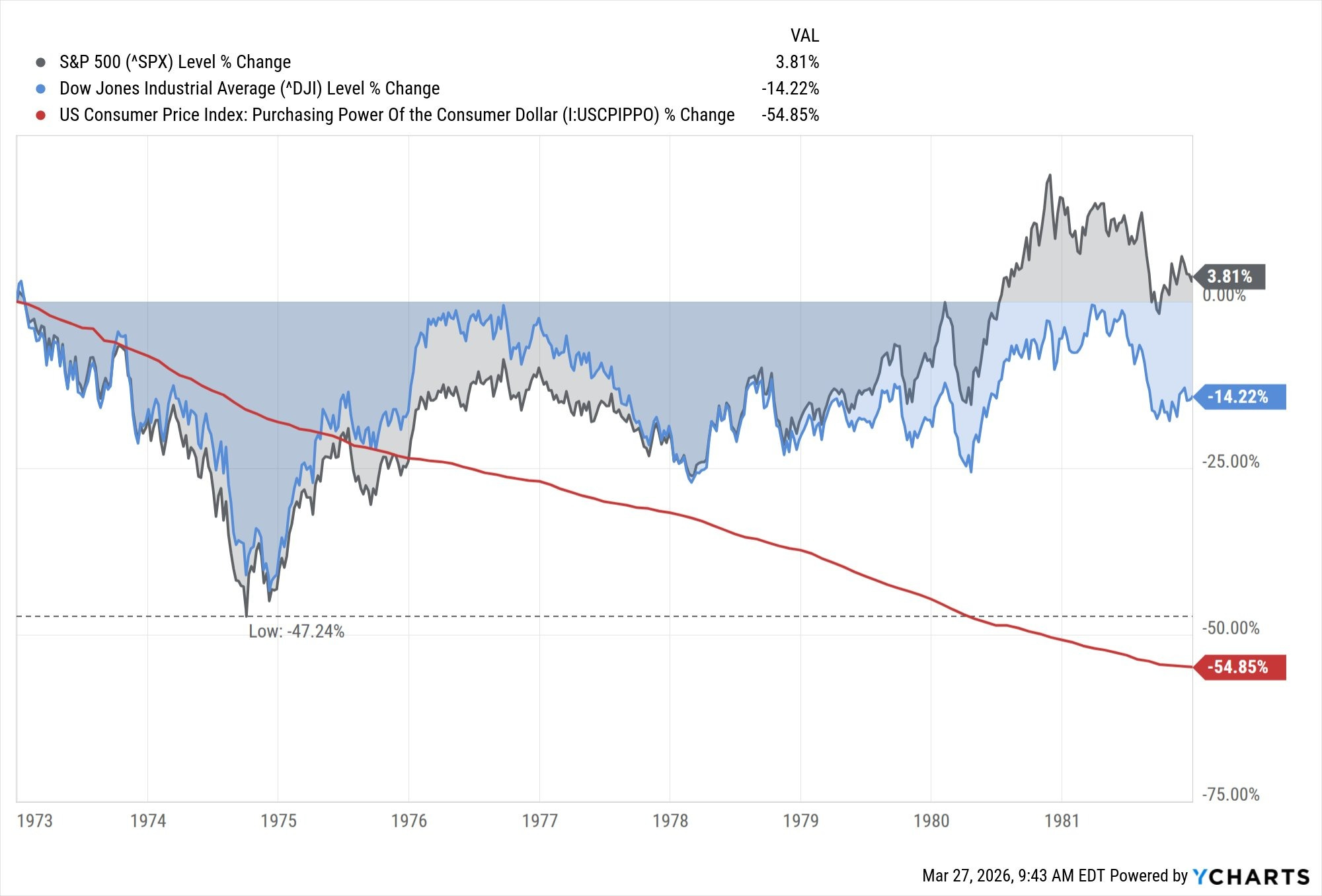
Inflation adjusted returns in the stock market are likely to be negative for seven to ten years after a mean-reverting crash in stock prices. We’ve said it so many times in the last few years that it probably goes in one ear and out the other. This week, I ran across a chart that shows it, which I’ve shared with you above. What does it show?
It shows the nominal performance, in percentage terms, for the Dow Industrials and the S&P 500 during the last oil shock, which lasted nine years, from roughly 1973 to 1982 (at which point stocks were a screaming buy). Not great results. The S&P was up 3.81% over the nine years. The Dow was down 14.22%. But…
But the inflation of the oil shock led to a 55% decline in purchasing power over the same nine years. Your inflation adjusted returns–your real returns after the decline in the value of your money–were much lower than the nominal returns. Even modest paper gains in stocks were cosmetic and couldn’t paper over the damage done to the value of your money.
By the way, in gold terms, stocks got clobbered over that nine years. Gold was up early during the energy shock (1973 and 1974) and up again late (1979). Adjusting for gold’s performance over the same nine years, the S&P 500 was down over 83% and the Dow was down 86%. And even if you include the nominal performance of the S&P 500 total returns index (which includes reinvested dividends), you still get a 74% decline in the S&P 500 over the nine years. Now look at this.
Let’s say that the war in Iran actually strengthens Iran’s control over the Strait of Hormuz. Or, in a worse case scenario, escalation in the coming weeks results in the massive destruction of energy infrastructure throughout the Gulf. The result would be soaring oil prices that would last years, not months. What happens to stocks then?
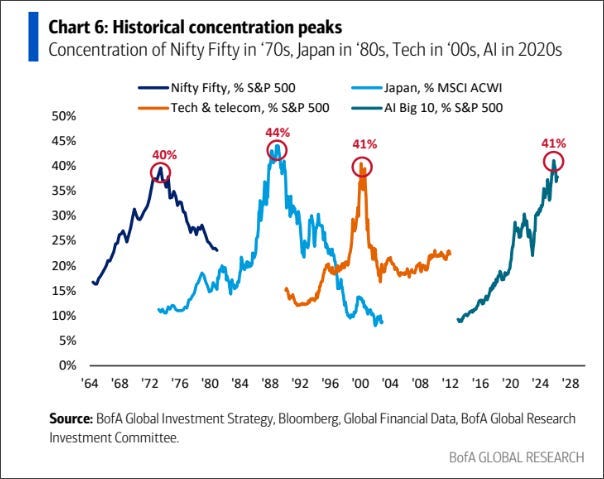
We’re already at a valuation peak (price-to-sales, CAPE, market cap-to-GDP). But we also have a cyclical concentration of investor money in the same sector of the market. It was the Nifty Fifty when the 1970s energy shock began. Japan in 1989 (before an 89% fall in the Nikkei). Then the TMT stocks of the dot.com boom. And now the AI ‘Big Ten) are 41% of the market—Apple, Amazon, Alphabet, Meta, Microsoft, Nvidia, Tesla, Broadcom, Oracle, and Palantir.
It’s going to be hard to run–much less build—AI data centers when the shockwaves of a global energy crisis are running through the metals and critical minerals supply chain (although this MAY accelerate the development and deployment of small modular nuclear reactors and next gen nuclear power). You wonder if the projected data center cap ex numbers are being revised as we speak, with the stock market re-valuation to follow.
In the meantime, there are still disturbing problems with private credit and all the nooks and crannies it flowed into during the last boom. This week, Swiss bank UBS ‘gated’ redemptions in a $470 million European real estate fund. If you want your money out, you may have to wait as many 36 months…and by then, it might be worth a lot less.
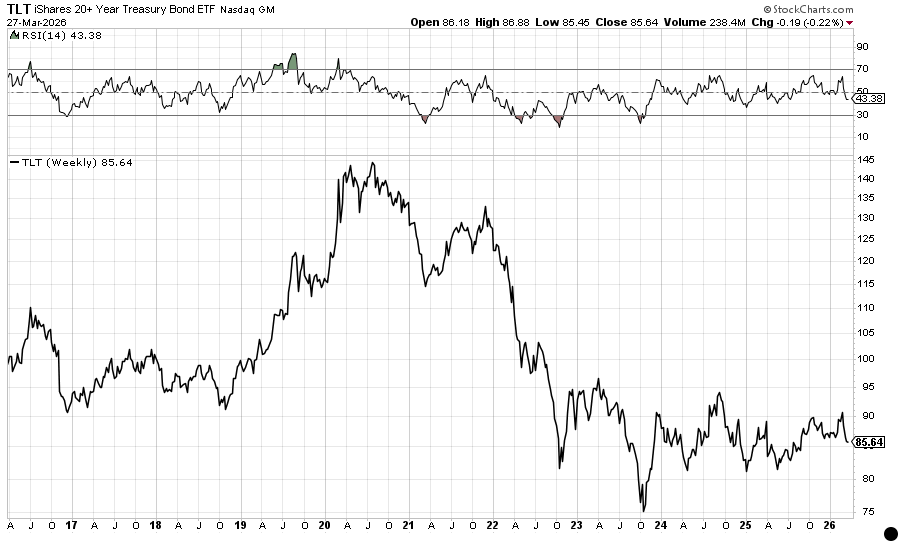
The government bond market is no place to hide either. Total global government debt is now 100% of global GDP. You could make a very good argument that the epicenter of the next debt crisis is in government bonds. The entire financial model of the modern Welfare/Warfare state may blow up.
What does that mean?
