

Friday, October 2nd, 2026
Laramie, Wyoming
By Dan Denning
Greetings from the High Plains!
The biggest and baddest financial disasters don’t fall from the sky. It’s not a geomagnetic excursion or crustal displacement or a coronal mass ejection that kills a bull market. It’s usually a ‘credit event’ that begins in a sector of the economy no one’s paying attention to, and then migrates its way, like an aggressive virus, to healthier, investment-grade companies and the rest of the economy. More on that below.
But first, if you missed Investment Director Tom Dyson’s October Report, you can find it here. Tom and I switched publishing days last week and are back to normal this week. But I did see a few questions on the message board about where to find his latest report.
Speaking of that, if you’re receiving Bill Bonner’s daily essays but have missed one of Tom’s reports or one of mine, check the ‘Promotions’ folder in your email provider. Also check the ‘Spam’ folder. Sometimes a risky or rogue subject line will get our emails tagged as ‘Spam’ by your email provider. You have to manually mark it as ‘Not Spam’ to ensure you see it in your regular inbox, where it belongs.
Now have a look at this wonderful chart.
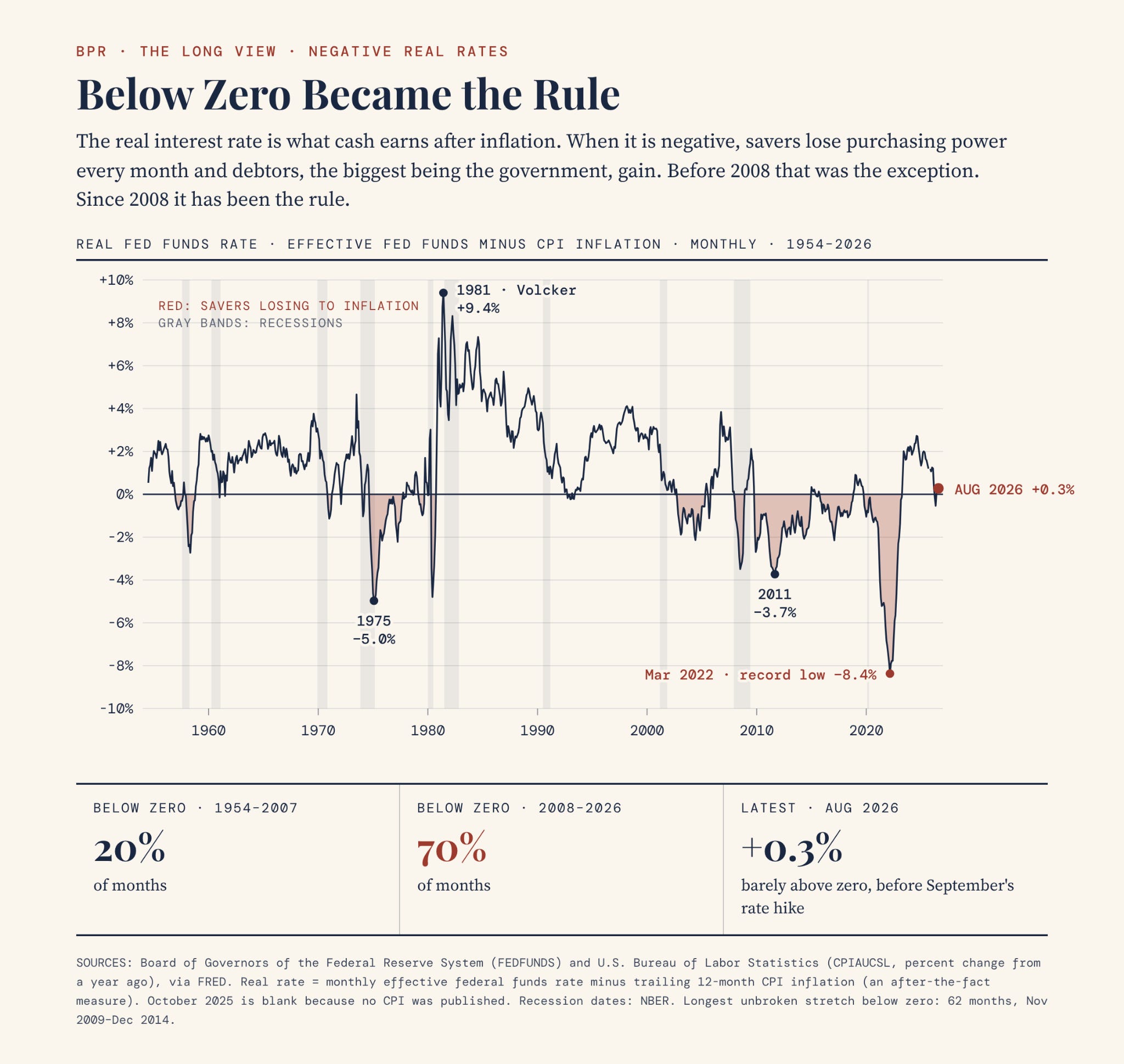
It’s back to the bad old days, in terms of negative real interest rates. No one wants to hear about interest rates on a Friday. I get that. But what we’re showing you here is the history of how the government manages to reduce the debt-to-GDP ratio without cutting spending or defaulting.
Spoiler alert: You’re going to pay for it in the reduced purchasing power of your savings. It’s called a stealth tax hike.
The chart I’ve created, based on data from the Federal Reserve, shows what ‘real’ interest rates are going back to the 1950s. It does that by subtracting the Effective Fed Funds Rate (the policy rate the Fed sets) from whatever the current official rate of Consumer Price inflation is (via the government’s CPI index). Interest rate minus inflation rate equals the ‘real’ rate. To the extent that CPI understates real inflation, real rates are probably already negative.
When inflation is higher than interest rates, savers lose value. In a negative real rate regime, it simply does not pay to be a saver or a creditor. You CAN earn interest above the rate of inflation. But you typically have to take a lot more risk, putting your capital at risk. Bad, or the creation of ‘moral hazzard’ as critics have called the consequences of the policy.
But according to one man in Washington D.C., who happens to be the current President of the United States, ‘certain levels of inflation’ could help reduce the national debt as a percentage of GDP ‘very rapidly.’ The Wall Street Journal reported today the President said as much in a contentious interview with Time magazine.
Never trust the media until you’ve seen the unedited video or read the transcript in its entirety. But President Trump is probably not wrong, even though he probably did not use the academic name for the tactic of reducing debt-to-GDP ratios by running the economy hot (high inflation) while holding official interest rates low. He knows how big debts are inflated away.
Long time readers and serious nerds will be familiar with the original research paper documenting exactly how it works with sovereign (government) debt. The paper was first published in 2015 and is called The Liquidation of Government Debt. If you enjoy suffering, you can read it yourself here. Or, you can have a look at the second chart I created today, below.
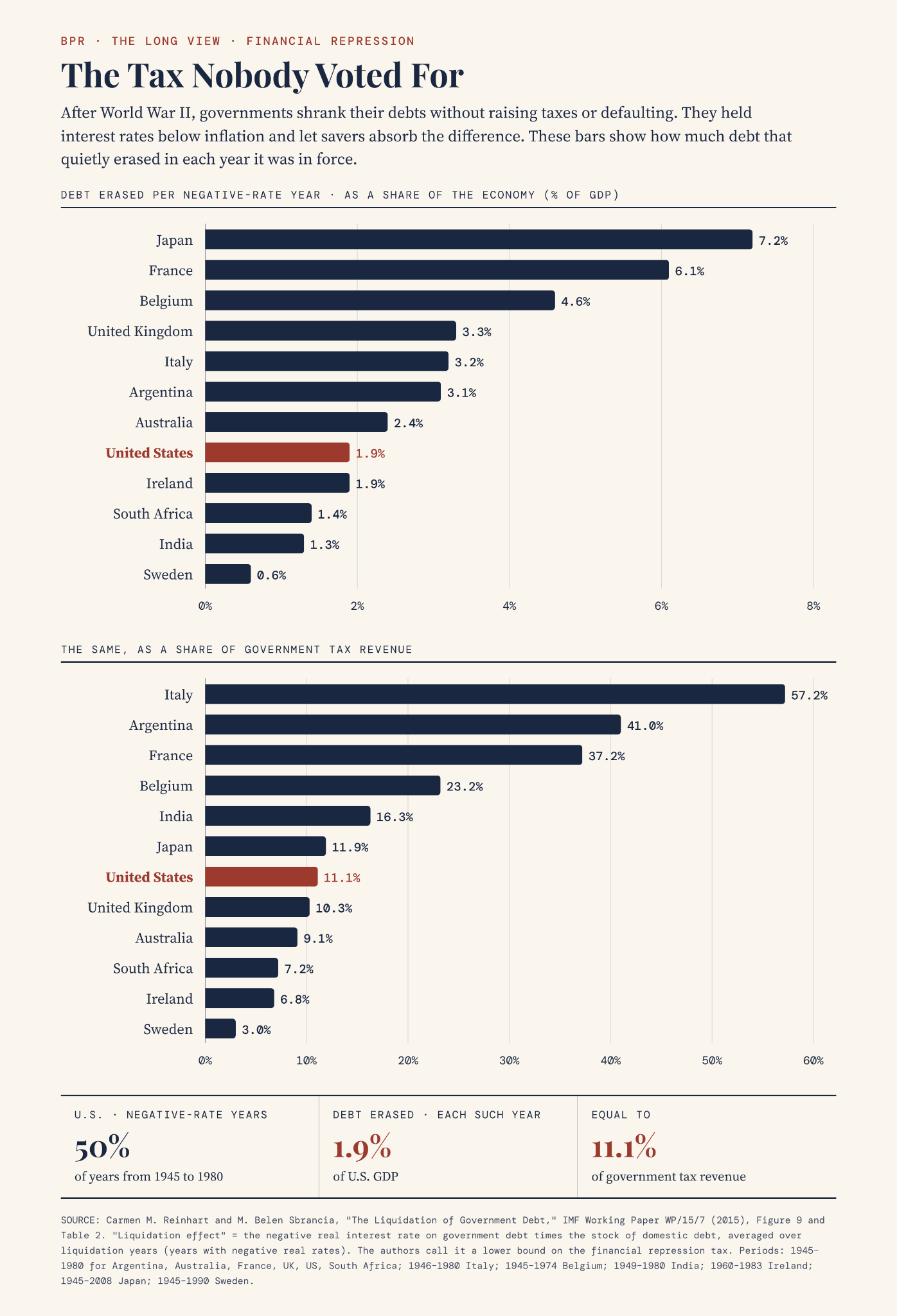
From 1945 to 1980, real interest rates were negative about half the time in the US. That translated into a yearly reduction of debt-to-GDP levels by about 3-4%. The gross federal debt-to-GDP ratio in the US was 120% in 1946. Through ‘financial repression’ (negative real rates) that ratio dropped to 60% by 1956. The economy ran very hot. By 1981, the ratio was just 31% (it’s 120% today…which only makes sense if you believe we are already fighting World War III).
Other countries ran inflation even hotter, mostly as a result of having to completely rebuild following the widespread destruction of their capital stock and economies in the war. So it turns out, in a roundabout way, you CAN grow your way out of a huge debt problem. But only if your country is physically destroyed in a war.
Of course the continental United States was NOT destroyed during the war. But the country did run massive deficits to become ‘the arsenal of democracy.’ High post-war growth rates were achieved by unleashing ‘pent up’ consumer demand domestically and exporting US capital and manufactured goods around the world to everyone who was rebuilding.
That seems unlikely to happen again. If anything, globalization seems to be turning into something more fractured, with higher energy prices, and with national industrial policies based on producing scare but economically critical resources.
All of which will make it much harder for anyone in Washington to disguise a simple fact; that negative real rates are a tax that gets passed on to ordinary people but which no one in the legislature actually has to pass or vote on. To achieve actual debt reduction equal to what financial repression accomplishes through inflation, the US government would have had to raise taxes by 11%.
No one would vote to pay down the debt by raising taxes. And no one wants to cut spending. The path of least democratic resistance is to run negative real rates. What does this mean for us in the years ahead?
Well, gold typically does well when real yields on government bonds are low. It means the ‘cost’ of holding gold (which has no yield) is minimal relative to the after-inflation return on bonds. And as we all know, gold has no counterparty credit risk. It’s a winner as a ‘reserve’ asset, which is why central banks continue to repatriate gold to their home-country vaults and buy even more of it.
You wouldn’t have guessed any of that today. Gold was down and stocks were up, allegedly because the jobs data out of DC was poor. In a world where bad news is good news, the bad jobs data makes a Fed rate hike later this month (negative for growth and tech stocks) less likely.
It’all hocus pocus anyway. The new con is the same as the old con. Don’t reduce spending or raise taxes. Boost nominal growth through de-regulation and lower energy prices (once these pesky wars are ended). And then reduce the ratio of government debt to GDP through ‘financial repression.’ Keep the Welfare/Warfare State from having an existential crisis that destroys its currency and its bonds.
We’ll see how that works out in the long run. But in the short run, staying in Maximum Safety Mode is the name of the game. And let’s remember, the Fed doesn’t control ALL of the bond market. It can try. But in the long run, markets are stronger than governments. Which brings me to a few curious images below and how to survive a world in which the State is both broke and extremely dangerous.
