

Wednesday, September 30th, 2026
Bill Bonner, from Ardmore, Ireland
The most important story we’re following this week is one we’ve been tracking since 2020. Back then, it was just a high-confidence hunch — that the 40-year Primary Trend of the credit market had bottomed out. If so, on the horizon was a long period of rising interest rates that would upend trillions in investment, saving, business and speculative decisions.
Six years on...the Primary Trend toward higher yields (and interest rates) is now well established. And this time, we think it is going ‘to the moon.’ It will end not with a natural correction in the markets or a deliberate policy by a Paul Volcker at the Fed. This time, the politicians will go whole hog...and turn it into a full-bore debacle.
Once again, we are just guessing. Not even Scott Bessent knows the future. But here’s the latest, Wolf Richter:
It would make sense for the bond market to take a breather here and digest a little. But the dynamics are in place for yields to rise further.
The 20-year Treasury yield rose by 17 basis points during the week, and by 37 basis points since Warsh’s Jackson Hole speech on August 28, to 5.55% on Friday, the highest since June 2004, and higher than the 30-year Treasury yield (5.50%).
During the day, the 20-year yield had traded as high as 5.59%..
Last week, we were puzzling over why the voters are turning against mainstream politics. This is why: they sent us up the creek...and took away the paddle.
Many are the dots that could be connected...from foreign policy ‘mistakes’ to undisciplined domestic giveaways...but like the spider at the center of the web, all the threads lead back to the money itself.
After 1971, fake dollars — with nothing to attach them to the real world of goods and services — spun out into the world as credit. They were borrowed into being, each one registered on the great ledger as an asset...and a liability, debt. The asset — cash — was spent. The debt is still there.
And set in motion was a whole chain of awfulness, link upon link...counterfeit money created the illusion of wealth...and every price signal became a lie, not a fact. It was as if the highway’s signs had been turned around as a fraternity prank; there were collisions on every street corner...and the economy veered toward the swamp.
And now, the Bubble Empire...following the phony signage, is far from home; in an alternate universe...it quakes and cracks. Its gold-braided warfare wing tried to impose itself on the Middle East four times — Afghanistan, Iraq, Libya, and Iran — with nothing to show for it. And at home, the weight gain in uncontrolled social programs is nothing less than breathtaking, even adjusted for inflation, it’s four times what it was in 1971.
What are voters to think? What are they to do...but turn against the people they hold responsible for it?
The authorities had two choices — inflate or die. They chose inflation, as they always do. They thought they could ‘inflate their way out’ of the spider’s web.
And wouldn’t it be nice to think so. A period of rising prices. Where’s the harm?
We’ve already done it. WWII debts, for example, largely disappeared as the US dollar lost 87% of its real value since 1971. Just since 2020, the rise in US Treasury yields from 1% to 5% wiped out half the bonds’ value. And here comes this headline from MarketWatch:
Junk bonds are heading for worst month since 2022 after punishing global selloff
So, bond investors lose money. Who cares? Inflate or Die? Easy, peasy...we’ll take inflation! And who owns Treasury bonds, anyway? Only big institutional investors, not many private investors. Nobody weeps for a pension fund manager. Trouble is, someone relies on the pension. And he votes.
Besides, hitting the debt Everest with a 10% inflation rate would turn it into a molehill in just a few years...but not while the feds are adding 10% per year. And meanwhile, the chumps in the bond market are rediscovering their ‘inner vigilantes.’ They want a real return on their money. Wolf Richter:
Bloomberg’s Markets Pulse survey of 173 macroeconomic and market participants revealed today that over 50% of them expect the 30-year yield to be higher than 6% by the end of 2026. Why buy now if you think you can get a 6%+ yield in a few months? This would be the highest yield since the roaring Dotcom Bubble year 1999. Those fence sitters are going to stay on their fence.
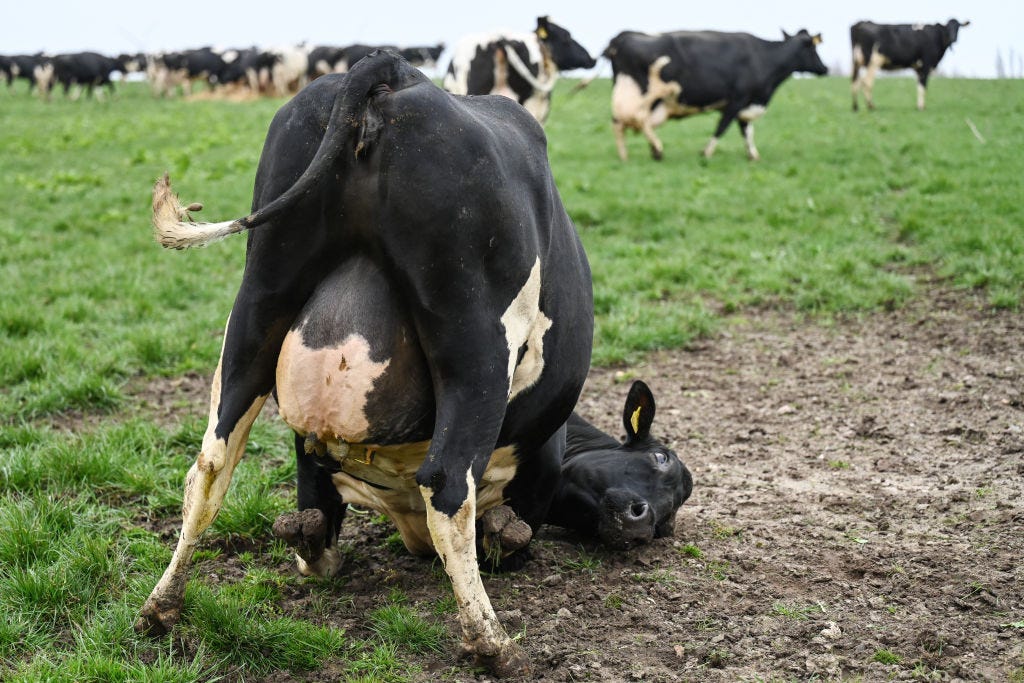
All of which just goes to say that there can be no orderly ‘inflating away’ the Bubble Empire. No gentle-action financial laxative. No gaucho’s knife to puncture the bloated cow.
The credit cycle has turned. As the dollar goes down, interest rates — and the real cost of carrying the debt — go up.
Yes, the debt will be inflated away. But so will a great deal more.
Regards,
Bill Bonner
Well I am not seeing anything that will change my thinking about a lot of cash, metals, and energy stocks and a couple commodity and P&C insurance stocks. Yep the ride we are on isn't going to end well.
Jim Marshall
Perhaps 1980–2020 was the exception, not the rule.
For decades, extraordinary forces masked the tension between credit-created demand and scarce real resources. China and the former Eastern Bloc entered the global economy; globalisation added hundreds of millions of workers to the effective labour pool, and computers, the internet and global supply chains generated enormous productivity gains. Without credit expansion, perhaps we would have experienced mild deflation rather than 2% inflation.
This matters from an Austrian perspective. Credit creation can increase monetary claims on resources, but it cannot create the real savings or real resources (labour, energy, commodities and capital goods) necessary to support them. Artificially low interest rates can obscure this mismatch for a time, but they cannot abolish scarcity.
What if the disinflationary forces that allowed this to continue for decades are now fading?
Globalisation is reversing, populations are ageing, and retirees may begin drawing down accumulated savings. Meanwhile, demand for capital is exploding. AI requires enormous investment in chips, data centres, electricity generation and grids. Its huge financing requirements and weak free cash flow show how capital-intensive the buildout is. Energy itself may become a bottleneck, while geopolitical conflicts, including Iran, add further inflationary risk.
So we may simultaneously have less genuine saving and greater competition for real capital.
A recession does not necessarily solve the problem. It lowers private demand, but it can also worsen deficits and debt-to-GDP ratios. If bond investors become increasingly concerned about the fiscal trajectory, they demand higher yields, which raises government interest expense and requires still more borrowing.
This may explain why the interest-rate trend changed around 2022. The central bank can suppress the price of capital for a while, but it cannot indefinitely suppress the underlying competition for scarce real resources.
Eventually the adjustment must appear somewhere: inflation, higher real interest rates, falling asset prices, failed investments, lower consumption, or fiscal retrenchment.
Perhaps the great bond bull market ended because the extraordinary world that made it possible ended with it.