


Thursday, September 17th, 2026
Bill Bonner, from Poitou, France
Yesterday, Kevin Warsh raised interest rates:
Fed Raises Rates for First Time Since 2023
The Federal Reserve has raised its benchmark interest rate by 0.25 percentage points, moving the federal funds target range to 3.75%–4% — the first hike since July 2023
While Warsh closes the flow of credit, the Houthis, Iranians, and Iraqis are turning the tap off on the flow of diesel fuel. AI Overview:
The Houthis, an Iran-backed Yemeni group, have deployed drones, missiles, and naval assets near the Bab el-Mandeb Strait, a critical chokepoint connecting the Red Sea to the Gulf of Aden, capable of affecting roughly 7–12% of global oil shipments and a significant portion of global trade [15]. While they have announced maritime bans targeting Saudi and Israeli shipping, they have not yet fully closed the strait.
Will either of these bring the long-awaited sell-off in the Bubble Empire? We don’t know.
Retracing our steps, we’ve seen that the Bubble part of the Empire has been financed by increases to the supply of credit — as much as $70 trillion worth.
And we’ve seen that the new fake money system creates money by lending it out. You buy a new car. You pay every month. The finance company has lent you the money; you are paying it back. But the finance company never had any real money. All it had was credit. And now, your loan is part of the Everest of debt...now around $130 trillion, public and private.
Pre-1971, the economy supported about two dollars of debt for every one dollar of output. Now, it is more than four dollars of debt/dollar of GDP. That means there are the aforementioned $70 trillion created by ‘inflation’...and ready to disappear in the next ‘deflation.’
In nominal dollar terms, measured by the feds, consumer items have gone up eight times. Measured in real money — gold — ‘inflation’ has been far worse. An ounce of gold would have cost you $41 in 1971; now it is 109 times more.
But here is the curious thing: Since gold has outpaced consumer prices, ‘stuff’ has actually gotten cheaper in real money terms.
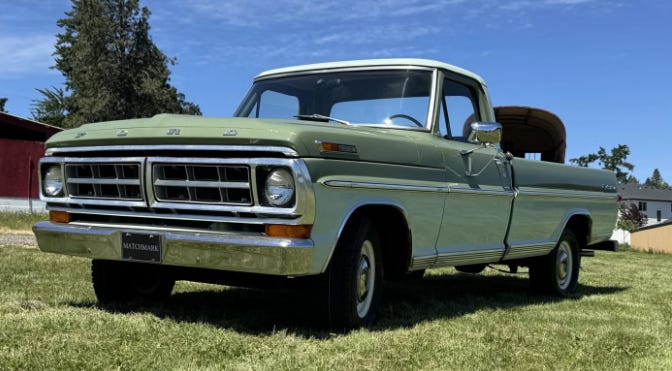
Let’s look at the most ubiquitous auto on the road — the Ford F-150, of which we are an owner.
The price in 1971, when it came out of the factory, was just $3,000. Now, it is $40,000. That is a 13x increase. It represents a huge loss of purchasing power in the dollar.
There is a whole school of thought that tells us that the 2026 truck is a much better truck, so it ought to cost more. But it’s certainly not 13 times better. And the same technological advances that make the truck better should also have made it cheaper and more efficient to make — new materials, robots, mass production, etc.
But we don’t have to argue about it. We don’t know what anything should cost. We just wait for the market to discover it, and measure it correctly.
The truck cost 73 ounces of gold in 1971. Today, it costs 8 or 9 ounces. The real price has dropped by nearly 90%.
A similar calculation could be made for houses. The average house in 1971 cost $28,000, or 682 ounces of gold. Today’s $410,000 average house would cost only 91 ounces, again, a price collapse of nearly 90%.
Even the stock market has been deflated in real terms. In 1971 you could buy the Dow stocks with 21 ounces of gold. Now, it takes only 13.
In other words, consumer and asset prices have gone down — in real money terms. But in nominal terms, they’ve gone up.
What to make of it?
Of course, the price of gold goes up and down — relative to Ford F-150s — along with everything else. But real money — the kind that bounces on the bar counter — holds its value over time. Paper money, on the other hand, loses it. And unless there has been some big change-up in the way the world works, gold will still be valuable 100 years from now, while the dollar probably won’t exist.
But where’s the surprise?
Markets won’t work at all without surprises. Every act of price discovery is a surprise. And every movement, up or down, proves half the traders have guessed wrong.
So, who will be surprised this time? People who thought SpaceX would take us to Mars? Investors who counted on AI to boost GDP so much that our debt Himalayas began to look like the Beverly Hills? Is that the surprise that is coming? Or what?
A melt down of the entire Bubble Empire?
Regards,
Bill Bonner

The numbers tell me to sit tight and watch the world go by. A pile of cash, and a bigger pile of metal. Should do me well for the next 20 years,,,,,if I live that long.
Jim Marshall