

Friday, May 15th, 2026
Bill Bonner, from Filadelfia, Paraguay
We noticed something was odd right away. Far away from tourists in the wilderness of the Chaco in Paraguay, we are normally surrounded by short people with dark hair. But here, in a local restaurant, there were people who seemed out of place. They were not the typical ‘local’ people. These people were bigger, whiter, taller — like the people you’d see in a McDonald’s franchise in Michigan. Three children, very blonde, sat with their parents on benches. Two girls, their blonde hair in braids, giggled in the corner.
Three big men — who looked like our neighbors in Maryland — sat in a booth, talking.
Who were they? How did they get there?
Paraguay always seemed so remote. Not just physically...but culturally, politically, and economically. Landlocked. Off the beaten path. Rumored to be a refuge of Nazi war criminals. Few outsiders visited.
We only arrived yesterday. All we know so far is that Paraguay is no longer a hopeless backwater...and that there is plenty of it. We rented a car in Asuncion and drove for five hours to get out here.
It’s a bit like driving across West Texas — with miles and miles of nothing much. Near Asuncion, the ground is wet with pools of water on the flat ground. We continued towards the Northwest until we crossed the Tropic of Capricorn. But four hours into our drive, we still had seen no sign of cultivation. The grasslands were untidy...swampy...and punctuated by lonely palms.
But the roadway itself bespoke a kind of progress. It was new...smooth...and crowded by large, dusty trucks coming and going. It was only after we had gone for the full five hours that we saw where they were coming from. In the space of just a few miles, at Filadelfia, the earth seemed to dry out...real farms appeared...with rolls of hay...fields of sorghum or soybeans...and tractor suppliers.
We had finally found what we were looking for. We’ve put money into amateurish farming ventures in the US, France, Argentina and Bolivia...and generally lost money. Now, we’re getting serious...in Paraguay!
Arriving in Filadelfia yesterday, we looked for the center of town, where we expected to find our hotel. We soon came to the hotel but no center of town...or any town at all. It is just a collection of hotels, farm supply stores and gas stations along a main road.
But wait; the road signs were in German! Our daughter, who accompanied us, went to the pharmacy nearby and reported back:
“Dad...they were speaking German. They didn’t look like tourists, either.”
At the bar that evening was a tall man who looked very much like a Nebraska farmer. Overhearing us speaking English, he introduced himself as a Canadian who had lived in these parts for years.
“Probably the most interesting people you’ll find around here,” he declared, “are the Mennonites.”
Traveling in Latin America — especially in Nicaragua — we often run into them. They are typically tall, sturdy people. The men wear work clothes. But it is the women who mark them as Mennonites. They wear long, calico dresses with white bonnets.
In the airport in Managua, for example, just a week ago, we had seen a whole family...a young couple with five well-behaved children. We wondered who they were and what they were doing, but didn’t have time to ask.
“Well, you’re in Mennonite country here,” said our bar-side friend.
It turns out that Paraguay is home to the largest group of Mennonites in Latin America, and that they are centered in this region — west of Asuncion. The first group came from Canada in 1927. Larger waves of immigrants came from Russia and the Ukraine later.
“If you’re coming here to invest in farms, you’re probably getting land that the Mennonites cleared and made productive. This is the ‘Chaco,’ probably the last and most difficult farming area in Patagonia.”
The experience of the Ukrainian Mennonites is worth recalling. They were starved in two famines, the first in the early ‘20s...the second ten years later. Then, they were persecuted by Stalin, who considered them unreliable. Mennonite men were rounded up and sent to the Gulag...or murdered on the spot.
Not surprisingly, when the Germans invaded the Ukraine in 1941, the Mennonites — who had come from Germany originally and who still spoke Plautdietsch (Low Prussian) — welcomed them. But when the Wehrmacht was pushed out of the Ukraine, the Mennonites had to go too. They knew the Soviets would show them no mercy. So, they joined the ‘Great Trek’ back to Germany and then moved on...many settling here in Paraguay.
“They’re the hardest workers you’ll find anywhere,” continued our new companion.
More to come...
Regards,
Bill Bonner
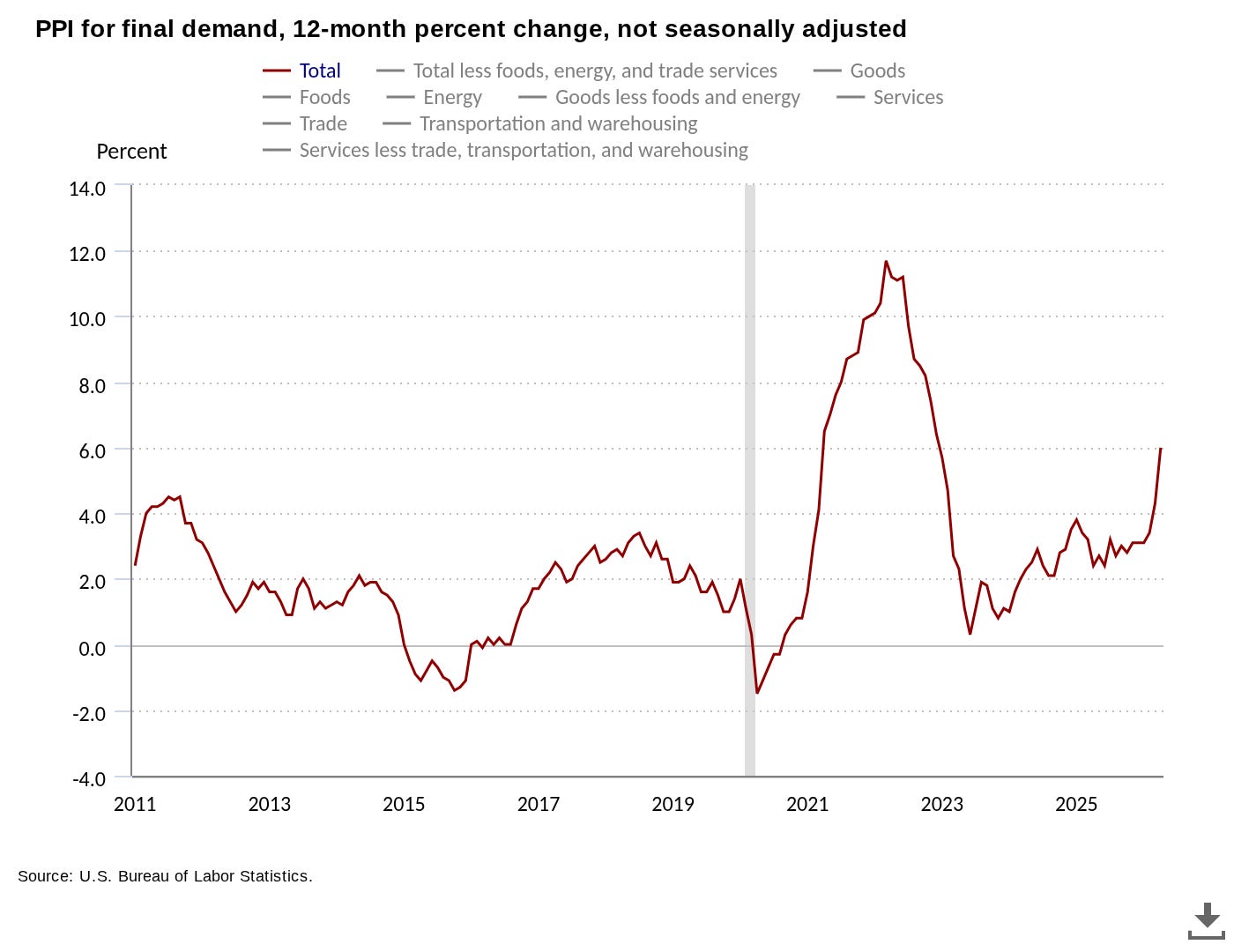
US producer prices were up 6% year-over-year, according to the Producer Price Index report released yesterday by the Bureau of Labor Statistics. This was higher than last month’s 4.3% and the highest monthly reading since December of 2022, when CARES act spending shifted the entire price level in the US 20% higher. If higher producer prices are passed through to higher consumer prices this summer—with energy and gasoline leading the way—the odds of Fed rate cut decrease. More on what this means for stocks later today.
You never see overweight, overindulgent (and overindulged) Mennonites, neither the men nor the women. And their children are well behaved. It can be done, proving once again that culture is the determinant. Culture determines values; values determine choices, and choices determine outcomes. The Mennonites will survive the Fourth Turning. What about us? Best always. PM
It's always interesting to see how people move around the world to find a better place to live. Also, this was a nice way to end the week. I live in S.E. Michigan and we have a lot of Amish and Mennonite families and farms in southern Michigan, Ohio, and Indiana. Their farms always seen to be clean and well maintained. These folks will survive well when the economy falls off the cliff.
Jim Marshall