

Tuesday, June 23rd, 2026
Bill Bonner, from London, England
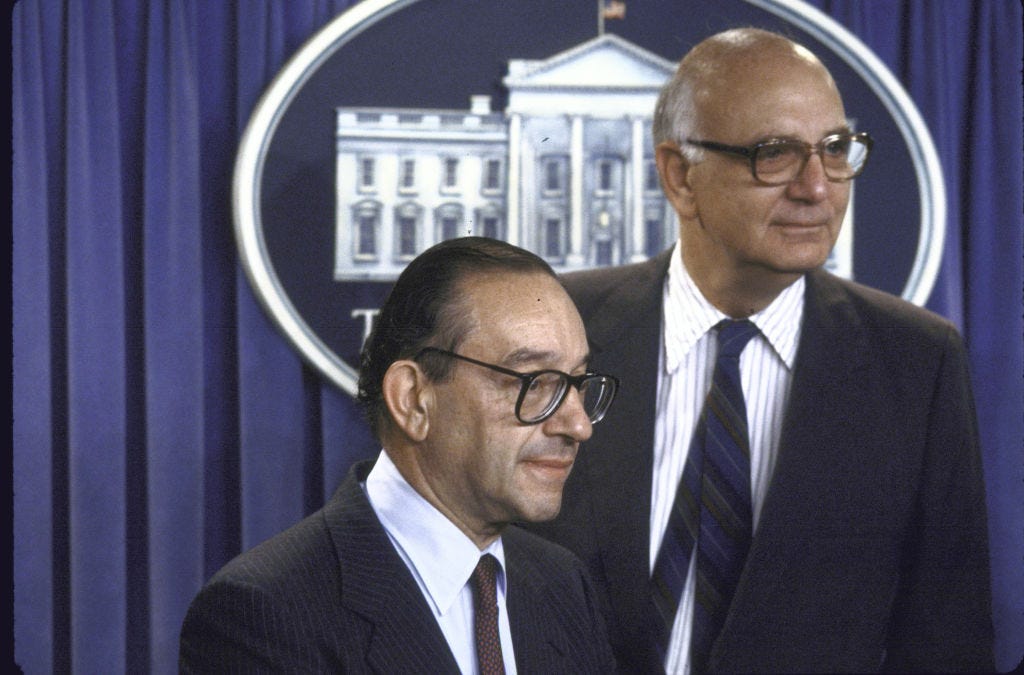
Alan Greenspan, RIP
We knew. He knew. We knew he knew. And — the final turn of the screw — he knew that we knew.
Yet the man sat there mum as a carp, his lips sealed. The surest way to keep a reputation for wisdom is to say nothing that can ever be checked.
We had got him into our office in Baltimore — Dan Denning, David Stockman, and your correspondent — to put the question to him plainly. He was past ninety. The honors were all banked, the pensions all drawing interest, the obituaries already set in type somewhere in a drawer at the Times. A man so situated has no earthly reason to dissemble. He has outlived every motive for the lie. It was the hour, we reckoned, for the confession.
For here was a fellow who ‘wrote the book’ on how counterfeit money picks the pocket of the honest. He understood — none better — that to run the printing press is to file silently away at the savings of the thrifty and to hand the clipped shavings, gratis, to the spendthrift and the speculator. He knew the trick cold.
So we asked him: knowing it, why in the name of sanity did you do it? You, of all the men alive, held the lever. Why let the engine scream off its rails?
And the old conjurer gave us the mumbly-fumbly — that fog of subordinate clauses and qualified retractions that bamboozled a whole generation of congressmen and made him the high priest of American financial claptrap.
But man, the most ingenious of the animals, is also the most artfully self-deceiving. Each of us schemes after his own idol. One sweats at the gymnasium to flex a bicep; another marshals ranks of armed men to impose his will upon the map; a third hoards dollars, a fourth chases skirts, a fifth merely wants to be thought the cleverest fellow in the room. But under every one of these appetites runs the same buried river: the craving to stand out, to be reckoned worthy, to matter.
In the old brute days, a man fought for the right to breed…or even to exist. The modern article connives instead — and as a conniver there has never lived a finer specimen than Alan Greenspan.
The draft board turned him down in WWII for “a spot on his lung.” Whatever the spot was, it did not hinder him from blowing a creditable clarinet and saxophone, nor from outlasting the doctors by some eighty-two years. At such an age there is no need to ask the cause of death, but the Times, supplies one anyway: the complications of Parkinson’s.
In the 1950s his first wife led him to the feet of Ayn Rand, and he was promptly baptized in the cold waters of “objectivism” and the Austrian creed. The doctrine is simple and, so far as it goes, sound: that whenever the politicians lay their meddling fingers upon the delicate machinery of a real economy — fixing a price here, printing a banknote there, taxing, tariffing — they corrupt the whole apparatus and turn honest exchange into a swindle.
Tampering with the money was the cardinal sin. Greenspan thought it grave enough to write a tract upon, in 1966, under the title “Gold and Economic Freedom.” He pronounced the printing of money to be precisely what it is: “a scheme for the hidden confiscation of wealth.”
Rand was in raptures when her smooth disciple was summoned to Washington. Now, she crowed, she had ‘her man’ at the Fed.
She did not have him long. Principles are cheap furniture for a struggling philosopher or a journeyman saxophonist; he may keep them about the parlor all his life and dust them fondly. But the Chairmanship of the Federal Reserve calls for principles of another make. Volcker had wrestled the inflationary beast to the floor, now the politicians could spend and borrow more freely. But they needed THEIR man at the Fed.
There lay Greenspan’s true historic office. The famous “Greenspan put” was nothing grander than this: he stood ready to catch every gambler who flung himself off the ledge — and so, he presided over the largest carnival of phony prosperity the world has ever staged.
From August 1987 to January 2006 Greenspan sat atop the Federal Reserve and did the opposite of everything his essay defended. After the 1987 crash he flooded the banks with liquidity and taught a generation of traders that the central bank would catch them every time they fell. They named the reflex after him: the Greenspan put.
He cut the federal funds rate to 1 percent by June 2003 and held it there, and you watched housing prices detach from any sane relationship to income. Mortgage credit gushed. He went on television in February 2004 and suggested Americans consider adjustable-rate mortgages, roughly eighteen months before he started hiking rates into those very borrowers. The man who warned in 1966 about the hidden confiscation of wealth engineered the largest credit distortion in postwar history.
Beneath the notice of his death on Facebook there are gathered dozens of mourners, heads bowed around the coffin, in a posture of reverence. A “great economist,” sighs one. He “helped us through a crisis,” murmurs another — the crisis being, of course, the one he himself had manufactured. A third lays a wreath upon the long years of “public service.” The Times joins the chorus and out-gushes them all:
At the peak of his fame, as the economy boomed in the late 1990s, his merest phrase could send the markets sharply up or down, and his face, behind thick glasses, was as familiar as any movie star’s.
So, the old scalawag got what he was after. The applause, the awe, the oracle’s mystery preserved intact…Alleluia, even unto the grave.
Requiescat.
Regards,
Bill Bonner
Well said, Bill. The Greenspan put turned out to be a put on all our futures.
A true snake! I remember your interview with Greenspan. I also remember that he was a disciple of Ayn Rand......man did he switch sides quickly. I am sure his personal financial status was in great shape long before he left the FED. It would be good if everyone understood that the FED DOES NOT work for we the people. It works for the TOP FIVE BANKS in the country. What a real snake pit.
Jim Marshall