

Thursday, July 16th, 2026
Bill Bonner, from Youghal, Ireland
We are in the most common situation for investors. We’re waiting.
Waiting for the end of the Iran-US war.
Waiting for the stock market to correct.
Waiting for the gold bull market to resume.
Waiting for the Primary Trend to express itself.
Waiting for the next elections, for the check to clear, for the wine to age and the ship to come in.
Waiting...waiting...waiting.
Waiting is the way to make money — waiting for the right price (you make your money when you buy)...and then waiting for the right time to sell.
You also wait for what ‘ought’ to happen to actually happen.
You wait to be proven right...or wrong. And you wait to make money...or lose it. Charlie Munger:
Wall Street makes money by activity. You make money by inactivity. It sounds simple, but it is the hardest thing in the world to do. Most investors are like hamsters on a wheel — running fast, sweating hard, and going nowhere. They think they are “investing.” I call it “gambling with a tie on.” I call my strategy “Masterly Inactivity.” It’s not about being lazy. It’s about being disciplined enough to wait for the fat pitch, and then sitting on your ass for decades while compounding does the heavy lifting.
But you can’t really ‘sit on your ass.’ Not in the financial world. Every seat, no matter how plush and attractive, has a pin in it somewhere.
You say, “I’ll sit this one out.” But how can you do that? You may be out of stocks, but you must be in something. “I’ll wait,” you say, “until prices are more reasonable.”
But you still have your money. But it is ‘invested’ in something — dollars...or Treasury bonds...or gold — something other than stocks. In the language of Wall Street, you are ‘long’ gold...and ‘short’ stocks. You are still wagering on what the future will bring.
In other words, it is an illusion to think you are making money by inactivity. You are always long or short. The real difference is that the shrewd investor, as opposed to the amateur or the trader, waits a long time between moves. He sticks with cash and waits...waits...waits for the pitch, slow and straight, and then swings for the bleachers.
And then, if he is smart, he waits, waits, and waits again for the trend to fully express itself. He is always fully exposed — to something. But the big movements — the kind that make your fortune or destroy it — take time to develop.
No point in just trying to get on base, making money with one investment and losing it on the next. You need a home run — something you can get in and stay in....sometimes for 10 or 20 years.
Investors are now in a lather about AI stocks. But are they likely in a major trend that you can stick with? Are they going to be like Berkshire Hathaway, giving investors twice the return of the S&P for over half a century?
Maybe not.
Analysts are beginning to see the problem. Charlie Bilello explains that the leading techs may be in an ‘earnings bubble.’ And it may soon pop:
In the first quarter, just three companies (Google, Nvidia, and Amazon) saw massive gains in the “other income” category from their private investments in companies like SpaceX and Anthropic.
The total of $69 billion in “other income” was roughly 10% of the S&P 500’s overall net income for the quarter. Absent this boost, S&P 500 YoY earnings growth would have been 15% in Q1, well below the reported figure (+28%).
This ‘other income’ is not from their businesses but from the high tech gambles they’ve taken...that, so far, look good. Prices have gone up, even without real profits. These are capital investments; they must soon be added to the depreciation column on their earnings statements — a negative, not a plus. Sometime next year, under pressure from these outsized wagers, the free cash flow that has powered Anthropic, SpaceX et al. will sink to a minus. And their investments will go to bubble heaven.
You can’t really build a major, long-term trend in the stock market on a bubble of tech investment. But when you are in the early stages of it, it can be hard to resist.
Stocks, quoted in gold, have been going down for 26 years. If you had sold out of your stocks in 2000 and simply stuck with gold, you would have approximately tripled your real wealth.
But the apparent inactivity might have been maddening. You would have missed Tesla...and missed Nvidia...and you would have been sitting tight in gold as the Amazing 8 — Amazon, Alphabet, Tesla, Nvidia, Microsoft, Apple, Netflix and Meta — went ‘to the moon.’
Other investors would consider you a loser. Your family would want to know why you ‘missed the boat.’ Even the family dog would no longer look to you for a pat on the head.
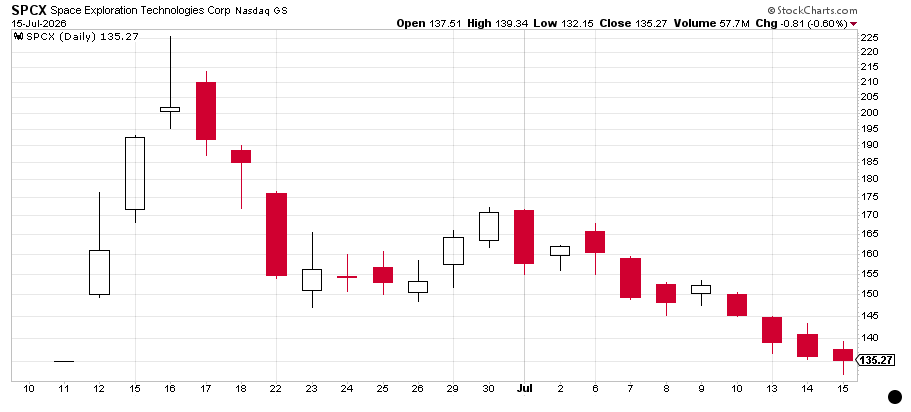
And then, came SpaceX. Forget the moon, these fellas are going to Mars. No kidding. That’s the business plan.
An investor was offered one fantastic opportunity after another. Like a married man asked to be a judge at a Miss Nude Universe contest, temptation beckoned.
But just as a prudent man wouldn’t throw over a happy, long-term marriage just to frolic for a night or two with a naked beauty, neither should he ditch a perfectly serviceable investment strategy in order to try to score some fast money.
Whether it’s fast money or fast women, they’re likely to be disappointing.
We have no real evidence of this; we have experience with neither. But we’re still hoping!
Regards,
Bill Bonner
Well here again Bill you have imparted worthwhile information and a smart perspective on longterm investment, and you did it all without any demonstration of your rather prominent propensity for TDS.
At my age I can’t plan for the long term. I’ll take the fast women.