

Tuesday, April 14th, 2026
Bill Bonner, from Baltimore, Maryland
‘War is the state’s escape from a collapsed internal economy.’
—Frank Chodorow
Blowing things up didn’t work in Vietnam. It didn’t work in Iraq. It didn’t work in Afghanistan either. Nor did it work in Iran.
Hegseth and Trump are proud of the destruction wrought by their planes and missiles, but Iran never surrendered, never gave up its enriched uranium and now controls the Strait. And when presented with a ‘take it or leave it’ ultimatum in Islamabad, replied that it would leave it.
So, what does the Trump Team do now? Violence didn’t work so far...but what else do we have?
“What’s the point of having this superb military that you’re always talking about if you can’t use it,” asked Clinton-era Sec. of Defense Madeleine Albright. She had a point. A late, degenerate empire, with the biggest bazooka in the world, must find a target.
On the surface war is a matter of choice. But deeper down, there are ‘primary trends’ that are hard to reverse. A beautiful spring does not become a hot summer because the people vote for it. Nor does a caterpillar, by willpower alone, become a butterfly. And now, the US must do what it must do. MoneyWeek:
Amid the fog of war, it would have been easy to overlook the latest deficit number coming out of Washington. According to figures from the Treasury Department, the US national debt is now more than $39 trillion. It is only five months since it went past $38 trillion. US debt has doubled from only $19 trillion when Donald Trump was sworn in for his first term as president.
Behind Donald Trump’s bluff, bombast, and bombs is a reality that cannot be blown up or wiped away. The US government is approaching $40 trillion in debt, a world with rising long-term interest rates…and a late-cycle debt crisis.
At just 5%, as more and more old loans are re-financed at new rates, it will soon mean annual interest payments of $2 trillion. Where do the feds get that kind of money? From the 80 million citizens who are living ‘paycheck to paycheck?’ From the 2.5 million Latinos who just got deported (or self-deported)? From the 2 million desperadoes in prisons and detentions? From the war budget...social security payments...Medicare?
While we all know that the feds can ‘print’ money, what few realize is that the private sector has printing presses too.
When you take out a mortgage, for example, the ‘money’ isn’t sitting in the bank’s vaults. It is created ‘out of thin air.’ In 1999, there was about $5 trillion worth of residential mortgage debt in the US. That amount has grown to $15 trillion.
The Fed had set the pace. And all through the economy, the calculation was about the same: taking on more debt was a shrewd thing to do. First, your purchase — bid up by the rising tide of new credit — was likely to go up in value. Second, the dollar was almost sure to go down. So, you made money coming and going.
Likewise, when you pay with your credit card, no money is taken from your account to pay the charge. The seller registers ‘income’ from the credit card company, as the amount of debt (unpaid balances) goes up...and up...and up. Lending Tree:
U.S. credit card debt has grown from around $478 billion in 1999 to a record $1.28 trillion by the end of 2025, reflecting long-term growth with periods of decline during economic crises.
Not included in these conventional money-printing/debt building operations is another form of credit rarely even considered — BNPL (buy now, pay later.) Consumer Financial Protection Bureau:
‘From 2022 to 2023, the number of loans made by the lenders we surveyed increased by 23 percent, and the total dollar amount of loans originated increased by 26 percent when adjusted for inflation, representing slower rates of growth than in prior years.’
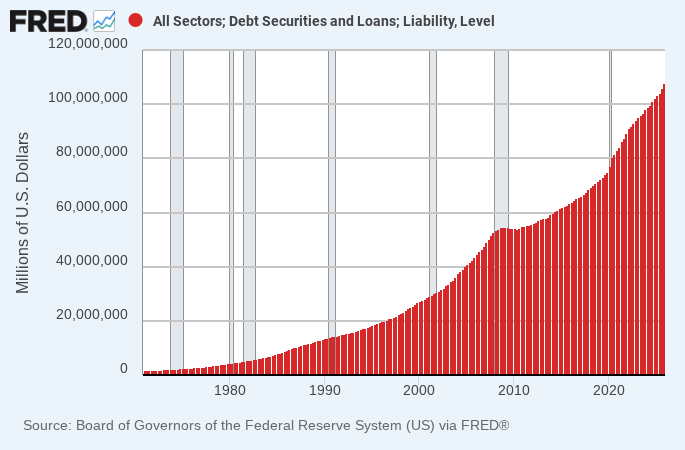
All of this private sector debt, added to federal, state, and local debt, comes to about $110 trillion. Not chump change. There again, the math is easy; it’s the repayment that is hard. At 5%....the interest would be about be about five and a half trillion per year — or nearly 20% of GDP.
This is the classic crunch that is coming: huge debts without enough real income to pay them.
It must have been in anticipation that private equity firms have begun telling their investors that they can’t get their money back. So far, Apollo, Ares, Blue Owl, BlackRock and Morgan Stanley have told investors to take a number and get in line.
As our old friend, Sid Taylor, used to say, ‘when your outgo exceeds your income, your upkeep is your downfall.’ Sid was describing the real threat to the republic -- not Iran...not Cuba...not Russia...not China, but too much debt.
A responsible government would stop its dilly-dallying and immediately tackle the debt problem. But that would leave History sadly unfulfilled, like George Armstrong Custer without the Little Big Horn.
Tomorrow....why the feds must saddle up...again!
Regards,
Bill Bonner
The US owes more money than exists.
That is fascinating. That’s like owing more oxygen than the planet has. You ever try to pay that back? You walk into the bank and they go, “Sir, we’ll accept your lungs.”
America is a nice place. Real stable. The kind of place where the currency is backed by optimism, which is good, because that’s the only thing they haven’t borrowed yet.
They say the US owes about 110 trillion of everything combined, and I thought, that’s interesting, because I don’t even know 110 trillion of anything.
I don’t know 110 trillion people.
I don’t know 110 trillion sandwiches.
But somehow, they owe it. That’s impressive.
Again and again, President Trump says “Don’t worry, we’ve got it under control.” And again, I believe him.
Because when I think “under control,” I think of a man standing on a pile of dynamite with a lit match, explaining interest rates. People are not panicking though, not at all, everyone just keeps on spending.
They say, “Well, it’s only debt.”
Which is true.
In the same way that a bear is only a large dog that wants to kill you.
I love how the Administration solves problems.
Economy collapses?
They say, “Let’s bomb something.”
Not to win.
Just… to keep busy.
It’s like a man sitting inside a house that’s already burned down, just the frame left, glowing and cracking in the dark.
And instead of leaving, instead of asking for help, he walks next door, drags his neighbor out into the yard, and sets that house on fire too.
Not to survive.
Not even to win.
Just so he’s not the only one standing in the ashes.
Then he looks around at the smoke, the screaming, the glow of everything collapsing and says, real calm, like he solved something: “Now it’s even.”
China and Russia are watching all this and I bet they’re very confused.
They’re probably saying, “Wait…you’re borrowing money, to pay interest on money you borrowed, to fund wars, that don’t work?”
And Trump’s like, “Yeah, but we’re very confident about it.”
Did you say Two trillion in interest Bill! That’s the kind of number where you don’t pay it, you just sort of acknowledge it politely.
“Ah yes, the interest… still there, I see.”
And the banks, they don’t even have the money they lend you. They just make it up. Which I respect, because I tried that once.
I went into a store and said, “I’d like to create some money out of thin air.”
And they said, “Sir, that’s called theft.”
And I said, “No no… it’s called banking. I’m just skipping the middleman.”
And President Trump, he smiles.
He says, “We’ve faced worse.”
Which is true, because eventually, this will be worse.
Assessing the hazard of the IRGC with nuclear weapons and delivery systems intact.
(h/t Perplexity Ai)
Summary
The Islamic Republic of Iran is animated by a vision in which the regime exists as the institutional vehicle for preparing the apocalyptic conditions — regional Islamic dominance, the destruction of Israel, the expulsion of American power, and generalized regional upheaval — that will precipitate the return of the Twelfth Imam and the inauguration of global Islamic justice. This vision, formalized by Khomeini through the radical innovation of Velayat-e Faqih, transformed a quietist eschatological hope into an active state mission. The proxy network, the ballistic missile program, the pursuit of nuclear capability, the ideological indoctrination of the IRGC, and the current multi-front confrontation with Israel and the United States are all coherent expressions of this framework — not in the sense that every tactical move is directly dictated by theology, but in the sense that the theological vision defines the ultimate purpose, justifies the costs, sanctifies the violence, and, critically, distorts the deterrence calculus that Western strategic planning relies upon.
in view of this animating principle what would be the most likely outcome when the regime acquired nuclear weapons and the means of delivering them to any desired targets
This is a question where the answer requires careful reasoning from the framework already established, combined with what is known about regime decision-making, internal factionalism, and the specific eschatological logic as it meets strategic reality.
The Central Analytical Problem
The question is not simply "what would a nuclear Iran do?" but something more precise: given that the regime's stated raison d'être is to precipitate the apocalyptic conditions for the Mahdi's return, and given that the destruction of Israel is identified as a theological prerequisite for that return, what is the most probable behavior of a regime possessing deliverable nuclear weapons?
The answer requires holding two things in tension that Western strategic culture habitually refuses to hold simultaneously: that the regime contains genuine apocalyptic believers, and that it also contains institutional survivors who want to preserve the state. The outcome depends on which faction controls the weapons at the moment of decision.
Why Standard Deterrence Theory Is Inadequate Here
The entire architecture of nuclear deterrence since 1945 rests on a single axiom: states value self-preservation above victory. Mutual Assured Destruction works because both parties prefer survival over any political or ideological objective. This is why the Soviet Union, despite official ideology declaring the inevitable triumph of communism, never used its nuclear arsenal — Moscow wanted to be alive for that triumph.
The Islamic Republic presents a structurally different case along two dimensions:
First, the regime's ideology does not treat the survival of the current Iranian state as the supreme value. The supreme value is the return of the Mahdi and the establishment of his global order. If the destruction of Israel — or the triggering of catastrophic regional war — is the price of that return, the theology endorses paying that price. Martyrdom is not a cost; it is an honor. As Times of Israel analysis notes, this regime "celebrates martyrdom, views bloodshed as sacred, and sees Israel's existence as a spiritual affront." An adversary that regards nuclear annihilation of its own population as potentially glorious — the ultimate martyrdom, hastening the Imam's arrival — cannot be deterred by the threat of that annihilation.
Second, there is a theological premium on irreversibility. If the Mahdi's return requires Israel's destruction, then a first strike that eliminates Israel — even at the cost of Iran's own obliteration in retaliation — accomplishes the eschatological mission. The regime does not need to survive the strike. It needs only to deliver it. This asymmetry — where one party has, in principle, a preference structure under which dying while destroying the enemy is the optimal outcome — breaks the mutual vulnerability logic entirely.
The Most Likely Outcomes, Stratified by Probability
Most Probable: Graduated Coercive Escalation, Not Immediate First Strike
The most immediately likely use of nuclear weapons — upon acquisition — would not be a bolt-from-the-blue strike on Tel Aviv. It would be the exploitation of nuclear status as a shield behind which conventional and proxy aggression intensifies dramatically.
This is the North Korean model, and it is well understood. A nuclear Iran would almost certainly:
Accelerate proxy attacks on Israel and American bases, knowing that any retaliation risks nuclear escalation
Extend a nuclear umbrella over its proxy network, daring Israel or the U.S. to strike Hezbollah or the Houthis
Dramatically increase its demands in any regional negotiation
Move toward the "liberation" of Jerusalem through proxy pressure rather than direct strike
The restraining logic here is the institutional one: the Khamenei faction of the regime — the Velayat-e Faqih apparatus itself — wants to survive to govern the post-Mahdi world. You cannot be the state that welcomes the returning Imam if you have been vaporized in a retaliatory strike. So the initial period after acquisition would likely look like emboldened aggression short of nuclear use.