

Wednesday, May 27th, 2026
Bill Bonner, from San Martin, Argentina
Yesterday, we brought up the ‘wealth divide’...which quickly became the ‘age divide.’ CNBC:
42% of Americans under 30 say they’re ‘barely getting by’ financially, Harvard survey finds
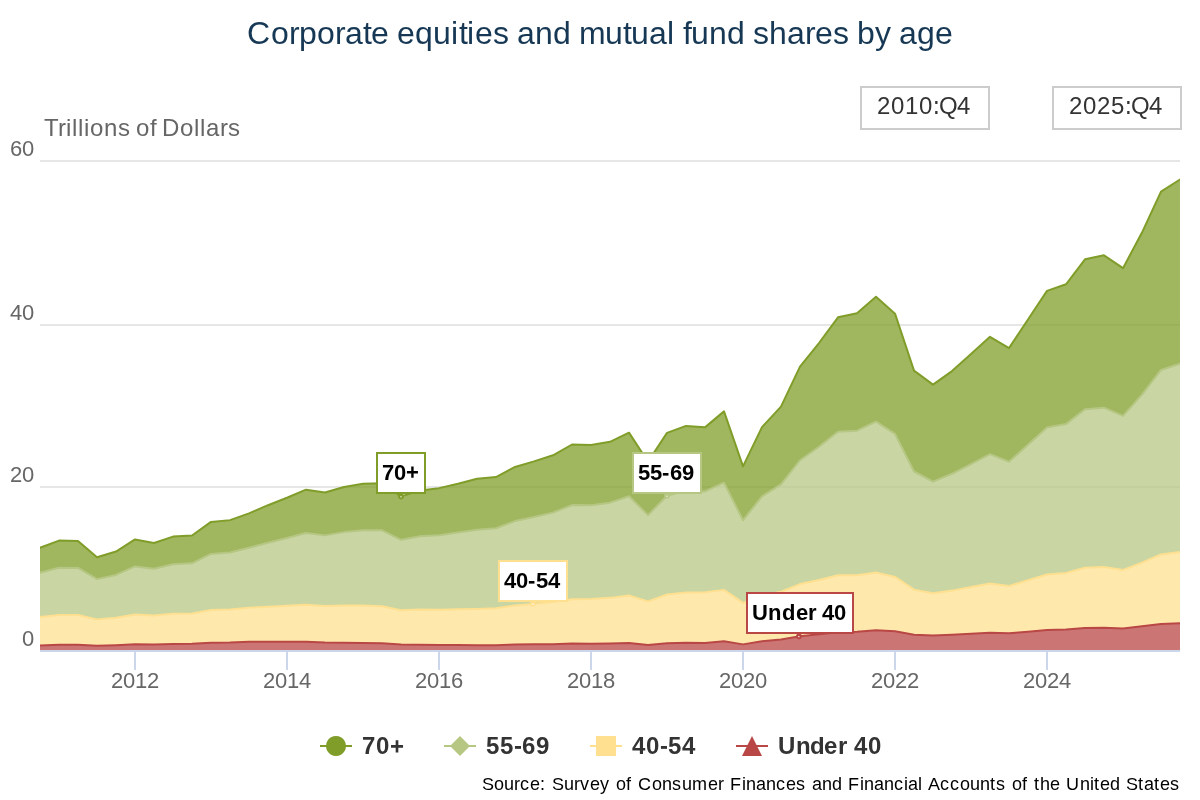
In short, old people have the money; young people do not. Old people voted Thomas Massie out of office; young people wanted him to stay.
So, let’s connect some dots. We’ll look at how the two Great Divides come together...and why the crusty old duffers want to stick with Donald J. Trump and his stooges.
Trump campaigned as a disrupter...a reformer. He was going to end the endless wars...stop the unstoppable spending...drain the undrainable swamp...and even pay off the national debt.
Young people would have loved him if he had followed through. He would be like a responsible parent...planting trees whose shade only his children and grandchildren would enjoy. Instead, we got the surface disruption -- the commotion and brouhaha of a real showman.
But the Deep State was not the least bit inconvenienced. The money flowed even more strongly to its insiders’ pockets, to its pet industries and to the feds themselves. The most recent example: the Pentagon’s budget is expected to shoot up by the biggest increase ever — to $1.5 trillion. And US debt has almost doubled since Trump was first elected.
And so it was that we didn’t get the reformation we needed. The swamp got deeper. The debt got steeper. The feds got creepier. The cost of living went up. And the financial prospects for young people went down.
And when the oldsters went to the polls in Kentucky last week, they voted for Trump and his puppet, Gallrein, not the conservative reformer, Massie. They were essentially voting for ‘more of the same.’ Why?
Perhaps they still recall the glory of military victory in WWII...and don’t want to think about Vietnam, Iraq, Afghanistan or Iran. Perhaps they remember when public schools seemed to teach...and Congress seemed to represent the interests of the American people.
Our guess is that their keenest nostalgia, though, was for the stock market, big housing equity, and Social Security/Medicare payments. Thanks to the feds’ willingness to spend money they didn’t have...mostly on the class of voters likely to give them an electoral win...the geezers have not necessarily done good. But at least they have done well.
Each dollar of debt accumulated by the federal government brought the boomers things that someone younger will probably have to pay for. They enjoyed kicking butt in Iraq and Afghanistan, for example. But that entertainment added about $5 trillion to the national debt — to be passed along to the next generations. They got their stock gains, too...largely funded by the Fed’s low interest rates, which is why so many people borrowed so much money.
And now, total US government debt is up to $39 trillion. There are about 120 million households in America, and about 96 million of them are made up of non-baby boomers. The boomers may be rotting in their graves before the bill comes due…but they will leave younger households with debt of $419,000 each.
Of course, they cannot pay it. And the feds have no intention of making them try. But every debt is paid by someone — either the debtor or the creditor...or, in this case, by just about everyone, via inflation.
Boomers also get a better deal from Social Security than the people who come after them. It was always a giant Ponzi scheme. And young people know it. Barrons:
According to a report by research firm Cerulli Associates, only 5% of Generation Z and 16% of millennials with 401(k)s say Social Security will be their primary source of retirement income. Among baby boomers, the figure is as high as 49%.
For at least two generations, the Soc. Sec. system seemed to work. The population expanded, so there were more and more people paying in...GDP growth was solid...and tech advances spurred productivity. But things have changed. While there are high hopes for new AI-driven output, GDP growth figures are disappointing. And as for the population...PRB:
U.S. Population Growth Is Slowing to Near Zero
An immigration cliff — combined with fertility declines and population aging — places the United States closer to the demographic experience of Europe.
In parallel with the Cantillon Effect (which rewards the first people who get inflated money and punishes those who come later), Soc. Sec. paid off well for the first recipients. And then, by tying payments to COLA (cost of living adjustments), retirees were somewhat immunized against the inflation that their policies had caused.
Having done so well for themselves, is it any wonder boomers want ‘more of the same?’ They stick with the Big Man, his Big Budgets, Big Deficits, and Big Government.
Regards,
Bill Bonner
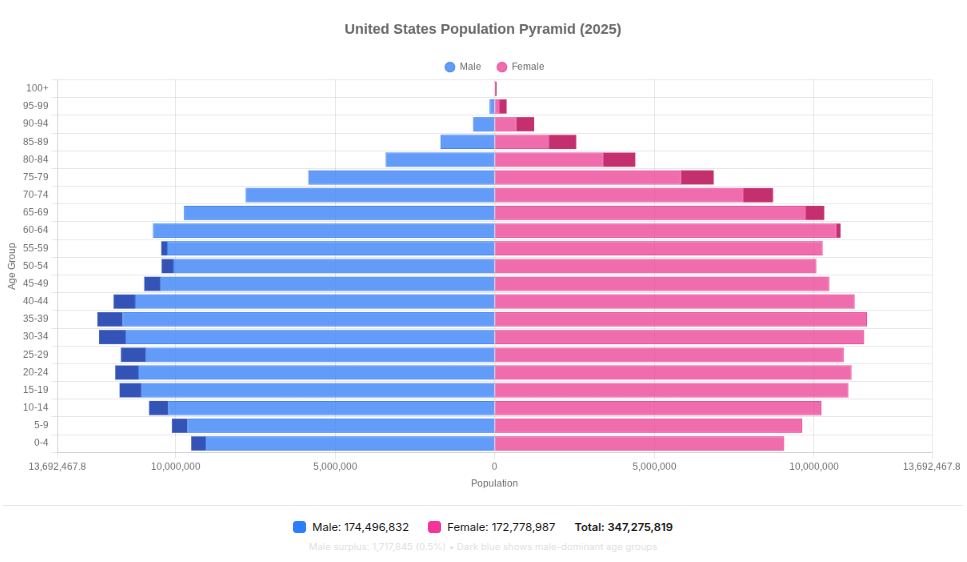
The population of the United States has grown by 65% since 1970, from 203 million to 347 million according to official data. The median age has increased from 28.1 to 38.9 years in that same time. Replacement rate fertility is at 1.6, with immigration accounting for most of the population growth. Age cohorts from 0-59 years show slightly more males than females. From 60 and above, every age cohort shows more females than males. Across the entire population, men outnumber women by 0.5%.
I agree with some of your comments Bill but we all know humans will always vote for people who give them what they want, the feeling of security " in their lifetime". That's the mess we find ourselves in today. I am sure that all the BPR readers know a lot of people who "live for today" and don't really plan for tomorrow. Sadly, they will continue to vote for someone to bail them out when they run out of money.
Jim Marshall
And, has the government ever done anything for the people that was NOT a PONZI scam? Most politicians, at any level, are there for the money & power, not for America or the people.