

Friday, October 16th, 2026
Bill Bonner, from Ardmore, Ireland
The trouble with growing old is this. As the years go by you pile up more and more bits of useful real-life experience and wisdom...but you can’t remember where you left them.
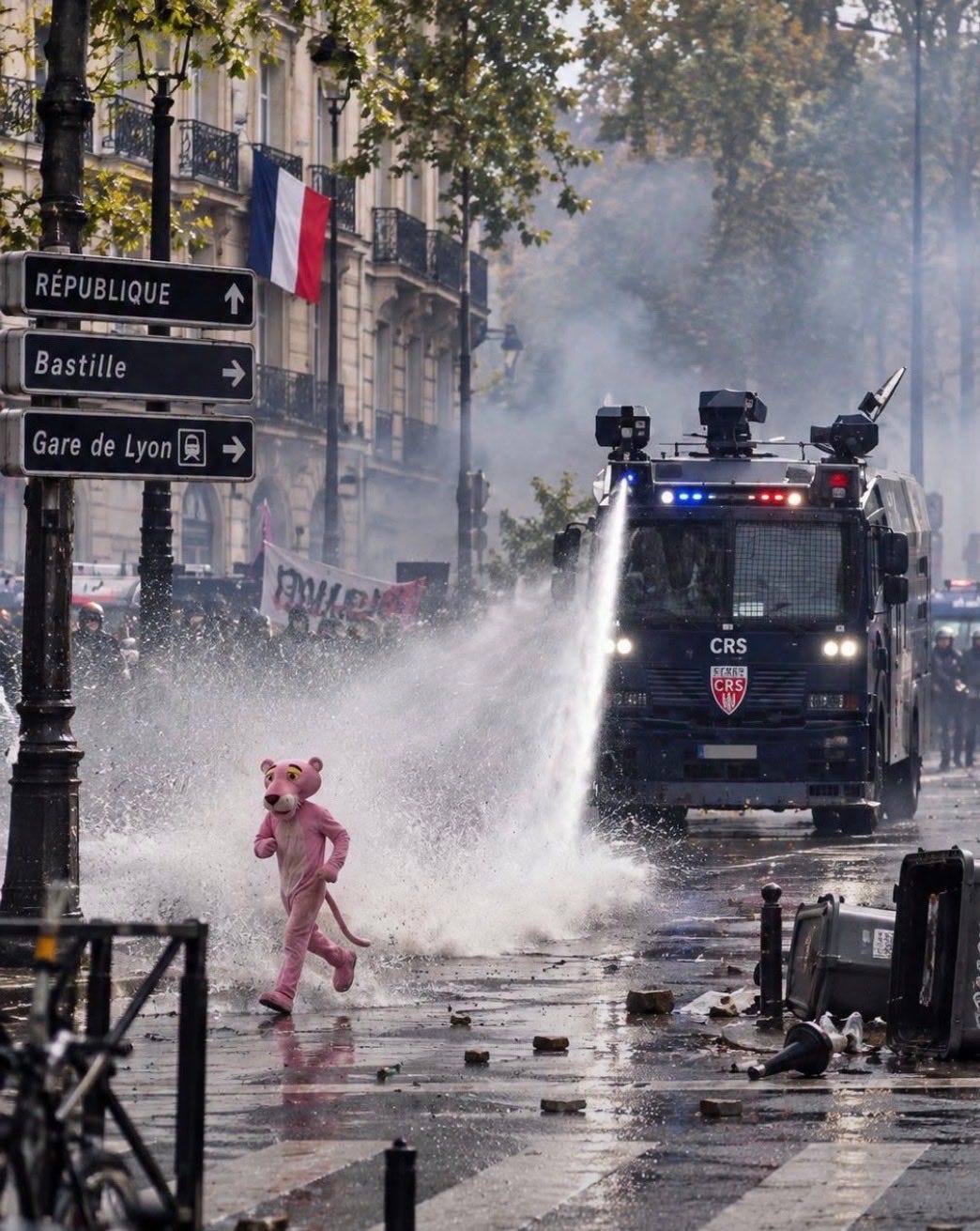
But the recent news from France brought back memories! The wail of ambulances and police sirens. The acrid smell of burning rubber. The sight of mobs in the streets...and gendarmes teaching them a lesson. Smoke. Noise. The madness of crowds and the discreet charm of the bourgeoisie.
Videos showed the battles between French students, along with the usual professional agitators, pitted against the forces of law and order, otherwise known as ‘les flics.’ Yes, in the immortal words of Yogi Berra, it was ‘déjà vu all over again.’
You shouldn’t believe everything you see on the internet, of course. The details are often invented or misunderstood. The ‘analysis’ is usually self-serving or superficial. And today, what you’re seeing with your own eyes could be a complete AI invention.
Here at Bonner Private Research we don’t trust any ‘fact’ unless we made it up ourselves. So, with no claim to absolute truth or moral uplift, we will just tell you what happened. Then, we’ll try to remember why we wanted to mention it.
We were a very poor student in the late ‘60s. And, at the University of Maryland, we were having a very poor student experience. Then came what looked like a way to fix both problems...at least temporarily. And here, we have no confidence in the numbers, since we dredged them out of our memories from more than half a century ago. Tuition at the University of Maryland was about $1,200 a semester. To that, we had to add living costs. We shared a humble apartment with other students in College Park...and worked in the kitchen of a sorority house, washing dishes in exchange for lunch and dinner. This arrangement — working amid 50 or so co-eds — gave our imagination a workout, but never amounted to much ‘in the flesh’ shall we say. The ‘sisters’ wanted nothing to do with the poor boys sweating in the kitchen.
But we partially repaid their contempt, at mealtime. We ate before they did and wolfed down such heroic quantities of food, so fast, that there was relatively little left for the sorority sisters. They should have thanked us.
The cook was a cheerful, middle-aged black woman named Hattie. She encouraged our mischief by looking on with an approving smile.
“I likes to see a man eat,” she said. We were all too eager to make Hattie happy.
But sometime in the autumn of 1968 we learned that the tuition at France’s prestigious ‘Sorbonne’ was only about $90. And they had a special program for foreigners with intensive French lessons. We had taken French in high school, for four years. We figured we could get by at a French university. France also fed its scholars with special student cafeterias where you could get a full platter of food for about 50 American cents. And many students lodged in what they called ‘chambres de bonnes,’ or maids’ quarters, for about $30 a month. No heat. No private bath. And no elevator (these rooms were almost always sixth-floor garrets in Haussmannian apartment buildings.)
As we calculated it, the savings — even after a transatlantic flight, on Iceland Air — would be substantial. And as it turned out, we got more than we bargained for.
So, thus it came to pass that we were among fellow students, in the Latin Quarter of Paris in the spring of 1969. The uprising that had happened the year before seemed like a lark to us. Students and leftists had pried up the paving stones to erect barricades. Windows were smashed. Fires were set. Pitched battles raged in the streets. But remarkably few people were seriously hurt.
“C’est la lutte finale...” It’s the final struggle...the ‘Internationale,’ the anthem of communists, anarchists, syndicalists, anti-capitalists and utopianists of all sorts. It expresses the hope of a worldwide revolution, where the working classes finally rise up and throw off their yokes.
The battles of ‘68 were over when we got there, but the tune of the ‘Internationale’ still echoed in the streets and meeting halls, even as the authorities were putting asphalt over the cobblestones to prevent them from being pried up again.
But beneath the calm, the spirit of rebellion still burbled. Students plotted in the cafes. The press earnestly warned of the need for ‘reform.’ The French were well schooled in Marxist theory; they considered it only a matter of time before the inevitable victory of the proletariat.
We were only just beginning to understand the cast of characters when a new wave of violence sloshed over the Latin Quarter. A large group of demonstrators took to the streets near where we were studying, on the Boulevard St. Germain. We were too ignorant and too naïve to understand what it was about, but we were curious. We followed along to see what would happen. But by this time the gendarmes of Paris were battle-hardened veterans who knew what to do. They formed a line in the street in front of the mob. Students threw rocks, which bounced off the plastic shields carried by the front line of police. For what seemed like a long time, the two armies remained in place, with the students lobbing insults and projectiles on one side...while the police, like cattle in a hailstorm, stood their ground.
Then, without warning, the police dropped their shields and charged. The protesters had let down their guard. They had gotten too comfortable. The police swung their truncheons, beating up several of the students, whacking them to the ground and then kicking and pounding away with their rubber clubs.
We watched this neither with alarm nor satisfaction, but like a tick wondering where the old dog would go next. After the demonstrators had fled, we continued watching as the police finished their business with the protesters they had collared, herding them into vans with grated windows.
It was time for us to move on too. But the route was now blocked by police lines. This was 1969. And to the police we must have looked little different from the hooligans and idealists they had just thrashed. So, naïve as we were, trusting in the good faith and training of the constabulary, we just walked right up to politely ask if we could pass.
We had barely gotten to the conditional mood of the French verb when the answer came good and hard — a truncheon blow to the jaw. Knocked to the ground, two of the gendarmes began repeating the performance they had just rehearsed on the protestors — beating us up. We used our arms to protect our head and were able to scramble away.
Our face was bleeding. Our body was battered. Worse than that, still lying in the street was our sense of justice. We burned to get even, but had no way to do it. We might as well have been a cat complaining about the local dogs.
What lessons can we draw from this experience?
The obvious one: there are times when it is better to be somewhere else. You can’t control what goes on around you. And, often, you can’t prevent something bad from happening to you — except by not being present when it happens. Whether an armed invasion or a stock market crash, better to watch from the sidelines...and then slip away unnoticed.
Regards,
Bill Bonner
Observing the sinking ship from the deck is probably not a good idea...
I like the opening paragraph. The older we get the more true it is. In 68 I came back from Vietnam to Long Beach CA., and the hippie movement was in full swing. Of course anyone in the military was considered sub human in those days, myself included.
Oh, what I would give to know half of what I do now back when I was 20! As you wrote in todays essay, not much has changed. The smart move, especially for us old farts, "Max Safety Mode"!
I think five years down the road we will be happy we sat on the sidelines.
Jim Marshall