

Please note, we’re aware some Gmail users are not receiving the weekly market and research notes from Tom Dyson and Dan Denning. Substack is aware of the issue and working with Google to resolve it. It in the meantime, we’ll also send the weekly updates to our back-up email list to ensure you receive them. As always, all BPR communications are available at the website at www.bonnerprivateresearch.com
Friday, October 9th, 2026
Laramie, Wyoming
By Dan Denning
Imagine not being able to live on $5.4 trillion a year. Yet that’s where the American government found itself when the fiscal year ended in September. The Congressional Budget Office publication summarizing the whole year was like reading a crime scene report. Some of the low-lights:
Receipts (let’s not call them revenues or sales) were up 3%, or $169 billion for the year, to $5.4 trillion. That would have been enough to generate a budget surplus in every year of American history through 2019 ($4.4 trillion in spending) until 2020.
Spending was up 6% and $386 billion for a total of $7.39 trillion.
The deficit was up $2 trillion, up from $1.77 trillion the year before
Mandatory growth rates in spending for Social Security and Medicare/Medicaid drove spending in each of those programs up by 5%, 8%, and 8% respectively. Social Security grew faster because more retirees are receiving benefits each year as the Baby Boomers are paid back what they paid in.
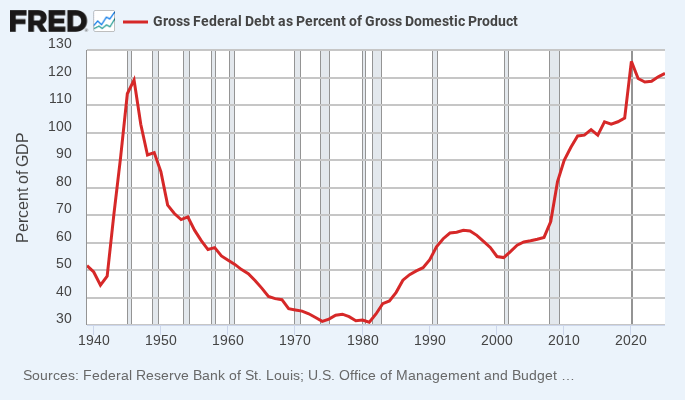
All up, those three big programs make up 45% of total federal spending, or $3.4 trillion out of $7.4 trillion. That leaves ‘just’ $4 trillion to pay for everything else. And when you’re paying $1.1 trillion for interest on $40 trillion in debt AND paying $900 billion for ‘defense,’ there goes another $2 trillion.
Even so, you’d think the rest of the Federal government could live on $2 trillion a year. It used to. And not that long ago. But those were the better old days. And now?
In late February, 10-year Treasury yields were 3.95%. Today they traded at 5.25%. That’s 128 basis points up, most of which you can probably attribute to the Iran war and higher oil/energy costs. Surely the end of the war(s) would lower oil prices and interest rates. But until then…
You could argue that higher energy prices are a temporary price to pay for an Iran that can’t build a nuclear bomb (that’s the Administration’s argument). But you can’t argue that war, plus high oil prices, plus $2 trillion deficits must lead to higher rates. How high? And for how long? Have a look below.
