

Wednesday, September 9th, 2026
Bill Bonner, from Poitou, France
‘I believed Free Trade would have the tendency to unite mankind in the bonds of peace, and it was that, more than any pecuniary consideration, which sustained and actuated me, as my friends know, in that struggle.’
--Richard Cobden
Yesterday, we reported on the move to remake the map of the world.
The UN approved a more ‘realistic’ map...in which the large countries of the northern hemisphere were no longer made to appear larger than they actually were.
The US voted against it. And then, POTUS, roused to cartographic fever, awakened his inner Mercator...or perhaps his inner Teddy Roosevelt. He draped the US flag over all of North America...including Caribbean islands.
Which is it? Is the US empire swelling, as Trump suggests?
Or, is it being downsized and deflated? All we know is that bubbles always deflate; Bubble Empires, like a bloated steer, deflate in a particularly noisy and disagreeable way.
We also mentioned yesterday that the US had lost the top credit rating, which it has had since 1919.
Here are couple more news ‘dots’ that need to be connected. Modern Diplomacy:
Norway’s $2.3 Trillion Fund Is Cutting Treasuries. Here’s Who’s Left Holding Washington’s Debt
The $2.3 trillion Government Pension Fund Global — the largest single pool of investment capital on Earth — asked its own finance ministry for permission to do something it has never done at this scale: shrink its government-bond weighting. The September 1 letter proposes cutting government bonds from 70% to 50% of the fund’s fixed-income benchmark, trimming roughly $80 billion from US Treasuries alone. It landed the same week fresh jobs data pushed the 10-year Treasury yield toward 4.8%, and as Beijing’s and Tokyo’s own Treasury stacks sit near multi-year lows.
The Financial Times:
Dutch Central bank moves gold bars out of New York over “geopolitical unrest”
DNB prefers London over the American city.
The Dutch are not given to hysteria. When they take their gold out of your vaults you might want to consider moving your own money, too.
But money — and the goods and services it buys — are on the move all the time. Cutting yourself off from the world is cutting yourself off from money...and progress. Then, the people who did not cut themselves off kick your butt. Cobden was wrong. Trade is not necessarily the way to peace; but it is the only way to protect yourself from war.
But POTUS seems to have come to a different conclusion:
We could do tremendous good for ourselves by just not trading with countries.
If that were so, there is no evidence for it in the historical record. Countries that cut themselves off fall behind. Eventually, they are pried open by someone with better artillery.
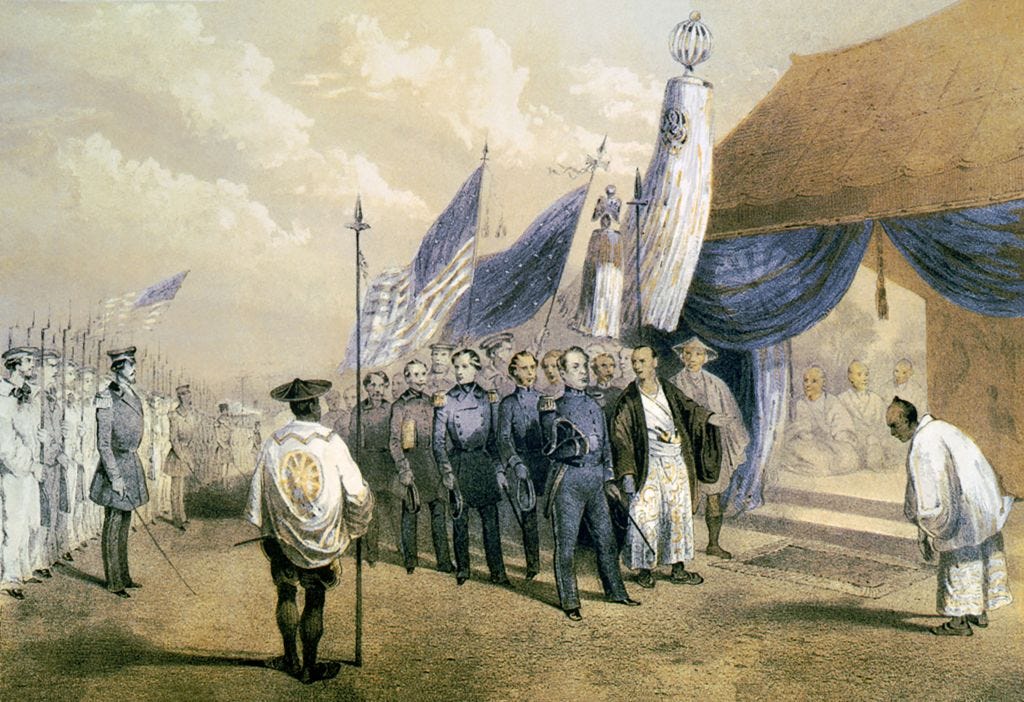
That is what happened to Japan. The country had been isolated — by choice — for 220 years. Then, in 1853, Commodore Perry landed a group of just 250 marines, backed by the latest ship-borne artillery. The local authorities realized it was impossible to resist. They came to an important insight: close your doors and you will fall behind.
Commodore Perry’s diplomatic gifts included a model train and the latest rifles and handguns. In a few years, there were railways all over Japan. And then, Japan was soon on the map...and growing larger — economically and militarily. A few decades later, Japan had the most lethal armies in Asia.
By the 1930s, it had captured much of the Chinese mainland. In 1940, it attacked French Indo-China. Then, in 1941, Japan bombed Pearl Harbor...followed in 1945 by America’s devastating firebombing of Tokyo...and the first and, so far, only use of atomic weapons on Hiroshima and Nagasaki. And by 1989, the Honda Accord was the best-selling car in America.
It is only by trade, interaction, and competition that a nation is able to keep up with its rivals...and improve its own citizens’ standards of living. Richard Cobden’s free-trading Great Britain proved it. Japan proved it twice, once with battleships...and later with camshafts.
More to come...
Regards,
Bill Bonner

Join Bill Bonner at Inernational Living’s ‘Future of Wealth’ Conference in Dublin, Ireland, from October 21st to the 23rd. Reserve your seat here.
As for the gold situation, I DO NOT believe the US has the gold we claim to hold. It has never had a REAL audit. Every time someone tries to conduct an audit it is blocked by whatever administration is in power. If I were another country I would want my gold in my hands also!
Jim Marshall
Trade should be determined and implemented by individuals, businesses and companies at their discretion. Not controlled by political control and regulation.