

Friday, August 28th, 2026
Bill Bonner, from Poitou, France
‘My worry isn’t AI. It’s the size of the financial bust that this AI-mania has teed up. It’ll be too big for the government to bail out, which means it’ll usher in deflation, finally.’
—Tom Dyson
Here’s Mishtalk.com with disheartening news:
Excluding Gov’t Transfer Payments, Real Personal Income Declines from a Year Ago
- Real Personal Income (all sources): -0.01 percent
- Real DPI (after taxes): 0.45 percent
- Real PI Excluding Transfers : -0.38 percent
- Real PCE (Personal Consumption Expenditures): 2.14 percent
Transfer payments are government checks or deposits for which no current services were performed. Social Security, Medicare, Medicaid, and food stamps are examples.
Not much explanation required. Americans are getting poorer. Despite the internal combustion engine, the internet, shopping malls, Amazon, AI, Henry Ford, Elon Musk and the genius of both democrats and republican leaders, most people see their financial, material lives are deflating. And many voters have decided, according to the Financial Times, that:
Capitalism’s not working
On the right, they turn to Donald J. Trump, who is not opposed to capitalism, as long as it does what it is told. Interest rates should be lower, he says; stock prices should be higher.
On the left, they turn to a new crop of ‘democratic socialists’ such as Mamdani in New York and Abdul El-Sayed in Michigan who promise more giveaways to entice new voters. And ‘we don’t need no stinkin’ billionaires,’ they add.
But the immediate problem for both is not that capitalism isn’t working...but that it still works. And right now, it threatens their racket. For at least three decades, both Republicans and Democrats have put the cuffs on capitalism...giving it a good thrashing from time to time. They do so to shift real wealth to their elite insiders and pet projects.
The result is the biggest debt-fueled bubble in human history.
But all bubbles pop. So, unless the rules have changed in some fundamental way, capitalism is tanned, rested and ready to put rich and poor alike back in their places.
How does that work? What happens to all that wealth investors have accumulated? And if there is a ‘short’ equal and opposite to every ‘long’, wouldn’t the sum of ‘wealth’ remain the same?
The easy answer is ‘yes.’
In the first stage of a bust, asset prices fall. It is deflationary. Prices go down...even prices for the assets you bought to protect yourself from the bubble. Gold would probably take a hit along with everything else. In the panic of a real sell-off, people will sell their grandmothers to raise cash. They need cash, sometimes desperately, to pay mortgages, school fees, child support and other necessities.
In that regard another interesting ‘dot’ appeared in the press recently. MoneyLion:
These 16 US Colleges Now Cost More Than $100K a Year
On the list was our own alma mater, Georgetown, where we spent three years in law school.
These high-priced schools are ripe for what the technologists call ‘disruption.’ Come the revolution...when the bubble bursts...they’ll have to find ways to cut back — both the schools and their customers. Note that the real wealth — the actual value of good teachers in classrooms and labs — remains. The real thing survives. The price collapses...along with claims on wealth that never actually existed. And students will be richer; they will get more education for less money.
In a genuine, capitalist bear market (as opposed to a dip) margin calls go unanswered, luxury cars go back to dealers, and people sell ‘liquid’ assets (those they can readily sell) to meet important commitments.
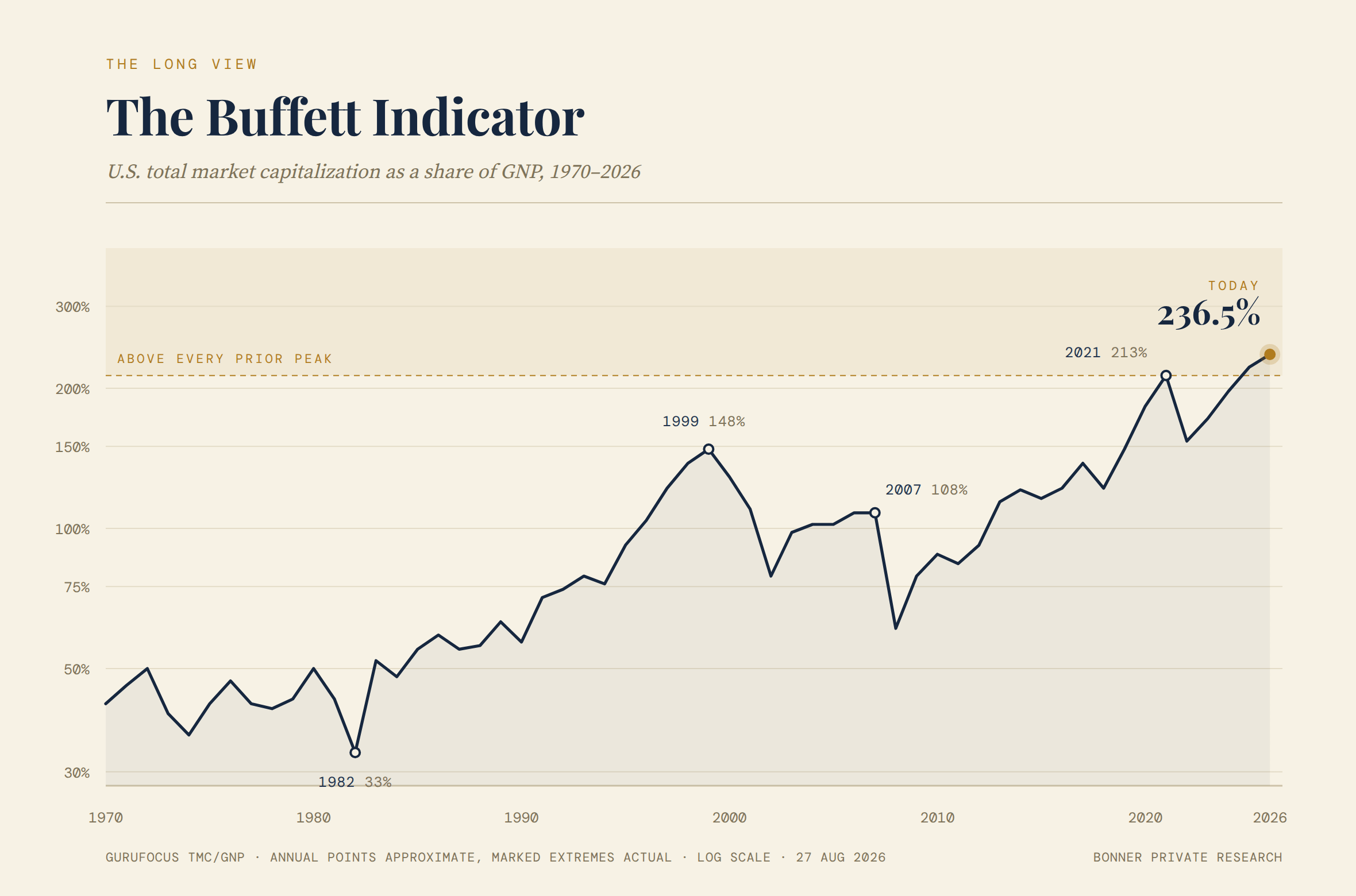
But while capital assets deflate, the ‘wealth’ of the common man, relatively, quietly inflates. The proof of that is in what is known as the Buffett Indicator. It compares the real wealth, grosso modo, of the US economy, measured by GDP, to the total value of stocks, measured by the Wilshire 5000.
For a long period, from after WWII until about 1995, stock holders had ‘wealth’ equal to about 60% of the goods and services represented by GDP. Then, beginning in about 1995 — with the Greenspan/Bernanke/Yellen/Powell bubble blowers — the wealth of stockholders grew to an out-of-this-world 236% of GDP.
At any given time, there are only so many hotdogs and baseball game tickets...and roofers and dentists...available. Those who were ‘long’ since 1995 can now buy more of them. Theoretically, they can afford to buy twice the annual output of the entire US economy, and still have $10 trillion to tip the valet car parker.
Capitalism, however, can put a stop to the whole circus. Left to discover prices without being suborned by political appointees, it would burst the bubble...and trim stockholders’ share of the US output dramatically. Not a single hotdog would disappear. But deflation would give non-shareholders a bigger bite of it. They, the people who were ‘short’ stocks, would be richer.
It is to that wheel — preventing capitalism from setting things straight...
...that Secretary Bessent now puts his shoulder.
Regards,
Bill Bonner
Appreciate the perspective regarding wealth. Same thing needs to happen with wages. CEO and Wall Streeter compensation is grossly disproportionate to their contributions. It’s the red cape waved at the general population, making “democratic socialism” attractive despite its history of epic failure.
You start with the quote from Tom Dyson: ‘My worry isn’t AI. It’s the size of the financial bust that this AI-mania has teed up. It’ll be too big for the government to bail out, which means it’ll usher in deflation, finally.’
I worry that the government will try to bail it out, even if they have to print $100T or more to do it, which would really juice inflation.
I have long thought that our current bubble will end in either a deflationary depression, or a hyper-inflationary depression, and while I would far prefer to see the former, I suspect that those in Congress and Wall Street will opt for the latter, even if it means that gasoline goes to $500/gallon or more. This is not without precedent. There have been numerous countries where people were living frugally on a pension, and getting by, and in the space of months prices went up such that their pension could buy no more than food for one day, or even less. But at least the banks were saved!